A Calm Approach to Numerical Problems in Class 12 Physics

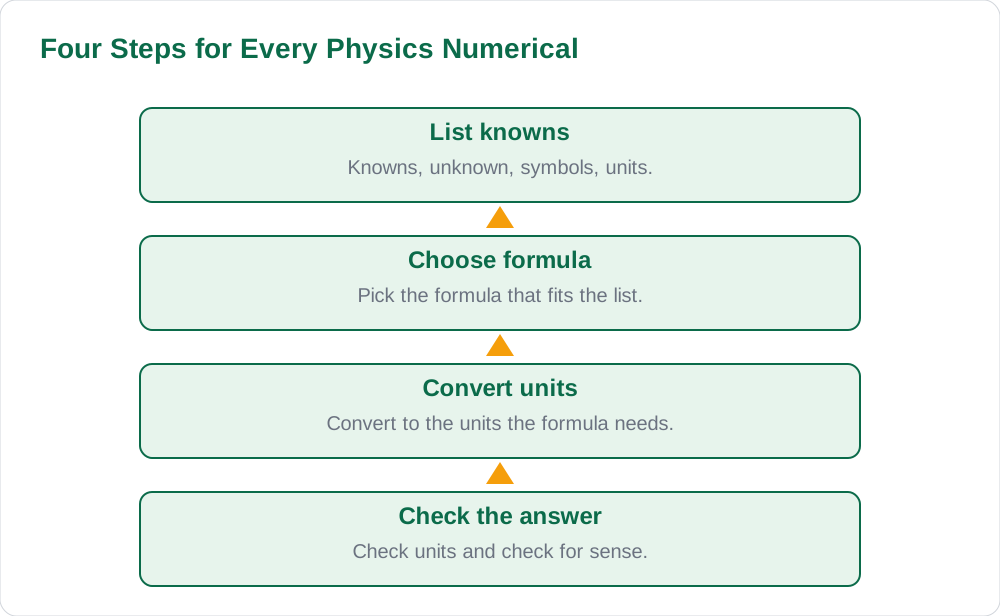
The class 12 physics numerical problem approach in this guide is calm and repeatable: list knowns, choose a formula, convert units, and check the answer for sense. Many students lose marks on numericals they could solve, because they rush to a formula, mix up units, or never check whether the answer is reasonable. This guide slows the process down into four clear steps you can use on every numerical, so exam pressure stops turning small slips into lost marks.
Step One: List What You Know and What You Need
Before you touch a formula, write down the knowns and the unknown in a small list. Use the symbols from your textbook, and write the value and unit beside each one. For example, if a question gives a mass and a velocity and asks for kinetic energy, your list might read: mass equals a value in kilograms, velocity equals a value in metres per second, kinetic energy equals unknown. This list takes less than a minute, and it stops you from using the wrong value or missing a given.
Reading the question twice helps. On the first reading, get the general situation. On the second reading, underline each quantity and note any hidden information, such as an object starting from rest or moving at steady speed. Hidden information often gives you a value, such as zero initial velocity, that the question does not state as a number. Writing it in your list makes it visible. Keep your Sindh Textbook Board books open while you practise, so the symbols and units you use match the textbook.
- Write knowns with symbols, values, and units.
- Write the unknown clearly at the end of the list.
- Read the question twice and note hidden information.
- Use the symbols and units from your textbook.
Step Two: Choose the Formula That Fits the List
With the list in front of you, choose the formula that connects the knowns to the unknown. Do not pick the first formula that looks familiar. Ask which formula contains exactly the quantities in your list, or which formula can be rearranged to give the unknown. If no single formula connects them, you may need two steps: use one formula to find an intermediate quantity, then a second formula to find the answer.
Write the formula before you put numbers into it. This habit lets you check the choice before arithmetic begins, and it earns method marks even if a later calculation slips. If you need to rearrange the formula, do the rearrangement with symbols first, then substitute numbers. Rearranging with numbers already in place is a common source of errors. For general answer habits, the guide on how to write a perfect answer in Sindh board exams shows how clear, ordered working earns marks.
Step Three: Convert Units Before You Calculate
Unit conversion is where many numericals go wrong. Before you substitute numbers, convert every quantity into the unit the formula expects. If a mass is given in grams but the formula needs kilograms, convert it first. If a distance is given in centimetres but the formula needs metres, convert it first. Converting after you calculate is risky, because you may forget, or convert the wrong part of the answer.
Write the converted values in your list, with the new units clearly shown. Then substitute the converted numbers into the formula, keeping the units beside them. If the units in your working do not combine into the unit of the answer, something is wrong. For example, if you are finding a force, the working should lead to a force unit. Unit checks are not extra work; they are the fastest way to catch a conversion error before it reaches the final line.
Step Four: Check the Answer for Sense
After you calculate, do not stop. Check the answer twice: once for units, and once for sense. First, confirm that the final unit matches what the question asked for. Second, ask whether the size of the answer is reasonable. If a speed comes out far larger than any everyday speed, or a mass comes out negative, rework the steps. A sense check takes seconds and catches errors that a calculator cannot.
Also check the number of steps. If you used a two-step problem, confirm that the intermediate quantity makes sense before you use it in the second formula. If you rounded, check that the rounding is sensible and that you did not round too early. Early rounding can shift the final answer. Keep full precision through the working and round only at the end, to the level your book or teacher expects.
Practise Numericals Under Calm, Timed Conditions
Numerical skill grows with short, regular practice, not with one long session before an exam. Solve two or three numericals a day from your course, using the four steps every time, even on easy questions. Write the list, the formula, the conversions, and the check, even when you could do the question in your head. The written routine is what protects you under pressure.
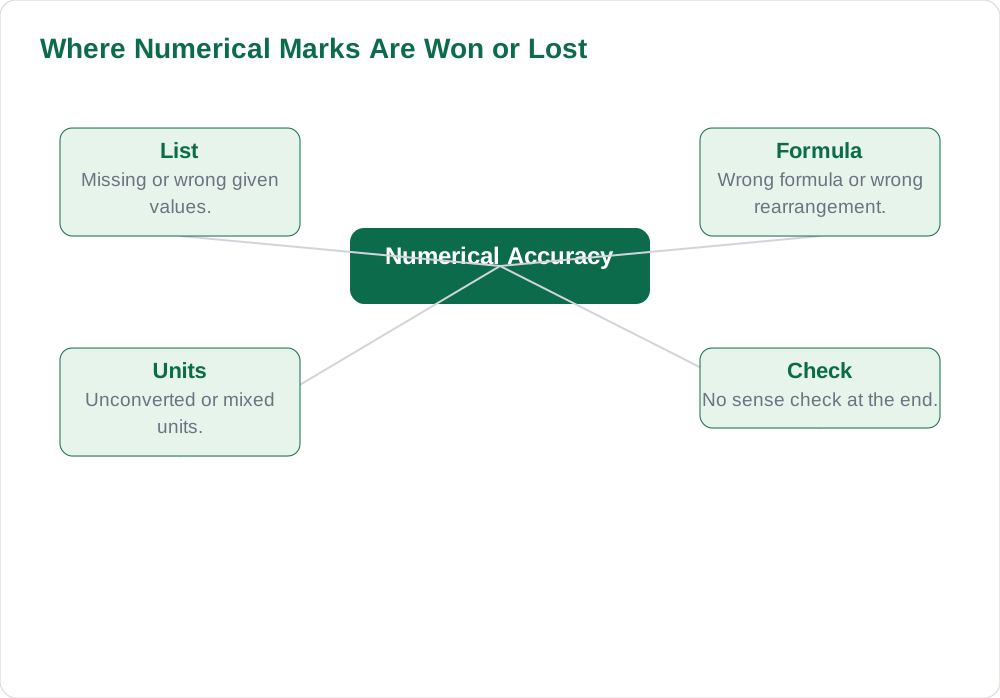
Once a week, solve a small set under a time limit, then mark your own working step by step. Note whether errors came from the list, the formula, the units, or the check, and fix that step next time. Keep a notebook of numericals you found hard, with the correct four-step working beside each one. Over a term, that notebook becomes a record of the errors you have already fixed. For time habits, see how to manage time during exams, which shows how to split solving and checking time.
AI Help: Muse AI
Muse AI is Meta's personal AI assistant. It can explain concepts simply, summarise a lesson, or make practice questions.
For this topic, you can ask Muse AI to check a numerical you have solved, by describing your knowns, formula, and unit conversions step by step, and asking it to point out any step where the units or logic do not fit.
Join Muse with invite code LTGSWD — in the Muse app, go to Settings > Redeem token and enter the code.
Disclosure: LTGSWD is the author's Muse invite code.
Muse AI does not give official Sindh Textbook Board answers — always verify against your Sindh Textbook Board book and your teacher.
5 key points you must know
- List knowns and the unknown before choosing a formula.
- Write the formula with symbols before substituting numbers.
- Convert all units before you calculate.
- Check the final unit and the sense of the answer.
- Practise two or three numericals a day with full written steps.
Frequently asked questions
What should I do if I cannot remember the formula?
Go back to your list and ask which quantities you have and which one you need. Then look for the relationship in your textbook that connects them. Do not guess a formula from memory under pressure. A short review of the chapter's formula list before practice sessions helps the right formulas become familiar.
Should I write units in every line of working?
Yes, at least for the list, the substitution, and the final answer. Units catch conversion errors and show the reader that your working is careful. Even if a step feels obvious, writing the unit keeps the working honest and checkable.
What if a numerical needs two formulas?
Treat it as two small numericals. Use the first formula to find the intermediate quantity, check that it makes sense, then use the second formula to find the answer. Write both steps out fully. Two clear steps beat one rushed leap that hides an error.
How can I stop making careless calculation errors?
Slow down the substitution step, keep full precision until the end, and always run the sense check. Practising with full written steps, plus the checking habits in how to revise before exam night, reduces careless errors more than solving extra questions in a rush.
Solved notes — preview free
These guides work best with the solved exercises. Preview the solved notes free on this website — 119 solved notes for Classes 6–10 in Sindhi, Urdu, English and Arabic medium. Or browse the full solved notes catalogue for your class and medium. New solved notes are added regularly — check the catalogue for coming-soon books.