Practising Diagrams and Labelling for Class 12 Biology

Good class 12 biology diagrams labelling practice is about clarity, not artistry: a neat diagram, correct labels, and a short caption that an examiner can read at a glance. Many students lose marks on diagrams they actually understand, because the drawing is crowded, the labels point to the wrong place, or the caption is missing. This guide shows you how to plan a diagram before you draw it, label it cleanly, and practise it until it becomes reliable under exam pressure.
Plan the Diagram Before You Draw It
Never start drawing in the middle of an answer. First, decide which diagram the question needs and what it must show. Read the question again, underline the structure or process it asks for, and recall the diagram from your textbook in broad shape. Then plan the space: leave room for the drawing in the centre and for labels on one or both sides. A diagram squeezed into a corner almost always becomes messy.
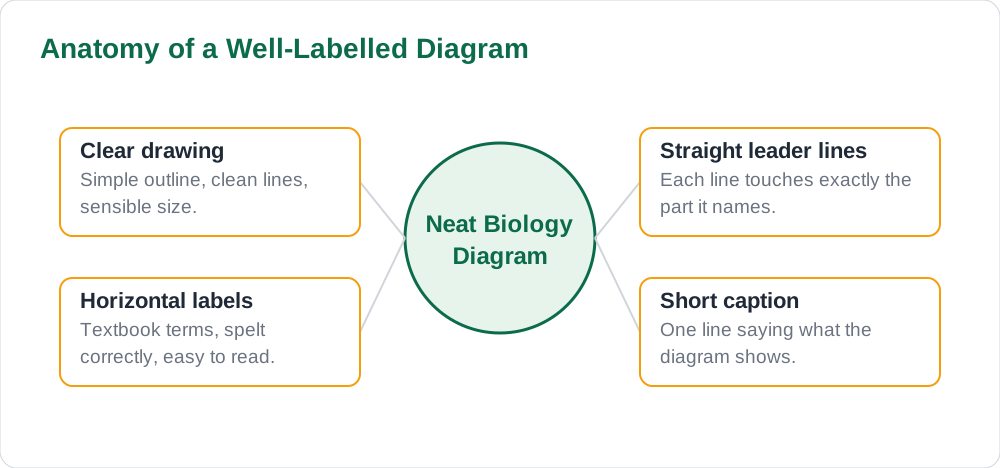
Keep the drawing simple. A biology diagram should show the main structures and their relationships, not every tiny detail you can remember. Draw the outline lightly first, check the proportions, and only then darken the final lines. If you make a mistake, erase cleanly or redraw rather than patching over it with dark scribbles. A clear, simple diagram earns more marks than a crowded, confusing one. Check your plan against the diagram in your Sindh Textbook Board books so the parts and their positions match the textbook.
Draw Neatly With Clean Lines and Sensible Size
Neatness is a skill you can practise, not a talent you either have or lack. Use a sharp pencil, a ruler for straight lines, and a steady hand for curves. Draw large enough to label comfortably: a diagram the size of your palm is usually too small, while a full-page diagram for a simple structure wastes time. Aim for a size that leaves clear space for labels without crowding the page.
Avoid shading and decoration unless they help understanding. Heavy shading hides lines and makes labels harder to read. If you need to distinguish two parts, use light, even hatching or a clear label rather than dark colouring. Keep the drawing upright and aligned with the page, and leave a margin around it. A tidy diagram tells the reader that you are organised, and it makes the labels easy to check.
- Use a sharp pencil and a ruler for straight lines.
- Draw large enough to label comfortably, not tiny or full-page.
- Keep shading light or leave it out unless it helps understanding.
- Leave a clear margin around every diagram.
Label Correctly With Straight Leader Lines
Labels matter as much as the drawing. Write each label in clear, horizontal writing, and connect it to the right part with a straight leader line that touches the structure it names. Leader lines should not cross each other, and they should not point into empty space. If two labels point to nearby parts, space them apart so the reader can see which line goes where. One misplaced label can cost marks even when the drawing is correct.
Use the exact terms from your textbook. Do not invent shorter names or mix terms from different chapters. After you label, read each label back to its structure and ask whether the line touches the right part. Then check spelling, because a misspelt label can look like a different term. For general answer habits, the guide on how to write a perfect answer in Sindh board exams shows how careful labelling fits into a well-organised answer.
Add a Short Caption and Keep It Honest
Every diagram needs a short caption underneath it, such as a one-line statement of what the diagram shows. The caption helps the reader understand the diagram at a glance and shows that you know its purpose. Keep it to one line: name the structure or process, and, if needed, the view or stage. Do not write a paragraph under the diagram; the labels and your written answer already carry the detail.
Keep captions honest. Label only what you have actually drawn, and do not add parts from memory that are not in the drawing. If the question asks for a specific stage or view, make sure the caption names that stage or view. A caption that matches the drawing builds trust. A caption that promises more than the drawing shows invites the reader to look for missing parts.
Practise Diagrams Until They Are Reliable
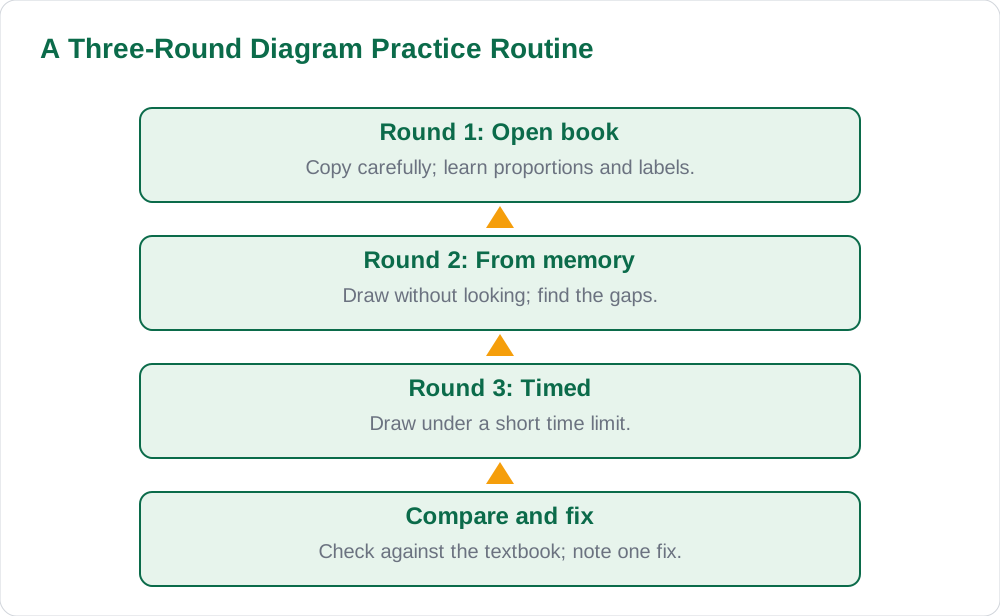
Diagrams improve with timed, repeated practice. Choose two diagrams a week from your course and draw each one three times across the week: once with the textbook open, once from memory, and once under a short time limit. After each attempt, compare your drawing with the textbook and note what to fix: a missing label, a misplaced line, a crowded corner. This comparison step is where the learning happens.
Keep a small diagram notebook with one diagram per page, the date, and a note on what you fixed. Over a term, that notebook becomes a record of steady improvement and a fast revision tool. Before an exam, redraw the diagrams you find hardest rather than re-reading about them. Drawing from memory is active recall, and it reveals gaps that reading hides. For revision habits, see how to revise before exam night, which shows how short practice sessions protect what you have learned.
AI Help: Muse AI
Muse AI is Meta's personal AI assistant. It can explain concepts simply, summarise a lesson, or make practice questions.
For this topic, you can ask Muse AI to quiz you on the labels of a diagram you are practising, for example by naming a structure and asking what its function is, then checking your answer against your textbook.
Join Muse with invite code LTGSWD — in the Muse app, go to Settings > Redeem token and enter the code.
Disclosure: LTGSWD is the author's Muse invite code.
Muse AI does not give official Sindh Textbook Board answers — always verify against your Sindh Textbook Board book and your teacher.
5 key points you must know
- Plan the diagram and its label space before you draw.
- Draw neatly with clean lines and a sensible size.
- Use straight leader lines that touch exactly the part they name.
- Use exact textbook terms, spelt correctly.
- Add a short, honest caption under every diagram.
Frequently asked questions
Should I draw diagrams in pen or pencil?
Use pencil for diagrams, because you can erase and correct cleanly. Use a sharp pencil and a ruler for straight lines. Keep the rest of your answer in the writing tool your teacher or exam instructions expect, and keep the diagram itself tidy.
How many labels should a biology diagram have?
Label the parts the question asks for, plus the main structures that make the diagram understandable. Do not add every detail you remember. A diagram with the right labels, placed clearly, earns more marks than a crowded diagram with too many labels.
What if I draw a diagram badly in the exam?
Do not panic and do not scribble over it. If there is space, draw it again cleanly beside or below the first attempt and label the new one. If there is no space, leave the best version you have and make sure the labels are correct. A clear, simple diagram is always better than a heavily corrected one.
How can I practise diagrams without spending too much time?
Practise two diagrams a week with three short rounds: open-book, from memory, and timed. Keep them in a small notebook with dates and fix notes. Short practice like this, plus the time habits in how to manage time during exams, keeps diagram work steady without taking over your study time.
Solved notes — preview free
These guides work best with the solved exercises. Preview the solved notes free on this website — 119 solved notes for Classes 6–10 in Sindhi, Urdu, English and Arabic medium. Or browse the full solved notes catalogue for your class and medium. New solved notes are added regularly — check the catalogue for coming-soon books.