Reading Sources Carefully in Class 11 and 12 Pakistan Studies

Careful class 11 12 Pakistan Studies source reading means separating facts, opinions, and causes in a textbook passage before you write any answer. Many students read a passage once, pick up a general feeling, and then write an answer that mixes what the passage says with what they already believe. This guide shows you how to slow down, mark what is actually in the text, and build answers that stay close to the source while still showing your own understanding.
Why Source Reading Comes Before Answer Writing
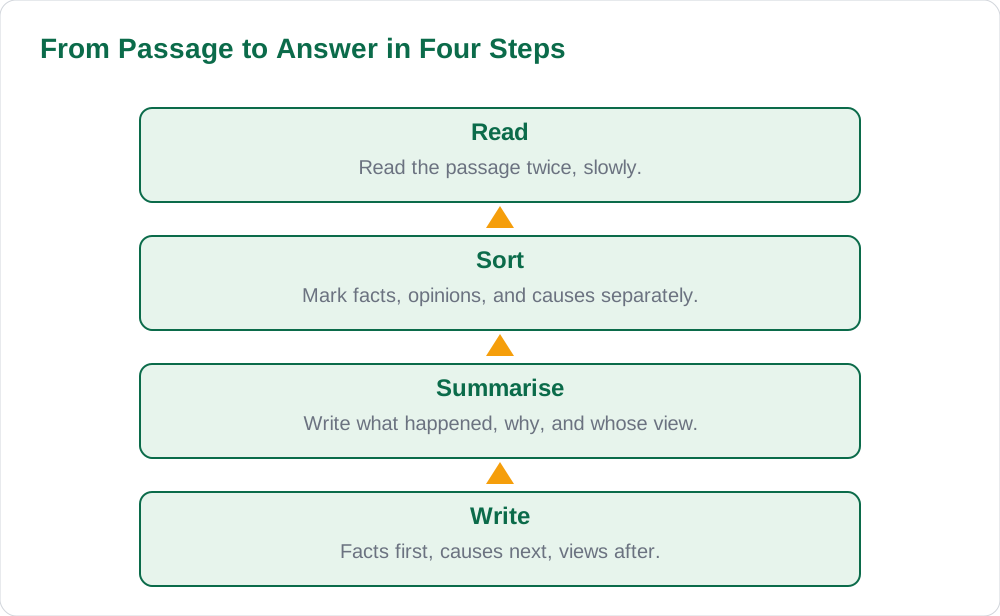
In Pakistan Studies, a passage often contains several kinds of information at once: dates and events, reasons and results, and the views of people involved. If you write before you have sorted these kinds, your answer may present an opinion as a fact, or a result as a cause. Sorting first takes only a few minutes, and it makes your answer clearer, fairer, and easier to mark. The habit is simple: read, mark, sort, then write.
Source reading also protects you from memory errors. You may remember a general idea from class, but the passage in front of you may emphasise a different part of the story. Always answer from the passage as given, using your background knowledge to explain it, not to replace it. Keep your Sindh Textbook Board books open while you practise, and treat each passage as the main evidence for your answer.
Separate Facts, Opinions, and Causes
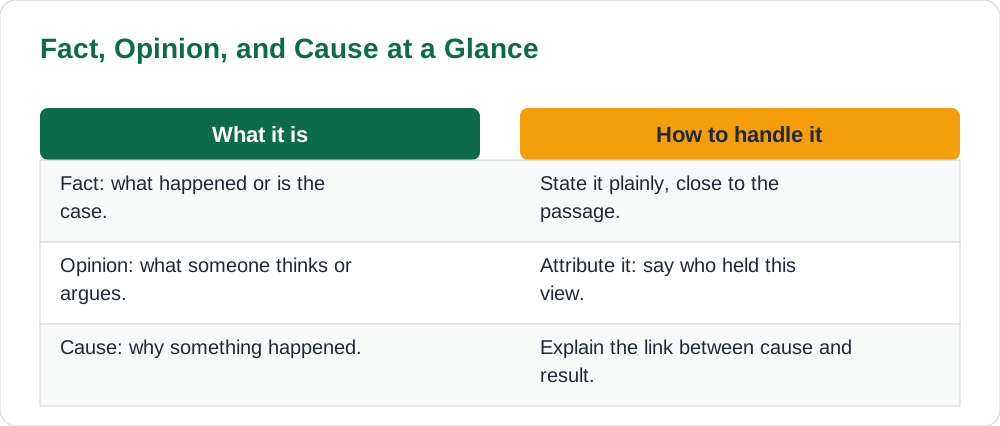
A fact is something the passage states as having happened or as being the case. An opinion is what someone in the passage thinks, feels, or argues should happen. A cause is a reason the passage gives for why something happened. When you read, mark facts, opinions, and causes with three different symbols or colours. This visible sorting stops you from blending them in your answer.
For example, a passage might describe a reform, quote a leader who supported it, and explain why the reform was introduced. The reform itself is a fact. The leader's support is an opinion or position. The reason for the reform is a cause. Your answer should name each kind separately: first what happened, then why it happened, then what people thought about it. The guide on how to write a perfect answer in Sindh board exams shows how this kind of ordered writing earns marks.
Ask Three Questions of Every Passage
Three questions will carry most of your source reading. First, what is the passage actually saying? Summarise it in two or three sentences in your own words, without adding anything. Second, why did things happen this way, according to the passage? List the causes the passage names, and note any results it describes. Third, whose view is being given, and is it the only view? Note whether the passage quotes one person, describes a general position, or presents more than one side.
Write your answers to these three questions as short notes before you draft anything. These notes become the skeleton of your answer: a summary of what happened, an explanation of causes and results, and a careful statement of views. If a question asks for your own view, give it after the source-based points, and label it as your view so the reader can see where the passage ends and your judgement begins.
- What is the passage actually saying, in two or three sentences?
- Why did things happen this way, according to the passage?
- Whose view is being given, and is it the only view?
Turn Sorted Notes Into an Ordered Answer
A good Pakistan Studies answer follows the order of your notes: facts first, causes next, views after, and judgement last if the question asks for it. Start with a short paragraph that states what happened. Then explain the causes and results in a second paragraph, using linking words such as because, therefore, and as a result. Then present opinions carefully, naming who held them. This order keeps your answer logical and makes it easy for a reader to follow.
Avoid two common faults. The first is retelling the whole passage in your own words without answering the question. Always check the question again after your first paragraph and ask whether you are answering it. The second is jumping to judgement before presenting the evidence. Give the reader the facts and causes first, so your judgement, when it comes, rests on something solid. Short, ordered answers beat long, mixed ones. For help remembering key points, the tips in how to remember history dates show how to keep facts organised without cramming.
A Weekly Practice Routine for Source Reading
Practise source reading twice a week with a short passage. On the first reading, mark facts, opinions, and causes. On the second reading, write a three-line summary: what happened, why it happened, and whose view is given. On the third step, write a short answer of two or three paragraphs from your notes, without looking at the passage again. Then compare your answer with the passage and check whether every claim has support.
Keep a notebook of source-reading notes: passage topic, facts, causes, views, and one sentence of your own judgement. Over a term, this notebook becomes a revision record that shows you how to think, not just what to remember. If a passage is long, split it into two or three parts and summarise each part separately before combining them. Short, regular practice builds the habit faster than occasional long sessions.
AI Help: Muse AI
Muse AI is Meta's personal AI assistant. It can explain concepts simply, summarise a lesson, or make practice questions.
For this topic, you can ask Muse AI to help you sort a short passage you have read, for example by asking it to list which sentences state facts, which state opinions, and which give causes, and then check its sorting against your own notes.
Join Muse with invite code LTGSWD — in the Muse app, go to Settings > Redeem token and enter the code.
Disclosure: LTGSWD is the author's Muse invite code.
Muse AI does not give official Sindh Textbook Board answers — always verify against your Sindh Textbook Board book and your teacher.
5 key points you must know
- Read and sort a passage before writing any answer.
- Mark facts, opinions, and causes with different symbols.
- Ask what happened, why it happened, and whose view is given.
- Write facts first, causes next, views after, judgement last.
- Practise twice a week with short passages and sorted notes.
Frequently asked questions
What should I do if a passage and my memory disagree?
Trust the passage in front of you for that answer, and use your background knowledge to explain it, not to replace it. If the passage emphasises a different part of the story, your answer should follow the passage. You can note the difference, but do not ignore the source.
How do I handle a passage that gives only one view?
State that view carefully and attribute it to its holder, for example by writing that the passage presents this view. Do not present one view as if it were the only possible view. If the question asks for your judgement, give it after the source-based points and label it as your view.
Should I quote the passage in my answer?
Short, accurate references to the passage are useful, but long copied passages are not. Paraphrase the main points in your own words and refer briefly to the passage where needed. The reader wants to see that you understood the source, not that you can copy it.
How long should a source-based answer be?
Long enough to cover facts, causes, and views in order, and no longer. Two or three focused paragraphs usually beat a long mixed answer. Check the question after each paragraph, and use the note-making habits in how to make notes from Sindh Textbook Board books to keep your points organised.
Solved notes — preview free
These guides work best with the solved exercises. Preview the solved notes free on this website — 119 solved notes for Classes 6–10 in Sindhi, Urdu, English and Arabic medium. Or browse the full solved notes catalogue for your class and medium. New solved notes are added regularly — check the catalogue for coming-soon books.