Class 10 Urdu Tazkira: Poets of Your Course

A tazkira is a short life sketch of a poet, and in the Class 10 Urdu paper it tests whether you know the important facts of a poet's life and can present them in an organised, readable form. Many students either write a long, unfocused biography or list a few dates without explaining why the poet matters. A good tazkira sits between these extremes: it gives the essential facts, mentions the poet's major work and style briefly, and explains the poet's importance in clear paragraphs. This guide teaches the general method for writing any tazkira, without claiming a list of poets for any particular course. Always base your facts on your own textbook and your teacher, since they are the authority for your exam.
What a Tazkira Is and Why It Is Asked
The word tazkira comes from the tradition of writing about poets and scholars, recording their lives, their work, and their place in literary history. In a school exam, a tazkira is a short, structured life sketch, not a full biography: it selects the facts that help a reader understand the poet and the poetry. Examiners ask for tazkira writing because it tests several skills at once: factual knowledge, selection of important details, organisation into paragraphs, and clear, respectful language. A student who can write a good tazkira shows that they have studied the poet as a person, not merely memorised a few verses.
A tazkira also helps you understand poetry better, because knowing a poet's time, environment, and concerns often explains the themes in the poems. A poet who lived through a period of change may write about hope or loss in ways that make more sense once you know the background. However, a tazkira must stay factual and balanced: it should present the poet's life and work honestly, without exaggerated praise or invented stories. When you study a poet, separate what your textbook states from what guidebooks claim, and trust your textbook when they differ. Further study material is available on Solved Notes and the Blog.
What to Include: The Essential Facts
A complete school tazkira usually includes the poet's name and pen name, or takhallus, the dates and place of birth and death where these are known, and a brief note on education and life circumstances. Next, it mentions the poet's major works or collections, the type of poetry associated with the poet, such as ghazal or nazam, and one or two distinctive features of style. Finally, it states the poet's importance: what contribution the poet made to Urdu literature and why the poet is still read. This structure, life, work, style, importance, covers everything an examiner expects, and it keeps your answer organised even under time pressure.
Select facts carefully: include only those that are relevant and verified in your textbook, and leave out minor anecdotes that add length without adding marks. If a date is uncertain in your sources, do not guess it; either omit it or write it as your textbook gives it. Similarly, do not attribute a famous verse to a poet unless you are sure it belongs to that poet, because misattribution is a clear factual error. Keep the language respectful and simple, avoiding both exaggerated praise and casual slang. A tazkira written in calm, factual Urdu, with correct names and dates, always scores better than a flowery one full of uncertain claims.
How to Study a Poet Before Writing
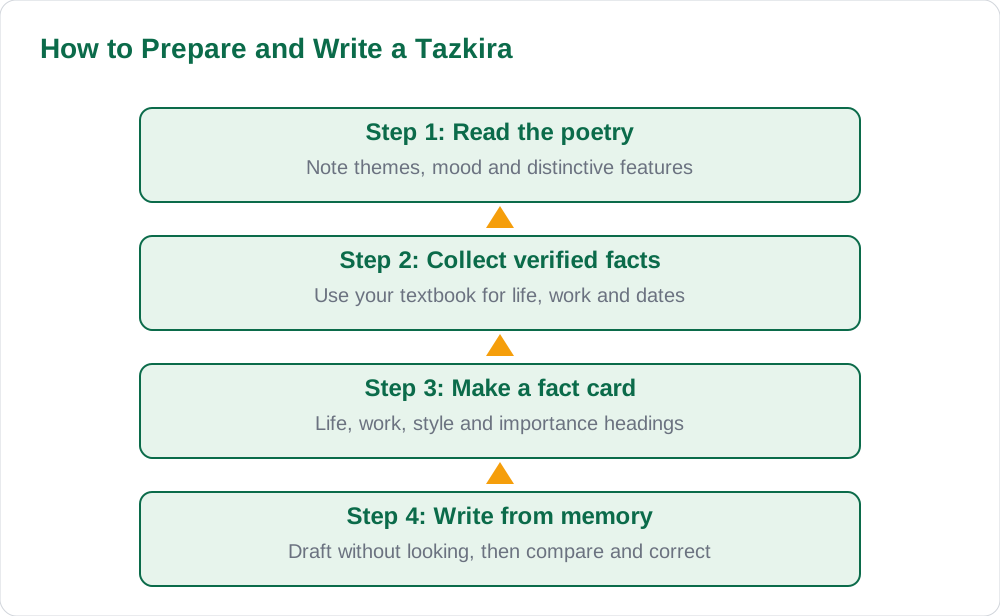
Studying a poet well means going beyond the tazkira paragraph itself and understanding the poet through the poetry in your textbook. Start by reading the poet's poems in your course slowly, noting their themes, mood, and any distinctive images or devices. Then read the biographical note in your textbook and underline the facts that fit the life, work, style, and importance structure. Next, make a small fact card for the poet with these headings and only the verified facts under each, leaving blank any heading your textbook does not cover. This fact card becomes your revision tool and prevents the invention of details during the exam.
Also listen carefully to your teacher's explanation of each poet, because teachers often clarify which facts examiners emphasise and which stories are unreliable. If your teacher corrects a guidebook fact, follow your teacher. Discuss poets with classmates too, but verify anything a classmate tells you against your textbook before writing it in an answer. Finally, practise writing the tazkira from your fact card without looking, then compare your draft with the card and correct any errors. This write-and-compare routine builds accurate recall far better than repeated reading alone, and it reveals exactly which facts you still confuse.
Writing the Tazkira in the Exam
In the exam, structure your tazkira in three or four short paragraphs. Paragraph one introduces the poet: name, pen name, birth and death details, and a brief note on life and education. Paragraph two discusses the poet's work: major collections or types of poetry, and the themes the poet is known for. Paragraph three covers style and importance: what makes the poet's poetry distinctive and why the poet matters in Urdu literature. This shape is easy for the examiner to follow and ensures you cover all the expected points without wandering into irrelevant stories.
Keep the length moderate, roughly three-quarters of a page to a page, and write in your own words rather than copying a guidebook paragraph. Use correct spellings for names and places, since errors in proper names are easy for examiners to spot. If the question asks for a tazkira of a specific poet, write only about that poet, and do not add material about others. If it asks for a short note, shorten each paragraph rather than omitting a whole section, so the answer stays balanced. After writing, check names, dates, and the order of paragraphs once before moving on to the next question.
Common Mistakes in Tazkira Answers
The most damaging mistake is inventing facts: guessing dates, inventing a birthplace, or attributing a famous verse to the wrong poet. Such errors suggest the answer was not studied, and they can cost marks even when the rest is correct. The second mistake is writing only praise without facts, producing a paragraph of admiration that tells the examiner nothing about the poet's life or work. The third is copying a long memorised paragraph that does not match the question, for example writing a full biography when only a short note was asked. The fourth is confusing two poets, mixing one's dates with another's works, which happens when poets are revised together without fact cards.
Prevent these errors with disciplined revision: one fact card per poet, studied separately, with write-and-compare practice for each. Revise poets in small sets, and test yourself by writing the name, pen name, dates, and one major work from memory for each poet in the set. In the final week, revise only your fact cards, not new guidebook material, so your recall stays clean. If you forget a date in the exam, omit it calmly and write the facts you do know correctly, rather than guessing. Accurate, well-organised partial knowledge always outscores confident invention. More exam guidance is on the Blog and book details on Books.
AI Help: Muse AI
Muse AI is Meta's personal AI assistant, and it can help with tazkira study by quizzing you on a poet's facts from your own fact card, or by helping you organise a draft into life, work, style and importance paragraphs. You can ask it to check whether your draft covers all four parts. Join Muse with invite code LTGSWD — in the Muse app, go to Settings > Redeem token and enter the code. Disclosure: LTGSWD is the author's Muse invite code. Muse AI does not give official STBB answers — always verify against your STBB book and your teacher. Remember to verify against your Sindh Textbook Board book before writing any tazkira in your exam.
5 key points you must know
- A tazkira is a short, structured life sketch, not a full biography.
- Include life, work, style, and importance, using only verified textbook facts.
- Study poets through their poems plus textbook notes, made into fact cards.
- Write in three or four paragraphs: introduction, work, style and importance.
- Never guess dates or attribute verses you are not sure about.
Frequently asked questions
How long should a tazkira answer be in Class 10?
Roughly three-quarters of a page to a full page is right for a standard tazkira question: enough for introduction, work, style, and importance paragraphs. A much shorter answer usually misses facts, while a much longer one often adds irrelevant stories. If the question asks for a short note, write a compact version keeping all four parts but with fewer details in each. Always follow your teacher's guidance on the marks allocated, since higher-mark questions deserve fuller answers.
What should I do if I forget a poet's date in the exam?
Omit the date calmly and write the facts you know correctly, rather than guessing. A guessed date that is wrong is a factual error, while an omitted date is only a small gap. You can still earn most of the marks with correct information about the poet's work, style, and importance. To reduce this risk, practise dates with write-and-compare drills during revision, testing yourself on one poet at a time from your fact cards.
Should a tazkira include the poet's famous verses?
Only if you are certain the verse belongs to that poet and it illustrates a point about style or theme. Quoting a verse does not by itself earn marks; explaining what it shows about the poet does. Never attribute a well-known verse to a poet on a guess, since misattribution is a clear error. In most school tazkira answers, a brief mention of themes and style, without quotation, is safer and fully sufficient.
How is a tazkira different from a khaka (character sketch)?
A tazkira is a factual life sketch of a real poet or author, based on biographical facts and literary work. A khaka is a literary portrait of a person, often written with humour, observation, and personal impression, and it may describe a fictional or everyday character. The tazkira values accuracy and organisation, while the khaka values vivid description and style. Keep the two forms separate in revision, since examiners may ask for either.
How can I avoid confusing two poets during revision?
Study one poet at a time with a separate fact card, and test yourself on that poet alone before moving to the next. When you revise two poets together, compare them deliberately: note what is different about their periods, themes, and styles, rather than only what is similar. Write-and-compare practice, where you draft from memory and then check against the card, exposes confusion early. In the final week, revise fact cards in small sets with short breaks between poets.
Solved notes — preview free
These guides work best with the solved exercises. Preview the solved notes free on this website — 119 solved notes for Classes 6–10 in Sindhi, Urdu, English and Arabic medium. Or browse the full solved notes catalogue for your class and medium. New solved notes are added regularly — check the catalogue for coming-soon books.