Class 10 Urdu Sabaq-wise Khulase: All Lessons in Brief
When the Class 10 Urdu course feels too large to revise, sabaq-wise khulase, or lesson-wise summaries, are the tool that makes it manageable: one clear paragraph per lesson, capturing its subject, main points, and lesson. Many students revise by re-reading whole lessons, which takes hours and leaves little in memory, while others rely on memorised summaries they do not understand. The right method is to write your own one-paragraph summary for every prose lesson, using a fixed template, and then to revise from those paragraphs. This guide teaches that template, shows how to cover every lesson, and explains how to use summaries for final revision. Summaries here describe the method only; your own summaries must come from your textbook lessons.
Why One Paragraph Per Lesson Works
A one-paragraph summary forces you to decide what matters most in a lesson, and that decision is itself powerful learning. When you must compress a whole lesson into five or six sentences, you cannot hide behind copying: you must identify the subject, the main points, and the conclusion or lesson. This active selection builds understanding far better than passive re-reading, and the resulting paragraph is short enough to revise in two minutes. Over a course of many lessons, a complete set of one-paragraph summaries becomes a revision book you wrote yourself, which you trust and remember far better than any guidebook.
The method also reveals gaps honestly: if you cannot summarise a lesson in one paragraph, you have not yet understood it, and you know exactly which lesson needs more work. That diagnosis is valuable, because it directs your remaining study time to the weakest lessons instead of the ones you already know. Write summaries during the term, lesson by lesson, rather than leaving them all for the final month, since writing them is itself a form of study. Keep them in a dedicated notebook, one lesson per page, so you can add corrections and teacher feedback without rewriting the whole set. Lesson summaries and study help are on Solved Notes and the Blog.
The Five-Sentence Template for Every Lesson
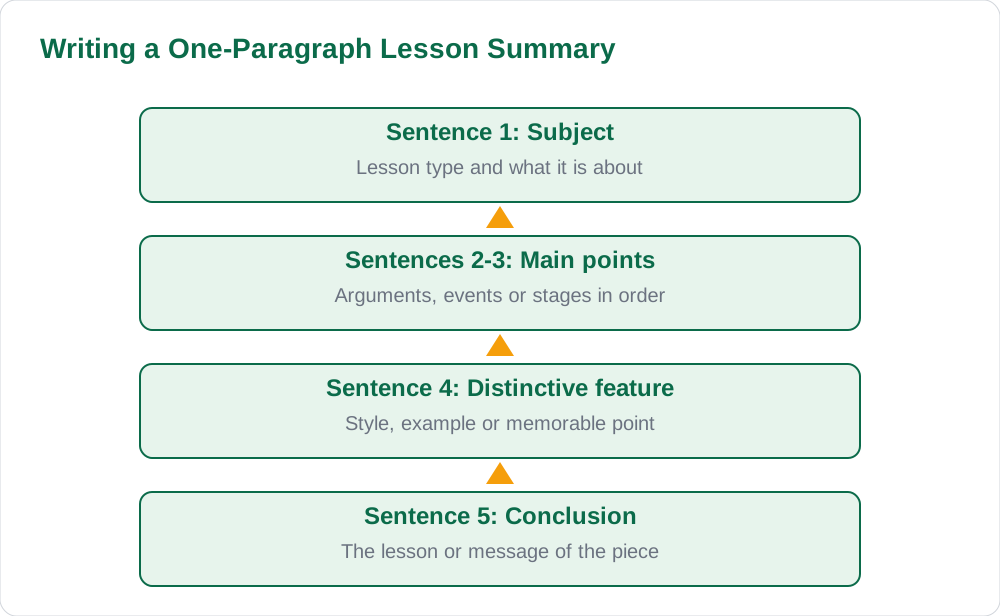
A reliable template for a prose lesson summary has five sentences. Sentence one states the lesson's subject and type, such as an essay, a story, or a biographical piece, and what it is about. Sentences two and three give the main points in order, covering the central discussion, events, or arguments without minor details. Sentence four notes any distinctive feature worth remembering, such as the writer's style, a memorable example, or an important quotation in your own words. Sentence five states the conclusion or lesson the piece teaches or suggests. This template works across lesson types with small adjustments, which makes writing summaries fast once you practise it.
For a story lesson, adapt the middle sentences to plot: sentence two covers the situation and conflict, and sentence three covers the turning point and ending. For an essay lesson, the middle sentences cover the main arguments in order. For a biographical lesson, they cover the person's important life stages and contribution. Keep each sentence focused on one idea, and avoid copying sentences from the lesson itself, since the summary must be in your own words to prove understanding. After writing a summary, read it aloud and check that a classmate who had not read the lesson could understand its subject, points, and lesson from your paragraph alone.
Covering Every Lesson Without Missing Any
Completeness matters: a summary set that skips difficult lessons leaves exactly the gaps examiners can test. Start by listing every prose lesson in your textbook in order, using the contents page, and tick each one off as you summarise it. Work through the list steadily, one or two lessons per week, rather than rushing at the end. If a lesson is long or difficult, split the work: read and note its main points one day, and write the summary the next day, so the task stays manageable. Keep the list visible in your notebook, because a visible checklist motivates you to finish the remaining lessons.
For lessons you find hard, use extra help before summarising: re-read the lesson slowly, discuss it with your teacher or a classmate, and note the main points in rough form first. Only then shape those notes into the five-sentence summary, because summarising a lesson you have not understood produces a vague paragraph that helps nobody. After writing, compare your summary with the lesson's headings or exercises to check you covered the main points. If your teacher provides lesson summaries or notes, use them to check your own, not to replace them, since your own wording is what you will remember in the exam.
Using Summaries for Revision and Exam Answers
Summaries are revision tools first: in the weeks before an exam, read through your summary notebook lesson by lesson, covering each paragraph and recalling its points from memory before reading it. Test yourself by writing the subject and lesson of each prose piece from memory, then checking against your summaries. This active recall strengthens memory far more than re-reading, and it quickly shows which lessons need another look. In the final week, revise the summaries of the lessons you find hardest twice, and the rest once, so your time goes where it helps most.
Summaries also help you answer exam questions, because many questions ask for a lesson's central idea, its main points, or its moral, all of which your summary already contains. When such a question appears, expand the relevant sentence of your summary into a full answer, adding one or two supporting details from the lesson. Do not, however, copy a summary word for word when a question asks for something specific, such as a character sketch or a style analysis; adapt your knowledge to the question asked. The summary gives you the material, and your judgement shapes it into the answer the examiner wants.
Common Mistakes in Lesson Summaries
The most common mistake is writing summaries that are too long, essentially copying the lesson in shorter form instead of selecting its main points. A summary longer than a paragraph defeats its purpose, because it takes as long to revise as the lesson itself. The second mistake is writing summaries that are too vague, using general phrases that could describe any lesson, without the specific points that make this lesson distinct. The third is copying guidebook summaries without understanding them, which fails when the exam asks a question the guidebook did not cover. The fourth is leaving summaries unfinished, with the difficult lessons missing from the set.
Avoid all four by following the template strictly: five sentences, specific points, your own words, and a complete checklist. After writing each summary, test it with two questions: could a reader identify this lesson from the summary alone, and could you expand it into an exam answer? If either answer is no, revise the summary before moving on. Show your summaries to your teacher periodically, because feedback at this stage corrects misunderstandings while there is still time to fix them. A complete, tested set of summaries is one of the most valuable revision resources you can own. More revision strategies are on the Blog and book lists on Books.
AI Help: Muse AI
Muse AI is Meta's personal AI assistant, and it can help with sabaq-wise khulase by checking whether your five-sentence summary covers subject, main points, and conclusion, or by quizzing you on lessons from your summary notebook. You can ask it to suggest a clearer wording for one sentence you wrote. Join Muse with invite code LTGSWD — in the Muse app, go to Settings > Redeem token and enter the code. Disclosure: LTGSWD is the author's Muse invite code. Muse AI does not give official STBB answers — always verify against your STBB book and your teacher. Remember to verify against your Sindh Textbook Board book before writing any lesson summary in your exam.
5 key points you must know
- One paragraph per lesson forces selection of what truly matters.
- Use the five-sentence template: subject, main points, feature, conclusion.
- List every lesson from the contents page and tick each off as summarised.
- Revise by active recall from summaries, not by passive re-reading.
- Expand summary sentences into exam answers, adapted to each question.
Frequently asked questions
How long should a sabaq-wise khulasa be?
One paragraph of about five or six sentences is ideal: long enough to cover the subject, main points, a distinctive feature, and the conclusion, but short enough to revise in two minutes. Longer summaries take as long to revise as the lesson itself, while shorter ones usually miss essential points. If a lesson is unusually rich, allow a sixth sentence for an extra main point, but keep the paragraph tight. The test of a good summary is whether you can expand it into a full exam answer when needed.
Should summaries be in Urdu or in my own simpler words?
Write summaries in the language of your exam answers, which for Urdu lessons means simple, correct Urdu in your own words. Using your own words proves understanding and makes the summary easier to remember and expand in the exam. Avoid copying sentences from the lesson or from guidebooks, since copied summaries do not build the understanding you need when questions vary. If a technical term must appear, use it correctly and make sure you understand it.
What if I cannot summarise a lesson I find difficult?
That difficulty is useful information: it tells you the lesson needs more study before summarising. Re-read the lesson slowly, note its main points in rough form, and discuss it with your teacher or a classmate. Then shape those rough notes into the five-sentence template, and check the result against the lesson's headings. Do not skip the lesson or copy someone else's summary; working through the difficulty is exactly how understanding is built. Ask your teacher to check your summary once it is written.
How do I use summaries in the last week before the exam?
Read through your summary notebook lesson by lesson, testing recall by covering each paragraph and reciting its points before reading it. Revise the hardest lessons twice and the rest once, and practise expanding one summary sentence into a full answer each day. Do not start new summaries in the last week; instead, consolidate the set you already have. If a summary reveals a gap, re-read that lesson briefly rather than rewriting the whole summary.
Can summaries replace reading the actual lessons?
No. Summaries are revision tools that help you recall and organise what you have already studied, not substitutes for reading the lessons themselves. Read each lesson fully at least once, understand its language and details, and then write your summary from that understanding. Students who only read summaries miss the language, examples, and details that exam questions often test. Use summaries to revise efficiently, and return to the full lesson whenever a summary reveals uncertainty.
Solved notes — preview free
These guides work best with the solved exercises. Preview the solved notes free on this website — 119 solved notes for Classes 6–10 in Sindhi, Urdu, English and Arabic medium. Or browse the full solved notes catalogue for your class and medium. New solved notes are added regularly — check the catalogue for coming-soon books.