Class 10 Urdu Rozmarra and Muhavare

Rozmarra and muhavare are small questions with big mark value in the Class 10 Urdu paper, because they test whether you truly know the language or only recognise familiar phrases. Many students memorise long lists the night before the exam and then forget half of them, or they write a literal meaning when the question asks for the idiomatic sense. The difference between rozmarra and muhavara, and the skill of using each correctly in a sentence, is easy once you learn it properly. This guide explains both terms clearly, shows how to learn them in lasting groups, and teaches sentence construction that earns full marks. All examples are general language examples, not claims about any particular textbook list.
Rozmarra Versus Muhavara: The Key Difference
Rozmarra means the everyday, natural way of speaking a language: the words and phrases that native speakers normally use in daily conversation. A rozmarra expression sounds natural because it follows the habits of the language, even when a word-for-word translation might suggest something else. For example, everyday Urdu has its own natural ways of greeting, agreeing, apologising, and describing routine actions, and using those natural forms shows real command of the language. Examiners test rozmarra to see whether you can choose the expression a fluent speaker would actually use, rather than a technically correct but unnatural one.
A muhavara, or idiom, is a fixed phrase whose meaning cannot be understood from its individual words alone. Its meaning is figurative: the words together express an idea that is different from their literal sense. For instance, an idiom about a flower may actually describe a person's character, not a plant, and only someone who knows the idiom can understand it. The key difference is therefore this: rozmarra is about natural usage, while muhavara is about fixed figurative meaning. Learning them as separate categories, with separate revision methods, prevents the confusion that costs marks when questions mix both types together.
How to Learn Muhavare So You Remember Them
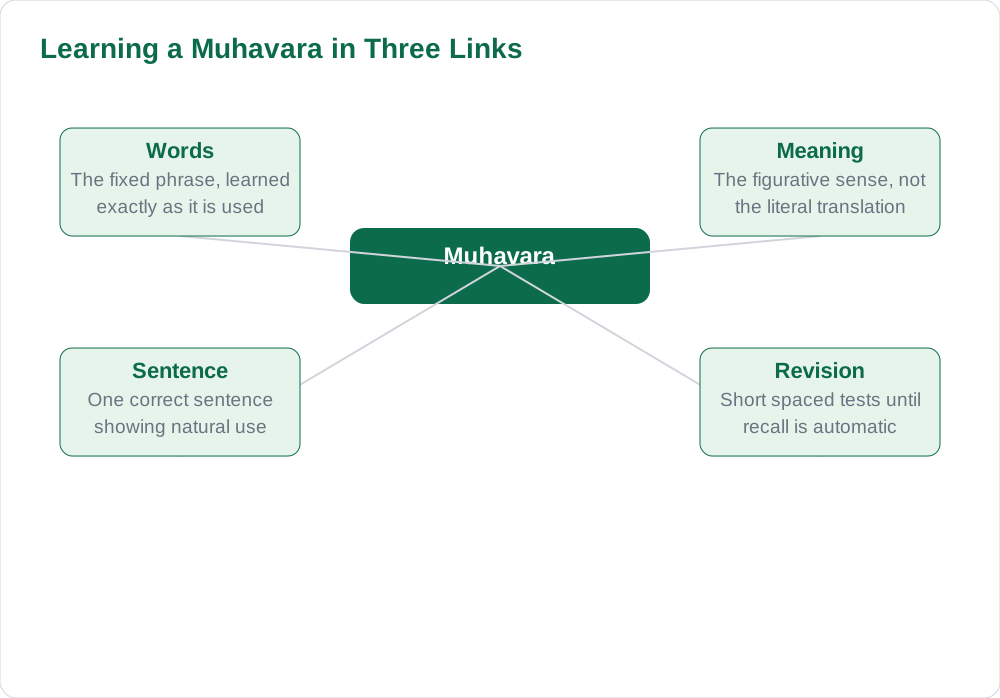
The worst way to learn muhavare is to memorise a long alphabetical list without meanings or examples, because isolated phrases fade quickly from memory. A better method is to learn them in small groups by theme, such as idioms about hard work, honesty, anger, happiness, or foolishness. For each idiom, learn three things together: its literal words, its real figurative meaning, and one sentence using it correctly. This triple link gives your memory three hooks instead of one, so recall becomes much easier. Study five idioms at a time, revise them the next day, and again after a week, because spaced revision beats a single long session every time.
Another powerful method is to connect each idiom with a mental picture or a short personal example. If an idiom describes someone working very hard, picture a student studying late with books spread around, and attach the idiom to that image. Personal connections work even better: link an idiom about honesty to a real incident you remember, without writing private details in your exam answer. Keep a dedicated notebook section for muhavare, with columns for the idiom, its meaning, and your example sentence, and test yourself by covering the meaning column. Regular short tests of this kind build a lasting stock of idioms that survives exam pressure. More language study help is on Solved Notes and the Blog.
Using Muhavare Correctly in Sentences
Knowing an idiom's meaning is only half the skill; using it in a sentence correctly is what earns full marks. A good exam sentence does three things: it uses the idiom in its correct grammatical form, it places it naturally in a realistic situation, and it makes the figurative meaning clear from the context. Avoid sentences that merely repeat the meaning, such as writing an idiom and then explaining it, because the sentence itself should demonstrate the meaning. Also avoid forcing an idiom into a sentence where it does not fit, since examiners notice unnatural use immediately. The sentence should sound like something a fluent speaker might actually say or write.
Practise sentence writing by taking one idiom at a time and writing two different sentences with it, then choosing the better one. Ask yourself whether the sentence would still make sense if you replaced the idiom with its meaning; if it would, the usage is probably correct. Watch out for common errors: changing the fixed words of the idiom, using it with the wrong verb form, or applying it to a situation it does not describe. Show your sentences to your teacher regularly, because a teacher can spot unnatural usage that you might miss. Over time, you will develop a sense for which idioms fit which situations, and sentence questions will become easy marks rather than guesses.
Types of Exam Questions on Rozmarra and Muhavare
Exam questions on this topic usually take four forms, and recognising each form helps you answer precisely. The first asks for the meaning of a given muhavara, where you write its figurative sense in clear words. The second asks you to use a muhavara in a sentence, where the sentence itself must show correct usage. The third asks you to correct a sentence that uses an expression unnaturally, which tests your knowledge of rozmarra. The fourth asks you to choose the correct idiom or expression for a given situation, which tests both knowledge and judgement. Read each question twice to identify which form it is, because answering a meaning question with a sentence, or vice versa, wastes the opportunity.
For meaning questions, write the figurative meaning directly and add a brief clarifying phrase if the meaning could be misunderstood. For sentence questions, write one complete, natural sentence and underline the idiom if your teacher advises it. For correction questions, rewrite the whole sentence correctly rather than only pointing at the error, since the corrected sentence is what earns marks. For choice questions, eliminate the options that are literal or unnatural before selecting your answer. Practise all four forms with past paper style questions from your teacher, because familiarity with the forms removes exam-day surprises and saves valuable time.
A Weekly Revision Plan for Lasting Recall
A sustainable revision plan treats rozmarra and muhavare as a small daily habit rather than a large occasional burden. Learn five new idioms on Monday with meanings and sentences, and revise them briefly on Tuesday. On Wednesday, learn five more and test yourself on Monday's set. On Thursday, practise correction and sentence questions using the idioms you have learned. On Friday, take a short self-test covering the whole week's set, and note any idiom you missed for extra revision. This cycle keeps the total workload small while building a stock of dozens of idioms over a term.
Also collect rozmarra expressions from your reading and listening, not only from lists. When you notice a natural expression in a lesson, newspaper, or teacher's speech, note it in your notebook with its context. This habit trains your ear for natural Urdu, which is exactly what rozmarra questions test. In the final weeks before the exam, revise your notebook by theme rather than from the beginning, and practise writing sentences under time limits. Do not try to learn a huge new list the night before the exam; instead, consolidate what you already know, because confident recall of known idioms scores better than shaky recall of many new ones. Further revision ideas are on the Blog and book lists on Books.
AI Help: Muse AI
Muse AI is Meta's personal AI assistant, and it can help with rozmarra and muhavare by testing you with quick quizzes: it can give you an idiom and ask for its meaning, or check a sentence you wrote using it. You can ask it to suggest a natural sentence for an idiom you are learning. Join Muse with invite code LTGSWD — in the Muse app, go to Settings > Redeem token and enter the code. Disclosure: LTGSWD is the author's Muse invite code. Muse AI does not give official STBB answers — always verify against your STBB book and your teacher. Remember to verify against your Sindh Textbook Board book before writing any idiom answer in your exam.
5 key points you must know
- Rozmarra is natural everyday usage; a muhavara is a fixed phrase with figurative meaning.
- Learn idioms in theme groups of five, with words, meaning, and sentence together.
- A good sentence uses the idiom naturally and makes its meaning clear from context.
- Recognise four question forms: meaning, sentence use, correction, and choice.
- Revise little and often with spaced tests instead of cramming long lists.
Frequently asked questions
What is the difference between rozmarra and muhavara in one sentence?
Rozmarra is the natural, everyday way of expressing something in Urdu, while a muhavara is a fixed phrase whose figurative meaning differs from its literal words. For example, a rozmarra question tests whether your sentence sounds natural to a fluent speaker, while a muhavara question tests whether you know the special meaning of a set phrase. Keeping the two categories separate in your notes prevents confusion when a paper mixes both types. Revise them with different methods: rozmarra by noticing natural usage, muhavare by learning meaning plus sentence.
Should I write the literal meaning of a muhavara in the exam?
No, unless the question specifically asks for it. Examiners want the figurative, real meaning of the idiom, not a word-by-word translation, which is often misleading or funny. Write the figurative meaning in clear, simple words, and if you add a sentence, make sure it demonstrates that meaning naturally. A literal translation as your answer shows that you do not know the idiom, even if every word is translated correctly. When in doubt, write the sense the idiom carries in real usage.
Can I change the words of a muhavara to fit my sentence?
Generally no, because a muhavara is a fixed expression and changing its words can break it or change its meaning. You may adjust grammatical endings where the language naturally allows it, but the core words and their order should stay as the idiom is normally used. If you are unsure whether a change is acceptable, use the idiom in its standard form in a sentence built around it, rather than reshaping the idiom itself. Your teacher can confirm the standard form of idioms you practise.
How many muhavare should I learn for Class 10?
Quality matters more than quantity: it is better to know forty idioms with meanings and sentences perfectly than to half-know a hundred. Start with the idioms your teacher emphasises and those in your textbook exercises, then expand gradually by theme. A steady pace of five per week builds a strong stock over a term without overwhelming you. Before the exam, consolidate your known set with self-tests rather than adding a large new list at the last moment.
How do I answer a rozmarra correction question?
First, identify what sounds unnatural in the given sentence: a wrong word choice, an unnatural phrase, or a literal translation from another language. Then rewrite the whole sentence correctly, using the natural Urdu expression. Do not only underline the error or explain it without giving the corrected sentence, since the corrected sentence earns the marks. Practise correction questions regularly, because they train your ear for natural usage in a way that memorising lists alone cannot.
Solved notes — preview free
These guides work best with the solved exercises. Preview the solved notes free on this website — 119 solved notes for Classes 6–10 in Sindhi, Urdu, English and Arabic medium. Or browse the full solved notes catalogue for your class and medium. New solved notes are added regularly — check the catalogue for coming-soon books.