Class 10 Urdu Nazam: Tashreeh With Central Idea

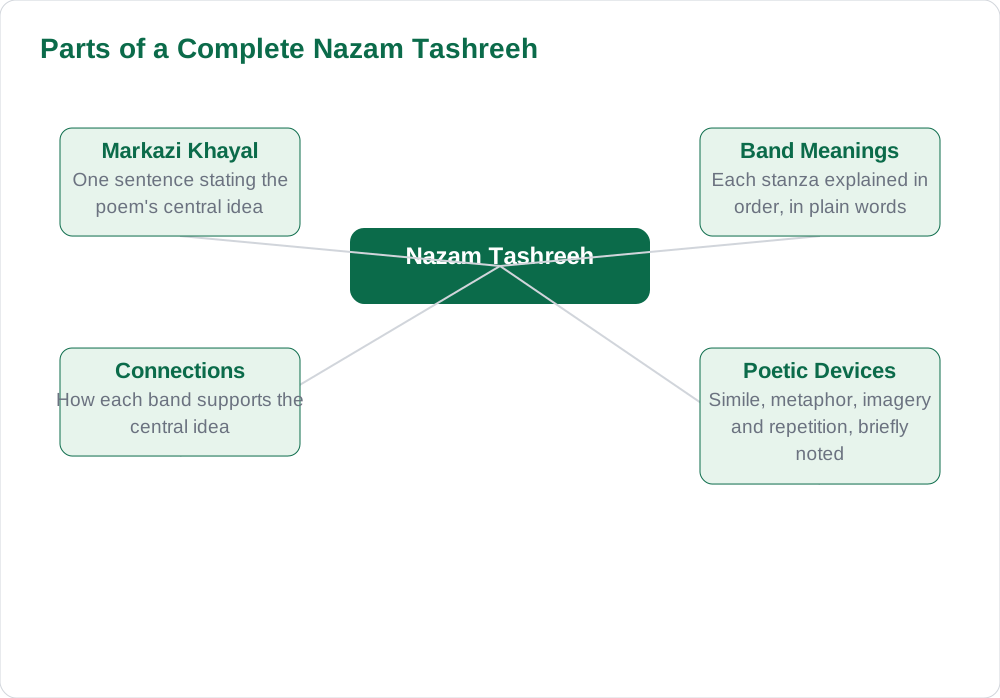
A nazam differs from a ghazal because it develops one theme through connected stanzas, so its tashreeh must show both the meaning of each stanza and the central idea that holds them together. Many Class 10 students explain stanzas one by one but never state the central idea, and their answers feel like separate pieces instead of one complete explanation. Others write only the central idea and skip the stanza meanings the examiner actually asked for. This guide teaches you to do both: find the markazi khayal, explain each stanza in order, and notice the poetic devices that carry the theme. The method works for any nazam in your course, provided you always check the real text in your own textbook.
What Makes a Nazam Different From a Ghazal
A nazam is a poem built around one subject or theme, and its stanzas, called band, follow each other in a logical order like paragraphs in an essay. Each band adds something new to the theme: it may describe a scene, raise a question, give an example, or draw a conclusion. Because of this connection, you cannot shuffle the bands around without damaging the poem, which is the opposite of a ghazal, where each sher stands alone. When you first read a nazam, look for this thread: what is the poet talking about, and how does each band move the discussion forward? Noticing the thread early makes every later step of tashreeh easier.
Nazams also vary in form, and recognising the form helps you describe the poem accurately in your answer. Some nazams rhyme regularly, others use blank verse, and some mix description with dialogue or address to the reader. You do not need advanced theory for Class 10, but you should be able to say in one sentence what kind of poem it is and what it is about. Read the nazam aloud twice before analysing it, because hearing the bands reveals the theme faster than silent reading. Keep your textbook open and mark band divisions with light pencil lines so you can work stanza by stanza without losing the whole. More study help is available on Solved Notes and the Blog.
Finding the Central Idea (Markazi Khayal)
The markazi khayal is the central thought the whole nazam expresses, and examiners often ask for it directly or award marks when your tashreeh reflects it. To find it, read the whole nazam first and write, in one sentence of your own, what the poet is really saying. Then test your sentence against each band: if a band does not fit, your sentence is probably too narrow or too vague, and you should revise it. A good central idea is specific enough to describe this poem only, not any poem on a similar topic. For example, saying a poem is about nature is too vague, while saying rain brings hope to farmers after drought is a genuine central idea.
A useful trick is to look at the first and last bands carefully, because poets often state or repeat their theme there. The opening band usually introduces the subject, and the closing band often gives the conclusion, advice, or emotional result. Do not confuse the subject with the central idea: the subject is what the poem is about, while the central idea is what the poet says about that subject. Write the central idea at the start of your exam answer in one clear sentence, and then let every stanza explanation support it. If you practise this on three or four nazams from your textbook, finding the markazi khayal will become a habit rather than a struggle.
Explaining Stanzas One by One
Once you know the central idea, explain each band in order, using the same plain-prose method you would use for a sher. Read the band twice, underline difficult words and find their meanings, then rewrite the band's meaning in two or three simple sentences. After the meaning, add one sentence connecting the band to the central idea: explain how this stanza advances the theme, gives an example, or changes the mood. This connection sentence is what turns separate stanza notes into a real tashreeh, and it is exactly what examiners reward. Avoid translating word by word, because a translation lists words while an explanation shows understanding.
Keep each band's explanation short and balanced, giving no band far more space than the others unless the question asks about one band. If the question asks only for one band, explain that band fully and mention the central idea in one sentence for context, without summarising the whole poem. Use simple, correct Urdu, and quote only a short phrase from the band if it helps; long quotations waste time and earn no extra marks. After writing, check that your explanation of every band agrees with the central idea you stated at the start. If one band's explanation contradicts your central idea, revisit both, because one is probably misread. Always verify your reading against your Sindh Textbook Board book.
Poetic Devices to Notice in a Nazam
Poetic devices are the tools a poet uses to make an idea vivid, and naming one or two correctly can lift an ordinary answer. A tashbeeh, or simile, compares one thing with another using a word of comparison, while an istiara, or metaphor, describes one thing as if it were another. Imagery means word pictures that appeal to the senses, such as the sound of rain or the colour of a morning sky. Repetition of a word or phrase can stress an emotion or idea, and contrast between two opposite images can sharpen the poem's message. You do not need to hunt for every device in a band; one accurate observation is worth more than three guessed ones.
When you mention a device, always link it to the meaning: say what the device does, not just its name. For example, instead of writing only that a simile is used, explain that comparing hope to morning light makes an abstract feeling visible and comforting for the reader. That link between device and meaning is what examiners look for, because it proves you understand why the poet chose that image. Practise by taking one band at a time and asking which single image stays in your mind after reading it, then naming the device behind that image. Over time you will build a small personal list of devices you recognise confidently, and you should use only those in exams.
Writing the Exam Answer and Avoiding Common Errors
A good nazam answer opens with the central idea in one sentence, then explains each band in order, with a brief note on devices where they genuinely appear. Write in paragraphs, one paragraph per band, so the examiner can see your structure at a glance. Keep your language simple and your sentences complete, and avoid memorised introductions that have nothing to do with the poem asked. If you forget a difficult word's meaning, explain the band's general sense honestly rather than inventing a meaning, because a small gap loses fewer marks than a confident error. End with a one-sentence conclusion that restates the central idea in different words.
The most common errors are easy to avoid once you know them. Some students summarise the whole poem in one paragraph and never explain bands. Others explain bands without ever stating the central idea, so the answer has no backbone. A third group copies long quotations instead of explaining, and a fourth writes about the poet's life instead of the poem. Check your answer against this list before moving on: central idea stated, bands in order, devices linked to meaning, no biography. Practise one full nazam answer every two weeks under timed conditions, and ask your teacher to mark it, because feedback on real answers improves you faster. More exam guidance is on the Blog and book details on Books.
AI Help: Muse AI
Muse AI is Meta's personal AI assistant, and it can help with nazam tashreeh by suggesting how to phrase a central idea in one sentence or by explaining a poetic device in simple words. You can ask it to check whether your one-sentence markazi khayal fits all the stanzas you described. Join Muse with invite code LTGSWD — in the Muse app, go to Settings > Redeem token and enter the code. Disclosure: LTGSWD is the author's Muse invite code. Muse AI does not give official STBB answers — always verify against your STBB book and your teacher. Remember to verify against your Sindh Textbook Board book before writing any tashreeh in your exam.
5 key points you must know
- A nazam develops one theme through connected bands, unlike a ghazal's independent couplets.
- State the markazi khayal in one specific sentence before explaining any stanza.
- Explain bands in order and connect each one back to the central idea.
- Name devices only when you can explain what they add to the meaning.
- Structure answers as one paragraph per band, opening with the central idea.
Frequently asked questions
What is markazi khayal and how do I write it?
Markazi khayal is the central idea of the whole poem: what the poet is really saying about the subject. Write it as one specific sentence in your own words, not as a vague label like 'this poem is about nature'. Test it by checking that every band of the poem supports it; if a band does not fit, revise the sentence. Place it at the start of your answer so the examiner sees your understanding immediately. A specific, accurate central idea can earn marks on its own and guides the rest of your tashreeh.
Should I explain every band if the question asks for only one?
No. If the question names one band, explain that band fully and mention the central idea in one sentence for context. Summarising the whole poem wastes time and may bury the answer the examiner asked for. However, if the question asks for the tashreeh of the whole nazam, you must cover every band in order, keeping each explanation balanced. Always read the question twice to see whether it asks for a band, a stanza, or the complete poem.
How do I handle a band I do not fully understand?
Start with what you do understand: the general mood, the subject, and any clear images in the band. Use the surrounding bands and the central idea to narrow down the likely meaning, and check difficult words in your textbook glossary. Write the general sense honestly rather than inventing details, because a partial but correct explanation earns more than a detailed but wrong one. After the test, ask your teacher to explain that band so the gap does not remain for the board exam.
Which poetic devices should Class 10 students know for nazam questions?
Focus on the devices your textbook and teacher emphasise, typically tashbeeh (simile), istiara (metaphor), imagery, repetition, and contrast. Learn one clear definition and one example of your own for each, so you can recognise them confidently. In answers, name a device only when you can explain what it contributes to the meaning of the band. Guessing device names is risky, since a wrong identification can cost the mark that a correct meaning alone would have earned.
How much quotation should I include in a nazam answer?
Very little. Quote a short phrase only when it directly supports your explanation, such as the image behind a device you are discussing. Long quotations do not prove understanding and they consume time you need for explanation. The examiner wants your explanation in your own words, with the poem's meaning made clear. If the question paper already prints the band, you do not need to copy it at all; begin straight with your explanation.
Solved notes — preview free
These guides work best with the solved exercises. Preview the solved notes free on this website — 119 solved notes for Classes 6–10 in Sindhi, Urdu, English and Arabic medium. Or browse the full solved notes catalogue for your class and medium. New solved notes are added regularly — check the catalogue for coming-soon books.