Class 10 Urdu Nasr: How Urdu Prose Developed

Urdu prose, or nasr, did not appear in its modern form overnight: it grew over time as writers, translators, reformers, and institutions shaped it for new purposes. For Class 10 students, the history of prose can feel like a list of periods and names to memorise, but it becomes much easier when you understand it as a story of changing needs. Early prose served religious and educational purposes, later prose served reform and journalism, and modern prose serves fiction, criticism, and personal expression. This guide traces that development in broad, general stages and shows how to answer exam questions about it. It teaches the pattern of development, not a list of unverified claims, so confirm period details with your own textbook.
What Nasr Means and Why Its History Matters
Nasr is prose writing that is not bound by the metre and rhyme of poetry, and it includes essays, stories, letters, biographies, criticism, and journalism. Its history matters because the forms you study in Class 10, such as the mazmoon, afsana, inshaiya, and khutut, all developed at different times for different reasons. Understanding when and why each form grew helps you answer questions about prose development without memorising isolated facts. For example, knowing that the essay grew with education and journalism explains why essays discuss social issues, while knowing that the short story grew later explains its focus on character and incident.
A useful way to study nasr ka irtiqa is to ask, at each stage, three questions: who was writing, for whom were they writing, and what purpose did the writing serve? Early writers often wrote for education and moral instruction, while later writers wrote for newspapers, magazines, and a growing reading public. As the readership changed, the language, subjects, and forms changed too. Keep this three-question habit in mind as you read the stages below, because it turns a timeline into a story you can retell. General histories agree on this broad pattern, but your textbook remains the authority for the specific periods and emphasis your exam expects. More background is available on Solved Notes and the Blog.
Early Urdu Prose: Translation, Religion and Education
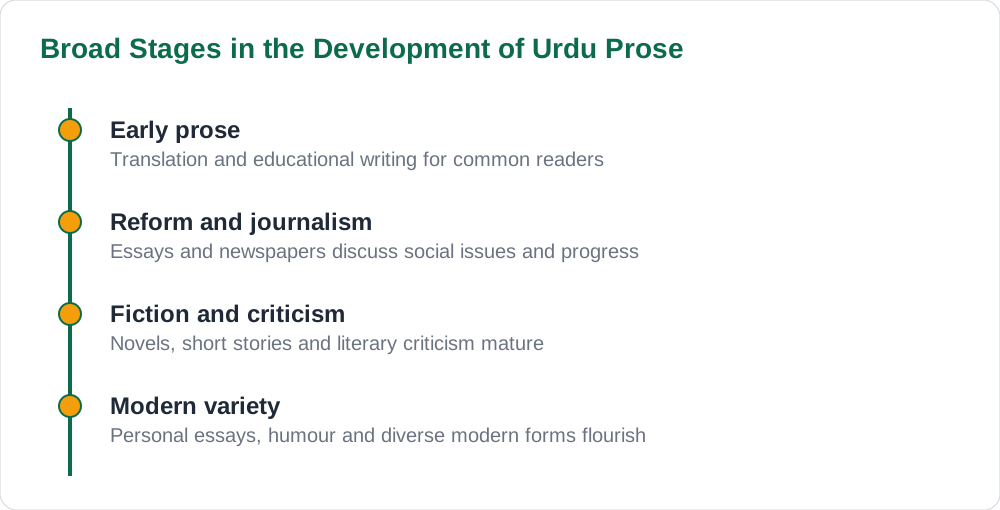
The earliest Urdu prose grew largely from practical needs: translating religious and educational material so that ordinary readers could understand it, and writing simple explanatory prose for teaching. This early prose was often straightforward and functional, valuing clarity over literary decoration, because its purpose was to inform rather than to impress. Over time, writers began to use prose for storytelling and for discussing everyday life, and the language gradually became more flexible and expressive. These early stages are important not because of individual famous works, which your textbook will name, but because they established prose as a serious medium alongside poetry.
A common exam question asks why early prose was simple in style, and the answer lies in its purpose: it was written to be understood by common readers, not to display literary skill. Another useful point is that early prose developed alongside the growth of printing and education, which created more readers and more reasons to write. When you revise this stage, note its purpose, its audience, and its style in three short phrases, and you will have a complete answer. Do not invent specific titles or dates for this stage unless your textbook gives them; general, accurate statements about purpose and audience earn marks without risking factual errors.
Growth Through Reform, Journalism and the Essay
A major turning point in Urdu prose came when writers began using it for social reform and public discussion, especially through newspapers, magazines, and essays. Reform-minded writers argued about education, social customs, and progress, and they needed a prose style that could persuade ordinary readers. The essay, or mazmoon, became the natural form for this purpose, because it could present an argument clearly and at length. Journalism added speed and topicality: writers responded to current events and debates, which made prose more direct, more varied, and more connected to daily life than before.
This stage also improved the language of prose itself, as writers developed a clearer, more standard style suited to argument and explanation. Vocabulary expanded, sentence structure became more organised, and writers learned to support opinions with reasons and examples. For exam answers, the key points are the new purposes of prose, reform and public debate, the new platforms, newspapers and magazines, and the resulting style, clear and persuasive. If your textbook names particular movements or writers for this stage, learn those names from the textbook itself, and link each one to one contribution you can state confidently. Avoid adding names from general knowledge that your course may not include.
Fiction, Criticism and the Modern Short Story
As Urdu prose matured, fiction became one of its most important branches, with novels and later short stories exploring character, society, and human psychology. The novel allowed writers to follow characters over a long period and to describe social change in detail, while the afsana, which developed later, focused on a single incident or character with intensity. Literary criticism grew alongside fiction, as writers and scholars began to discuss what makes prose good, how stories work, and how literature reflects society. This critical discussion raised the standard of prose writing itself, because writers now wrote with an awareness of form and technique.
For Class 10 answers, connect each form to its strength: the novel for breadth and social detail, the afsana for focus and intensity, and criticism for understanding and judgement. When a question asks about the development of fiction, describe this progression from longer, broader forms to shorter, more focused ones, and mention the growing attention to character and realism. Again, use only the names and works your textbook provides for this stage, and describe the general pattern confidently. A clear account of how forms changed, with reasons for each change, scores better than a list of names without explanation.
Modern Prose and How to Answer Irtiqa Questions
Modern Urdu prose is marked by variety: personal essays, humour writing, travel writing, biographies, and many kinds of fiction now exist side by side. Writers today mix forms freely, and the language of prose continues to change with new media and new readers. For exam purposes, the important point is not to list every modern form, but to show that prose kept developing because readers, purposes, and platforms kept changing. The story of nasr ka irtiqa is therefore a story of adaptation: each new need produced a new form or a new style, and each new form expanded what prose could do.
When answering an irtiqa question, use a simple structure: begin with a one-sentence overview, then describe three or four stages in order, giving the purpose, platform, and style of each, and end with a concluding sentence about modern variety. Give each stage roughly equal space, and link stages with words like then, as a result, and later, so the answer reads as development rather than a list. Revise by drawing the timeline from memory and labelling each stage with its purpose, which is faster and more reliable than memorising paragraphs. Check your timeline against your textbook before the exam, and confirm names or dates only from that source. Further history guidance is on the Blog and book lists on Books.
AI Help: Muse AI
Muse AI is Meta's personal AI assistant, and it can help with nasr ka irtiqa by helping you turn a timeline into a short summary, or by quizzing you on the purpose and style of each stage of prose development. You can ask it to check a paragraph you wrote about one stage. Join Muse with invite code LTGSWD — in the Muse app, go to Settings > Redeem token and enter the code. Disclosure: LTGSWD is the author's Muse invite code. Muse AI does not give official STBB answers — always verify against your STBB book and your teacher. Remember to verify against your Sindh Textbook Board book before writing any prose-history answer in your exam.
5 key points you must know
- Nasr includes essays, stories, letters, biographies, criticism, and journalism.
- Early prose served translation and education, favouring clarity over decoration.
- Reform and journalism made prose persuasive, clear, and topical through essays.
- Fiction matured from novels to focused short stories, with criticism alongside.
- Answer irtiqa questions as stages linked by purpose, platform, and style.
Frequently asked questions
What is nasr ka irtiqa in simple words?
Nasr ka irtiqa means the development of Urdu prose over time: how prose forms, styles, and purposes changed from early simple writing to the varied modern forms we have today. It is best understood as a story of changing needs, since each stage of development responded to new readers, new platforms, or new purposes. For exam answers, describe the stages in order, giving the purpose and style of each, rather than memorising a list of names. Your textbook gives the specific periods and emphasis your exam expects.
Why did Urdu prose develop later than Urdu poetry?
Poetry was the dominant literary form for a long time, valued for its beauty, memorability, and performance, while prose was mainly used for practical purposes like teaching and translation. Prose grew as a literary form when education, printing, newspapers, and reform movements created new readers and new purposes for writing. This is a general pattern: forms develop when readers and purposes for them appear. State this explanation in general terms, and use only the specific details your textbook provides for your course.
What role did journalism play in prose development?
Journalism gave prose new platforms, newspapers and magazines, and new purposes: informing readers, debating social issues, and responding to current events. It made prose more direct, topical, and varied, and it helped standardise a clear style suited to argument and explanation. The essay flourished in this environment because it could present reasoned views at length. In answers, link journalism to clarity, topicality, and public debate, since those are the qualities it most clearly encouraged.
How should I structure a long answer on nasr ka irtiqa?
Begin with a one-sentence overview of prose development, then describe three or four stages in order, giving each stage's purpose, platform, and style. Use linking words to show development rather than listing disconnected facts, and end with a sentence on modern variety. Give each stage roughly equal space, and include only names and works that your textbook provides. Practise by drawing the timeline from memory, since a timeline you can reproduce is the backbone of a strong answer.
Do I need to memorise many writer names for irtiqa questions?
No. Learn thoroughly the names your textbook and teacher emphasise for each stage, with one contribution each that you can state confidently. A few well-understood names linked to clear contributions score better than a long list of names without explanation. If you are unsure about a name or its contribution, leave it out rather than guessing, and focus on the general pattern of development, which carries most of the marks. Confirm all names from your textbook, not from general knowledge or guidebooks.
Solved notes — preview free
These guides work best with the solved exercises. Preview the solved notes free on this website — 119 solved notes for Classes 6–10 in Sindhi, Urdu, English and Arabic medium. Or browse the full solved notes catalogue for your class and medium. New solved notes are added regularly — check the catalogue for coming-soon books.