Class 10 Urdu Inshaiya: Style and Humour
An inshaiya looks like an essay at first glance, because both are prose pieces on a subject, but reading one feels very different: the inshaiya is personal, playful, and full of wit, while an essay is formal and argumentative. Many Class 10 students lose marks by treating an inshaiya as a serious essay, summarising its subject but missing its tone, humour, and personal voice. Others enjoy the humour but cannot explain how it works or what point it makes. This guide explains what makes an inshaiya distinct, how its humour is created, and how to write exam answers that capture both its style and its meaning. Examples here are illustrative, so always check your own textbook for the real texts.
What an Inshaiya Is: Personal, Light and Purposeful
An inshaiya is a short personal essay in which the writer shares thoughts, observations, and experiences in a light, conversational style. The writer speaks directly to the reader, often using the first person, and moves freely from one idea to another the way a person thinks aloud. The subject may be ordinary, such as a daily habit, a journey, or a common human weakness, but the treatment makes it interesting. Unlike a formal essay, an inshaiya does not need to prove a thesis with evidence; its purpose is to entertain while making the reader think. This combination of lightness and purpose is its defining quality.
Because the inshaiya is personal, its charm depends on the writer's voice: the choice of words, the jokes, the exaggerations, and the sudden turns of thought. When you read one, notice how the writer talks to you, not at you, and how humour appears in everyday details rather than in grand statements. A good reader asks two questions throughout: what is the writer actually saying about this subject, and what makes the saying enjoyable? Answering both questions together is the key to inshaiya questions. If you only summarise the subject, you miss the style, and if you only laugh at the jokes, you miss the point. Study help for prose forms is available on Solved Notes and the Blog.
Inshaiya Versus Mazmoon: Five Clear Differences
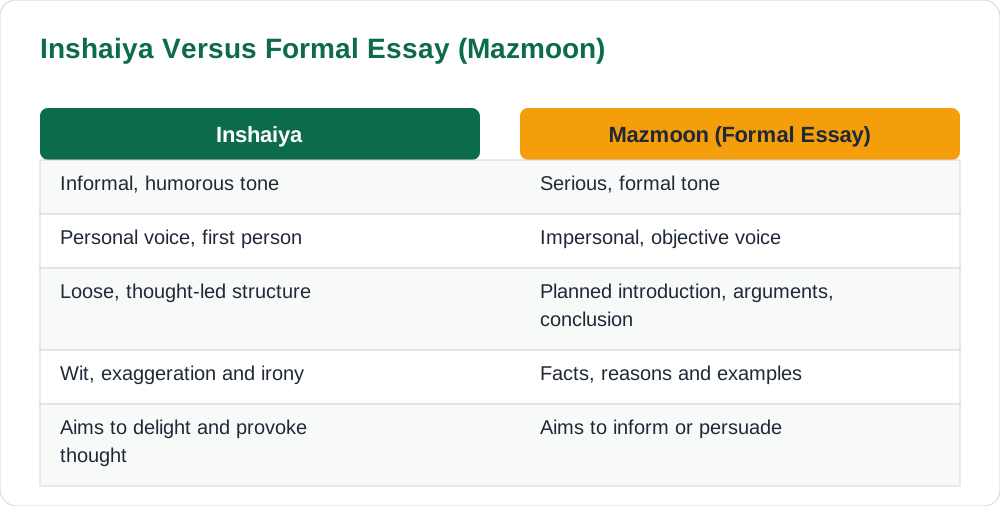
The clearest difference between an inshaiya and a mazmoon, or formal essay, is tone: the inshaiya is informal and humorous, while the mazmoon is serious and structured. Second, the inshaiya is personal and uses the first person freely, whereas the mazmoon is usually impersonal and avoids personal stories. Third, the inshaiya moves loosely from idea to idea, following the writer's thoughts, while the mazmoon follows a planned order of introduction, arguments, and conclusion. Fourth, the inshaiya uses wit, exaggeration, and irony as its main tools, while the mazmoon uses facts, reasons, and examples. Fifth, the inshaiya aims to delight and gently provoke thought, while the mazmoon aims to inform or persuade.
Examiners often test exactly these differences, so learn them as a set rather than as isolated facts. A useful revision method is to draw a two-column table in your notebook, with inshaiya on one side and mazmoon on the other, and fill in tone, voice, structure, tools, and purpose from memory. Then test yourself by covering one column and recalling it. When a question asks you to distinguish the two forms, write four or five clear points with a brief explanation for each, rather than one long paragraph. Short, well-separated points are easier for the examiner to mark and harder for you to confuse under pressure.
How Humour Works in an Inshaiya
Humour in an inshaiya usually comes from exaggeration, surprise, or gentle irony rather than from jokes told for their own sake. Exaggeration takes an ordinary weakness, such as laziness or love of praise, and stretches it until it becomes funny and recognisable. Surprise comes when the writer sets up an expectation and then turns it in an unexpected direction, making the reader smile at the twist. Irony says one thing while meaning almost the opposite, so the reader must think for a moment to catch the real point. Self-mockery is another common tool: the writer laughs at himself first, which makes criticism of others feel friendly rather than harsh.
When you analyse humour, always connect the joke to its purpose, because examiners reward that link. Ask what the exaggeration reveals about human nature, or what the irony criticises gently. For instance, an illustrative inshaiya might exaggerate a character who collects praise the way others collect stamps, and the humour works because readers recognise that hunger for praise in real life. The point is not the collection itself but the human weakness it exposes. In your answer, name the device briefly, explain the example in your own words, and state the point it makes. That three-part comment, device, example, and point, is a complete humour analysis in miniature.
Language and Style: What to Notice and Quote
The language of an inshaiya is usually simple and conversational, full of everyday words, short sentences, and direct addresses to the reader. Writers often use idioms, proverbs, and colloquial expressions to keep the tone natural, and they may switch suddenly from serious to playful language for comic effect. Notice also the use of rhetorical questions, which invite the reader to agree or think, and the use of brief stories or anecdotes that illustrate a point better than an argument could. When you study an inshaiya, underline two or three phrases that show its style clearly, and be ready to explain why they are effective rather than merely quoting them.
In exam answers, short quotations work best: quote a phrase, explain its humour or effect, and move on. Long quotations waste time and suggest you are filling space instead of analysing. If you cannot remember an exact phrase, paraphrase it accurately and discuss its effect; a correct paraphrase with good analysis earns more than a wrong quotation. Also notice the writer's sentence length: short, punchy sentences often deliver jokes, while longer sentences build up a scene before the punchline. Commenting on one such feature, with an example, shows genuine stylistic awareness and lifts your answer above a simple summary.
Answering Inshaiya Questions in the Exam
Inshaiya questions usually ask for one of four things: a summary of the piece, its central idea, its distinctive style, or a comparison with the mazmoon. Identify which one the question asks before writing, because each needs a different shape. A summary follows the writer's thoughts in order and keeps the tone light. A central-idea answer states the main point in one sentence and supports it with two examples. A style answer discusses tone, humour, and language with brief examples. A comparison answer uses clear points of difference, ideally in a structured list. Writing the wrong shape, such as a summary when style was asked, loses marks even if the content is accurate.
Practise by taking one inshaiya from your textbook each fortnight and writing a short answer of each type in rotation. Show your answers to your teacher, because feedback on style analysis is especially valuable: students often think they have explained humour when they have only retold a funny incident. Keep a notebook page for each inshaiya with its subject, central idea, two humour examples, and two style features, and revise these pages before tests. This compact record is far more useful than memorised paragraphs, because it lets you build fresh answers for any question the paper sets. More prose guidance appears on the Blog and book lists on Books.
AI Help: Muse AI
Muse AI is Meta's personal AI assistant, and it can help with inshaiya study by explaining the difference between an inshaiya and a formal essay in simple words, or by suggesting how humour devices like exaggeration and irony work. You can ask it to check a short paragraph you wrote about a style feature. Join Muse with invite code LTGSWD — in the Muse app, go to Settings > Redeem token and enter the code. Disclosure: LTGSWD is the author's Muse invite code. Muse AI does not give official STBB answers — always verify against your STBB book and your teacher. Remember to verify against your Sindh Textbook Board book before writing any inshaiya answer in your exam.
5 key points you must know
- An inshaiya is personal, light, and conversational, unlike a formal essay.
- Know five differences: tone, voice, structure, tools, and purpose.
- Humour works through exaggeration, surprise, irony, and self-mockery.
- Analyse humour by linking device to example to point, briefly.
- Match your answer shape to the question: summary, idea, style, or comparison.
Frequently asked questions
What is the simplest definition of an inshaiya for the exam?
An inshaiya is a short personal essay written in a light, humorous, conversational style, in which the writer shares personal thoughts and observations on an ordinary subject. Its purpose is to entertain while gently making the reader think. For a definition question, write this definition and add one distinguishing feature, such as its personal voice or its use of wit, to show fuller understanding. Avoid confusing it with a mazmoon, which is formal, impersonal, and argumentative.
How do I explain the humour of an inshaiya without just retelling jokes?
Use the three-part method: name the device, give the example in your own words, and state the point it makes. For example, say that exaggeration is used when a human weakness is stretched to an absurd degree, explain the illustrative example briefly, and state what it reveals about human nature. This shows analysis rather than retelling. Practise this method on two or three passages from your textbook so it becomes automatic in the exam.
Can an inshaiya have a serious message despite its humour?
Yes, and this is one of its most important qualities. The humour is often a vehicle for gentle criticism of social habits or human weaknesses, so the laughter carries a serious point. When you write about an inshaiya, mention both layers: what is funny and what it criticises or suggests. An answer that captures only the jokes misses the purpose, while one that ignores the humour misses the form. The best answers show how the humour delivers the message.
What is the difference between inshaiya and khaka (character sketch)?
An inshaiya is a personal essay on any subject, written in the author's voice with humour and free-flowing thought. A khaka is a portrait of a person, focusing on that person's appearance, habits, character, and memorable incidents. While an inshaiya may include personal anecdotes, its subject is an idea or experience, whereas a khaka's subject is always a person. Keep this distinction ready, since examiners sometimes ask students to identify which form a given passage belongs to.
How should I revise inshaiya topics before the exam?
Make one notebook page per inshaiya with its subject, central idea, two humour examples with devices named, and two style features. Revise by covering the page and recalling each item from memory, then writing one short practice answer per week. Also revise the five differences between inshaiya and mazmoon as a set, since comparison questions are common. Always base your notes on your own textbook, and confirm uncertain points with your teacher.
Solved notes — preview free
These guides work best with the solved exercises. Preview the solved notes free on this website — 119 solved notes for Classes 6–10 in Sindhi, Urdu, English and Arabic medium. Or browse the full solved notes catalogue for your class and medium. New solved notes are added regularly — check the catalogue for coming-soon books.