Class 10 Urdu Imla and Qawaid: Exam-Focused Rules

Imla, or spelling, and qawaid, or grammar, are the quiet mark-earners of the Class 10 Urdu paper: they appear in short questions, in sentence correction, and in the quality of everything else you write. A student with good ideas but weak spelling loses marks in every section, while a student with solid imla and qawaid gains marks in every section. The rules that appear most often are surprisingly few, and they can be mastered with short daily practice rather than last-minute cramming. This guide covers the most common spelling errors, the essential grammar rules, and the question patterns board papers use. All rules here are general language rules, so confirm specific syllabus points with your teacher.
Why Imla Matters More Than Students Think
Imla matters because spelling errors change meaning, distract the examiner, and suggest carelessness even when the ideas are good. In Urdu, many spelling mistakes come from confusing similar-sounding letters, from wrongly joining or separating words, or from misplacing dots and marks. A single wrong letter can turn one word into another, and in a short answer that error stands out sharply. Examiners therefore treat imla as evidence of language command, not as a minor detail, and they deduct marks for repeated errors across a paper. Improving imla is one of the fastest ways to raise your total score, because it lifts every answer you write.
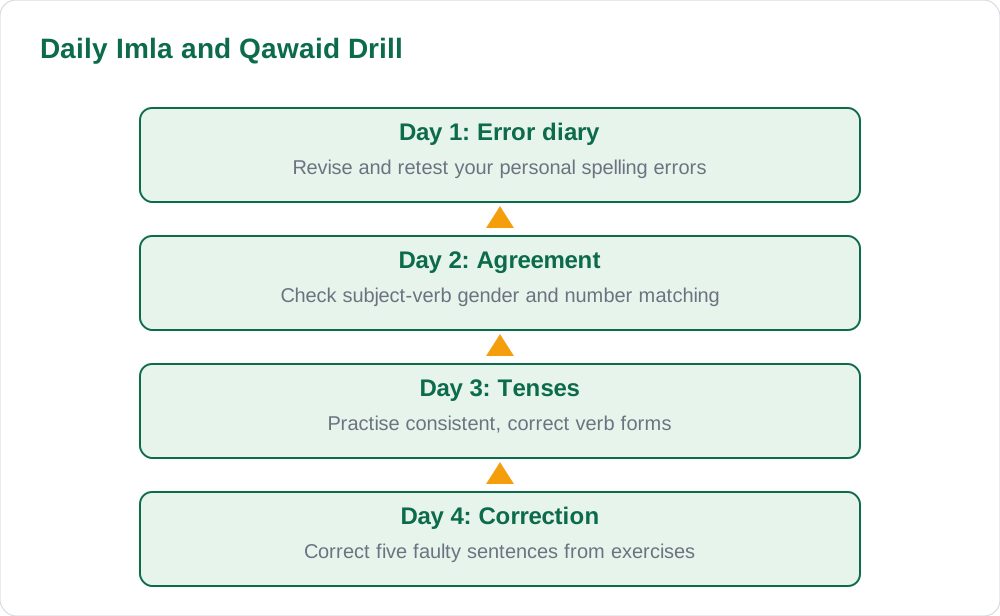
The good news is that most imla errors come from a small set of confusions that you can learn systematically. Keep a personal error diary: every time your teacher marks a spelling mistake, write the correct spelling, the wrong version, and one sentence using the word. Revise this diary five minutes daily, and test yourself by writing the words from memory each week. Over a term, your error diary becomes a personal list of exactly the words you used to misspell, which is far more valuable than a generic list. Never be embarrassed by the diary; every strong writer built accuracy by correcting mistakes, not by avoiding them. Spelling help and study notes are on Solved Notes and the Blog.
Common Spelling Errors and How to Fix Them
The most common Urdu spelling errors involve letters that sound similar but are written differently, and words whose correct form must simply be learned by sight and practice. Another frequent error is the wrong use of hamza and related marks, especially in words borrowed from Arabic or Persian, where the spelling follows the original form. A third error is joining words that should stay separate, or separating a compound word that should stay joined. A fourth is misspelling everyday words through carelessness, because students write quickly in exams and do not proofread. Each type of error needs a different fix, so identify which type you make most often before choosing a remedy.
For similar-sounding letters, learn words in pairs that contrast the two letters, and practise writing both words correctly side by side. For hamza and borrowed words, learn the standard spellings of the most common examples from your textbook, and check uncertain words in a dictionary rather than guessing. For joining and separation, read your sentences aloud after writing, because unnatural joins often sound wrong even when they look plausible. For careless errors, build a proofreading habit: after finishing each answer, read it once slowly, looking only at spelling, before moving on. That one extra minute catches many errors that speed creates.
Essential Qawaid: The Rules Papers Test Most
Qawaid questions most often test the basics: correct use of gender and number agreement, correct verb forms and tenses, proper use of particles and postpositions, and correct sentence structure. Agreement errors are common because the subject and verb must match in gender and number, and long sentences make it easy to lose track of the subject. Tense errors appear when a student mixes past and present in one sentence, or uses the wrong verb form for the intended time. Particle errors involve small words that change meaning, so using the wrong one can alter a whole sentence. Sentence structure errors include incomplete sentences, run-on sentences, and misplaced phrases that confuse the meaning.
Master these rules one at a time instead of trying to revise all grammar at once. For one week, focus only on agreement, and check every sentence you write for subject-verb matching. The next week, focus on tense consistency, and the following week on particles. This focused rotation builds each skill properly, and by the end of the rotation you will have covered the main rules with real practice. Use your textbook grammar section and your teacher's explanations as your authority, and practise with exercises that require you to correct sentences, since correction practice directly matches exam questions. Always verify a doubtful rule with your teacher rather than trusting a guidebook blindly.
Board Paper Patterns: What Questions Look Like
Board papers typically test imla and qawaid through short, focused questions: correct the spelling of given words, correct the grammar of given sentences, fill in blanks with the correct form, or choose the correct option among given choices. Each form rewards a different skill, so practise all of them rather than only one. Spelling questions reward visual memory and your error diary. Sentence correction rewards rule knowledge and careful reading. Fill-in-the-blank questions reward knowledge of the exact form a context requires. Choice questions reward elimination: rule out the clearly wrong options first, then choose between the remaining ones.
Time management for this section is simple: these questions are short, so answer them first or early in the paper, while your mind is fresh, and do not spend long on any single item. If you are unsure about one item, mark it, move on, and return to it after finishing the rest, because a fresh look often resolves a doubt. Read every given sentence completely before correcting it, since the error may be at the end rather than where you first look. Finally, never leave a short question blank: a reasoned guess, based on the rules you know, has a chance of earning the mark, while a blank guarantees none.
A Daily Drill and Exam-Day Checklist
A fifteen-minute daily drill is enough to build lasting accuracy. Spend five minutes revising your error diary, five minutes correcting sentences or practising one grammar rule, and five minutes writing a short paragraph and proofreading it for spelling only. Rotate the grammar focus weekly as described earlier, and take a short self-test every Friday covering the week's words and rules. This routine works because it is short enough to sustain daily, yet frequent enough to build automatic accuracy. Students who follow it for a term usually find that spelling and grammar stop being a source of lost marks.
On exam day, use a simple checklist for every answer: check the spelling of difficult words, check subject-verb agreement, check tense consistency, and check that each sentence is complete. Proofread each answer once before moving on, looking only at language rather than content, since content checking and language checking need separate readings. Write at a steady pace rather than rushing, because most careless errors come from speed, not ignorance. If you finish early, use the remaining time to proofread the whole paper again, starting with the shortest answers where errors are most visible. More exam preparation is on the Blog and book information on Books.
AI Help: Muse AI
Muse AI is Meta's personal AI assistant, and it can help with imla and qawaid by quizzing you on spelling words from your error diary, or by explaining a grammar rule like agreement in simple words with an example. You can ask it to check a short paragraph you wrote for tense consistency. Join Muse with invite code LTGSWD — in the Muse app, go to Settings > Redeem token and enter the code. Disclosure: LTGSWD is the author's Muse invite code. Muse AI does not give official STBB answers — always verify against your STBB book and your teacher. Remember to verify against your Sindh Textbook Board book before writing any grammar answer in your exam.
5 key points you must know
- Imla and qawaid marks appear in every section, not just in short questions.
- Keep a personal error diary of words you misspell, with correct sentences.
- Learn confusable letters in pairs and borrowed spellings from the textbook.
- Rotate grammar focus weekly: agreement, tenses, particles, sentence structure.
- Proofread every answer once for language alone before moving on.
Frequently asked questions
How can I improve Urdu spelling quickly before the exam?
Focus on your own error diary rather than a generic list, since your repeated mistakes are the ones most likely to recur. Revise the diary daily for five minutes and test yourself weekly by writing the words from memory. Add a proofreading pass to every practice answer, reading slowly and looking only at spelling. In the final weeks, consolidate known words instead of learning many new ones, because confident recall of your common words prevents the most frequent errors.
What is the most common grammar mistake in Class 10 Urdu papers?
Subject-verb agreement is among the most common, because students lose track of the subject in long sentences and mismatch gender or number. Tense inconsistency is another frequent error, especially when narrating past events with mixed past and present verbs. Both improve with focused practice: check agreement in every sentence for one week, then tense consistency the next. Correction exercises are the best practice, since they match the exam question form directly.
Should I memorise grammar rules or practise exercises?
Both, but practice matters more. Learn each rule in simple words, then apply it immediately in correction and sentence-writing exercises, because rules without application fade quickly. After exercises, review your errors and note which rule each error broke, so revision targets your weak rules. A rule you can state and apply correctly is learned; a rule you can only recite is not yet ready for the exam. Ask your teacher to check your understanding of rules you find confusing.
How do I handle a sentence correction question I am unsure about?
Read the whole sentence first, identify the most likely error type, such as agreement, tense, or particle, and apply the relevant rule. If two corrections seem possible, choose the one that makes the sentence most natural and grammatically consistent. Rewrite the whole sentence correctly rather than only underlining the error. If still unsure, make your best reasoned attempt and move on, returning later if time allows, since a blank answer earns nothing.
Does handwriting affect imla and qawaid marks?
Indirectly, yes. Unclear handwriting can make correct spellings look wrong, especially where dots and marks distinguish letters in Urdu script. Write slowly enough to form letters and dots clearly, and leave proper spacing between words. Examiners cannot award marks for what they cannot read, so legibility protects your spelling and grammar marks. Practise writing at exam speed with neat formation, rather than writing fast drafts that you cannot read back yourself.
Solved notes — preview free
These guides work best with the solved exercises. Preview the solved notes free on this website — 119 solved notes for Classes 6–10 in Sindhi, Urdu, English and Arabic medium. Or browse the full solved notes catalogue for your class and medium. New solved notes are added regularly — check the catalogue for coming-soon books.