Class 10 Urdu Ghazal: Tafheem and Tashreeh

A Class 10 Urdu ghazal can look difficult at first because every couplet, or sher, stands on its own while still belonging to the same ghazal. Tafheem means understanding what each sher really says, and tashreeh means explaining that meaning clearly in your own words for the examiner. Many students memorise a ready-made tashreeh without understanding it, and then they struggle when the paper asks about a different sher or a new angle. This guide teaches a simple couplet-by-couplet method that works for any ghazal in your course. You will learn the basic terms, a four-step reading routine, and how to write an answer that earns full marks. Keep your textbook open: examples here are illustrative, so check the real wording in your own book.
What a Ghazal Is and Why Each Sher Matters
A ghazal is a collection of couplets called ash-aar, and each sher usually carries a complete thought of its own. Unlike a nazam, a ghazal does not tell one continuous story, so you cannot depend on the previous sher to explain the next one. The first sher is called the matla, and it sets the rhyme pattern for the whole ghazal, while the last sher, often containing the poet's pen name, is called the maqta. Understanding this structure saves you from a common mistake: forcing all the couplets into one summary when the examiner actually wants each sher explained separately. When you open your textbook, count its ash-aar, then read it aloud once slowly without stopping to analyse anything.
Reading aloud matters because a ghazal is written to be heard, and its rhythm often reveals the mood before the meaning becomes clear. After your first reading, ask yourself one simple question about the whole ghazal: is the mood one of love, longing, praise, reflection, or complaint about life? That overall feeling is your starting point, not a substitute for explaining each sher on its own. A good answer moves from the general mood to the particular meaning of the sher asked. Students who skip this slow first reading often misread words later, so read the poem twice before you pick up your pen. More Class 10 study material is on Solved Notes and the book list on Books.
Key Terms You Must Know: Matla, Maqta, Radeef and Qafia
Four terms appear again and again in ghazal questions, so learn them properly instead of guessing in the exam hall. The matla is the opening sher of the ghazal, and both of its lines follow the rhyme scheme. The maqta is the closing sher, and it traditionally includes the poet's takhallus, or pen name, woven into the verse. The qafia is the rhyming pattern that repeats at the end of the second line of each sher, while the radeef is the identical word or phrase that follows the qafia in every sher. If you can point out the qafia and radeef in your ghazal, you immediately show the examiner that you understand its technical craft, not just its surface meaning.
Do not confuse these terms, because examiners often test exactly that distinction with a short question. A useful memory trick is to link matla with the start, since both words suggest a beginning, and maqta with the end, since it closes the ghazal. For qafia, remember rhyme, and for radeef, remember repetition of the same words after the rhyme. When you practise, take any ghazal from your textbook and underline the qafia and radeef in each sher with a pencil. After three or four ghazals, recognising the pattern becomes automatic, and technical questions take seconds. Practise regularly and check your answers against your textbook and your teacher, because your own book is the final authority on its ghazals.
The Four-Step Couplet-by-Couplet Method
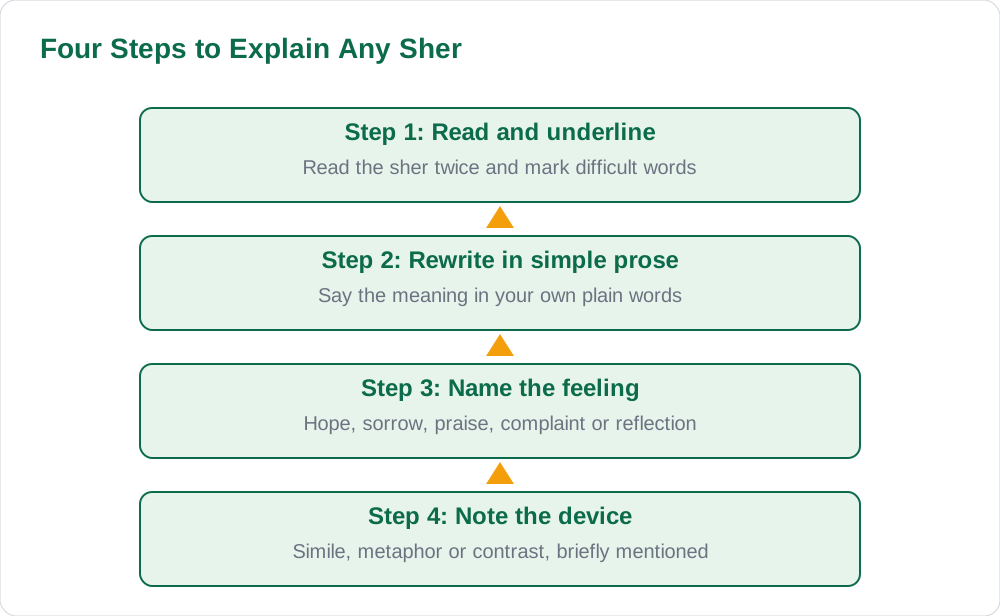
Step one: read the sher twice, underline any difficult word, and find its meaning from your textbook glossary or teacher rather than guessing. Step two is to rewrite the sher in simple prose in your own words, as if you were explaining it to a friend who has never read poetry. Step three is to ask what feeling or idea the poet is expressing: is it praise, complaint, hope, sorrow, or a comment on human nature? Step four: notice any poetic device, such as a simile, metaphor, or contrast, and mention it briefly. This routine works because it separates understanding from writing; many students mix the two and copy difficult words they do not understand.
Let us try the method on an illustrative sher composed for practice, not taken from any textbook: imagine a sher saying that the traveller found light only after accepting the darkness of the road. In step one, you would note the words for traveller, light, and darkness. In step two, write in plain words that a person gains guidance only after passing through difficulty. In step three, you would name the feeling as hope after hardship. In step four, point out the contrast between light and darkness. That short paragraph is a complete tashreeh in miniature. Apply the same four steps to every sher in your own textbook, and remember to verify your reading against your Sindh Textbook Board book.
Writing a Tashreeh Answer That Earns Full Marks
A strong tashreeh answer has a clear shape: one short sentence giving the literal meaning, two or three sentences explaining the deeper idea, and one sentence on the poetic device or beauty of expression. Start with the meaning, not with praise of the poet, because the examiner awards marks for understanding first. Use simple, correct Urdu in your answer, and avoid stuffing it with difficult words you cannot use accurately. If the question asks for the tashreeh of one sher, do not write about the whole ghazal; stay focused on that sher and answer only what was asked. A focused half-page answer usually scores better than two wandering pages that never explain the sher itself.
Presentation also matters, so write the sher itself at the top of your answer if the question paper does not already print it, and then begin your explanation in a new line. Keep your handwriting neat and leave a line between paragraphs so the examiner can follow your points easily. After writing, read your answer once and check that every sentence connects to the sher; delete any sentence that only repeats the same idea in different words. Finally, practise writing one tashreeh every week under a time limit, because speed comes from habit, not from last-minute cramming. You can browse more study guidance on the Blog and check the books index on Books.
Common Mistakes and a Weekly Practice Plan
The most common mistake is memorising a tashreeh from a guidebook without understanding the sher, which fails the moment the paper asks a slightly different question. Another mistake is writing a word-by-word translation instead of an explanation, which shows vocabulary but not understanding. A third mistake is ignoring the technical terms altogether, so an answer that could have earned extra marks for naming the qafia or device stays ordinary. A fourth mistake is writing about the poet's life when the question asks only for the meaning of a sher. Avoid all four by always returning to the four-step method, even when you feel confident, because method protects you under exam pressure.
A simple weekly plan keeps ghazal work manageable alongside your other subjects. On day one, read one ghazal aloud twice and mark its qafia and radeef. On day two, write the tashreeh of two ash-aar using the four steps. On day three, revise the difficult words and show your answers to your teacher for correction. Repeat this cycle with a new ghazal each week, and by the end of the term you will have practised every ghazal in your course. Keep a small notebook only for ghazal terms and difficult words, and revise it for ten minutes before every Urdu test. Steady practice of this kind beats a single night of memorisation every time.
AI Help: Muse AI
Muse AI is Meta's personal AI assistant, and it can help you practise ghazal tashreeh by explaining a difficult sher in simple words or by quizzing you on terms like matla, maqta, qafia and radeef. You can ask it to rephrase an illustrative couplet in plain language and then compare that version with your own explanation to check your understanding. Join Muse with invite code LTGSWD — in the Muse app, go to Settings > Redeem token and enter the code. Disclosure: LTGSWD is the author's Muse invite code. Muse AI does not give official STBB answers — always verify against your STBB book and your teacher. Remember to verify against your Sindh Textbook Board book before writing any tashreeh in your exam.
5 key points you must know
- Read each sher separately: a ghazal's couplets usually carry independent thoughts.
- Learn matla, maqta, qafia and radeef before attempting technical questions.
- Use the four-step method: underline difficult words, rewrite in prose, name the feeling, note the device.
- Write focused answers: meaning first, deeper idea next, device briefly at the end.
- Practise one ghazal weekly under time limits instead of memorising guidebook answers.
Frequently asked questions
What is the difference between tafheem and tashreeh in Class 10 Urdu?
Tafheem is understanding: grasping what a sher or passage actually means, including its difficult words and overall feeling. Tashreeh is explanation: expressing that understanding clearly in your own words, usually with a note on the poetic device or beauty of expression. In practice you need both, because you cannot explain what you have not understood, and understanding alone earns few marks unless you can write it down well. Practise them together: first rewrite a sher in plain prose for yourself, then shape that prose into a neat exam answer.
How long should a tashreeh answer be in the board exam?
For a single sher, a focused answer of roughly half a page is usually enough: one sentence of literal meaning, two or three sentences of deeper explanation, and one sentence on the device. Longer answers do not earn extra marks if they repeat the same idea, and they waste time needed for other questions. If the question asks for two ash-aar, explain each separately rather than merging them into one paragraph. Always check your teacher's guidance on the marking scheme for your paper.
What should I do if I cannot understand a difficult word in a sher?
First, use the glossary in your textbook or ask your teacher, because guessing a key word can change the whole meaning of the sher. Second, use the context: the other words in the sher and the overall mood of the ghazal often narrow down the likely meaning. Third, note the word in your revision notebook with its meaning and one example sentence of your own. Never copy a guidebook explanation of a word you do not understand, since the examiner may test the same word in a different sher.
Do I need to mention qafia and radeef in every tashreeh answer?
Not in every answer, but you should mention them when the question asks about the ghazal's structure, or when identifying them strengthens your answer. A brief mention, such as naming the qafia pattern, shows technical understanding and can earn extra marks. However, never let technical detail replace the meaning: the explanation of the sher comes first, and technical terms support it. If you are unsure of the qafia, leave it out rather than writing a wrong identification.
How can I revise ghazals effectively before the exam?
Keep a small notebook with each ghazal's difficult words, its qafia and radeef, and one-line meanings of its important ash-aar. Revise by covering the meanings and reciting them from memory, then writing one tashreeh from memory each week. In the final week, read every ghazal aloud once more and practise the technical terms, since short questions on matla, maqta and radeef are easy marks. Always revise from your own textbook, not from memorised guidebook paragraphs.
Solved notes — preview free
These guides work best with the solved exercises. Preview the solved notes free on this website — 119 solved notes for Classes 6–10 in Sindhi, Urdu, English and Arabic medium. Or browse the full solved notes catalogue for your class and medium. New solved notes are added regularly — check the catalogue for coming-soon books.