Class 10 Urdu Afsana: Khulasa and Moral
An afsana, or short story, tests more than memory: the examiner wants to know whether you followed the characters, understood the turning point, and grasped the lesson the story teaches. Many students retell every small incident and run out of time, while others write only the ending and miss the plot that leads to it. A good khulasa sits between these extremes: it covers the main events in order, names the important characters, and states the moral clearly. This guide teaches a simple method for reading any afsana in your course and writing a summary that earns full marks. All examples here are illustrative, and you must check the real story details in your own textbook.
What an Afsana Is and How It Differs From a Novel
An afsana is a short prose story that usually focuses on one main incident, a small number of characters, and a single theme or lesson. Unlike a novel, which follows many characters over a long time, an afsana moves quickly: it introduces a situation, develops a conflict, reaches a turning point, and ends with a result. Because the story is short, every scene matters, and examiners often ask about details that reveal character or advance the plot. When you read an afsana, pay attention to the opening scene, because it usually establishes character, setting, and problem in just a few paragraphs. A story opening with a character facing difficulty already tells you what the rest of the story will explore.
The other feature of an afsana is its unity of effect: the whole story works toward one impression or lesson, whether that is sympathy, humour, criticism of a social habit, or admiration for a virtue. Ask yourself after your first reading what single feeling or idea stayed with you, because that is usually the story's theme. Then, on a second reading, notice which scenes support that theme and which characters carry it. This two-reading habit prevents the common error of summarising incidents without understanding why the author included them. You can practise this method on any story in your textbook, and extra study material is available on Solved Notes and the Blog.
Understanding Characters: Main, Supporting and Changing
Characters are the heart of an afsana, and examiners often ask about a character's nature, role, or change during the story. The main character, or markazi kirdar, is the person around whom the story revolves, and most events happen to or because of this character. Supporting characters help reveal the main character's qualities: a friend may show loyalty, an opponent may create conflict, and a family member may represent tradition or pressure. When you study a character, note three things: what the character does, what the character says, and what others say about the character, because authors reveal personality through all three.
Also notice whether a character changes by the end of the story, because that change often carries the moral. A proud character who learns humility, or a selfish character who learns generosity, shows the story's lesson through action rather than preaching. In your khulasa, introduce each important character briefly with one defining trait, and mention a change only if the story actually shows it. Do not invent background details or motives that the story never gives; examiners mark what the text supports, not what sounds dramatic. If a character's motive is unclear, say so honestly in your answer and focus on what the character does, which is always safer evidence.
Plot Structure: Beginning, Conflict, Climax and Ending
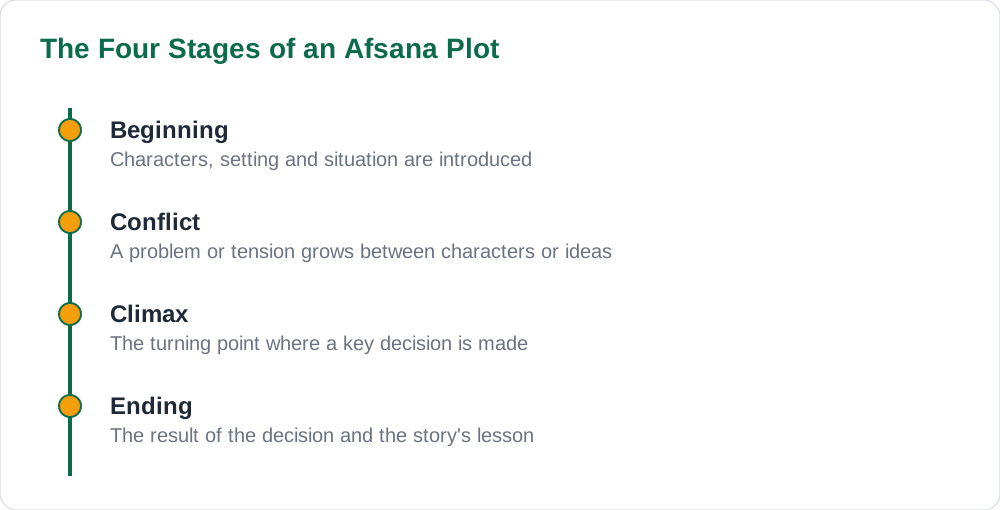
Every afsana plot can be divided into four useful parts for summary writing. The beginning introduces the characters and setting and hints at the situation. The middle develops a conflict or problem, which may be between characters, between a character and society, or within the character's own mind. The climax is the turning point where the tension reaches its highest point and a decision is made. The ending shows the result of that decision, which may be happy, sad, or thought-provoking. Learning to spot these four parts makes summarising much easier, because your khulasa simply follows them in order.
To practise, take any afsana from your textbook and mark the four parts with light pencil notes in the margin. Ask yourself at each part what changed: a new problem appeared, a secret was revealed, or a character made a choice. The climax is often the scene you remember most vividly, which is a helpful clue. In your exam summary, give the beginning and ending less space than the conflict and climax, because those middle parts carry the story's meaning. Avoid retelling minor incidents that do not change the plot; a khulasa is a summary, not a second copy of the story. Always check plot details against your own textbook, since memory alone can mix up scenes from different stories.
Finding the Moral Without Forcing One
The moral, or sabaq, of an afsana is the lesson the story teaches through its events, not a slogan pasted onto the ending. To find it honestly, ask what the main character learns, or what the ending rewards and punishes. If kindness is rewarded and cruelty fails, the story is teaching the value of kindness. If a character suffers because of pride, the story warns against pride. State the moral in one clear sentence at the end of your khulasa, and support it with one event from the story as evidence. This evidence link matters: a moral without evidence sounds like a guess, while a moral tied to the climax sounds like understanding.
Be careful not to force a moral the story does not support, and do not present your own opinion as the author's message. Some stories end ambiguously or criticise a social habit rather than teaching a simple virtue, and in those cases your moral should reflect that nuance. For example, a story might show how a social custom harms ordinary people, and its lesson is to question that custom rather than to praise a single virtue. If your teacher has explained the story's theme in class, follow that explanation, because class discussion often clarifies what the textbook intends. When in doubt, phrase the moral carefully, such as saying the story suggests or highlights a lesson, rather than claiming absolute certainty.
Writing the Khulasa in the Exam
A strong exam khulasa follows a simple shape: one opening sentence naming the story's subject and main character, then the plot in order through conflict and climax, and finally the ending and moral. Keep it to roughly one page, using your own words throughout, and do not copy sentences from the textbook. Write in paragraphs rather than one long block, with a new paragraph for each major stage of the plot. Use the characters' names correctly, since wrong names suggest you are summarising a different story. End with the moral in a separate short paragraph so the examiner can find it easily and award its marks.
Time management matters, so practise writing a khulasa in twenty to twenty-five minutes at home. Read the question first to see whether it asks for a full khulasa, a character sketch, or only the moral, and answer exactly what was asked. After writing, check that your summary covers the beginning, conflict, climax, ending and moral, and that every event you mentioned actually happens in the story. Delete any incident you added from imagination, because invented details damage credibility even when the rest is correct. Regular practice with different stories from your textbook builds the speed and accuracy that one night of cramming cannot provide. More exam tips appear on the Blog and book guidance on Books.
AI Help: Muse AI
Muse AI is Meta's personal AI assistant, and it can help with afsana khulasa by helping you outline a story's plot stages or by checking whether your one-sentence moral matches the events you described. You can ask it to suggest a clear structure for a summary paragraph you write yourself. Join Muse with invite code LTGSWD — in the Muse app, go to Settings > Redeem token and enter the code. Disclosure: LTGSWD is the author's Muse invite code. Muse AI does not give official STBB answers — always verify against your STBB book and your teacher. Remember to verify against your Sindh Textbook Board book before writing any khulasa in your exam.
5 key points you must know
- An afsana focuses on one incident, few characters, and a single theme.
- Study characters through actions, speech, and what others say about them.
- Structure summaries as beginning, conflict, climax, ending, then moral.
- State the moral in one sentence supported by an event from the story.
- Write khulase in your own words in about a page, practised under time limits.
Frequently asked questions
How long should an afsana khulasa be in the exam?
Roughly one page is a good target for a full khulasa: an opening sentence, the plot in order, and a short final paragraph for the moral. Shorter summaries risk missing the conflict or climax, while much longer ones usually retell minor incidents and waste time. If the question asks only for the moral or a character sketch, write a shorter, focused answer instead of a full summary. Always follow your teacher's guidance on the marks allocated, since higher-mark questions deserve fuller answers.
Should I use the author's exact words in a khulasa?
No, except for a very short phrase where it helps. A khulasa must be in your own words, because copying the textbook shows memory, not understanding, and it consumes time. Examiners reward summaries that capture the plot and theme accurately in the student's own language. The only names you must reproduce exactly are the characters' names and any important place names from the story. Practise retelling stories aloud in your own words before writing them down.
What if I forget part of the story in the exam?
Write what you remember accurately and keep the summary coherent, rather than inventing scenes to fill gaps. Cover the beginning, the main conflict, and the ending if you know them, and state the moral if you are confident about it. An honest, slightly shorter summary earns more than a longer one containing invented events, because invented details signal that you did not study the story. After the exam, re-read the story fully so the gap does not remain for the board paper.
How is a character sketch different from a khulasa?
A khulasa summarises the whole story's plot, while a character sketch focuses on one character's personality, role, and change. A character sketch still mentions key events, but only those that reveal the character's traits or development. It usually opens with the character's introduction, then discusses qualities with evidence from actions and speech, and ends with the character's importance to the story. Read the question carefully: answering a character question with a plot summary, or vice versa, loses marks even when the content is correct.
Can the same afsana have more than one moral?
Sometimes a story teaches more than one lesson, and different readers may emphasise different ones, but your exam answer should state the main moral your teacher and textbook highlight. If a story genuinely supports two lessons, mention the main one clearly and add the second briefly with evidence, rather than listing many possible morals. Avoid forcing a moral the events do not support, and do not present personal opinions as the author's message. When uncertain, follow your class discussion, which usually settles the intended theme.
Solved notes — preview free
These guides work best with the solved exercises. Preview the solved notes free on this website — 119 solved notes for Classes 6–10 in Sindhi, Urdu, English and Arabic medium. Or browse the full solved notes catalogue for your class and medium. New solved notes are added regularly — check the catalogue for coming-soon books.