Class 9 Chemistry: Valency and Chemical Formulae
The class 9 chemistry valency formulae topic is the key to writing correct chemical formulas instead of guessing them. Valency is the combining capacity of an element, and the crossover method lets you combine two valencies into a balanced formula quickly. This guide explains valency in simple words, shows the crossover steps with worked examples, covers polyatomic ions such as sulphate and ammonium, and warns you about the mistakes that make a correct idea into a wrong formula.
What Valency Means in Simple Words
Valency is the number of bonds an atom can form, or the combining capacity it shows when it joins with other atoms. Hydrogen has a valency of 1, oxygen has a valency of 2, sodium has a valency of 1, calcium has a valency of 2, and aluminium has a valency of 3. These numbers come from how many electrons an atom needs to gain, lose, or share to reach a stable arrangement. You do not need to derive every valency from electron shells at this stage; learning the common valencies by heart, with understanding, is enough for Class 9 formula writing.
Valency is not the same as charge, though they are related. A sodium ion has a charge of plus 1 because it loses one electron, and its valency is 1. A calcium ion has a charge of plus 2 and a valency of 2. For negative ions, chloride has a charge of minus 1 and a valency of 1, while oxide has a charge of minus 2 and a valency of 2. When writing formulas, you use the size of the valency, not its sign, because the crossover method balances positive and negative combining capacities against each other. Keep a small valency table in your notebook for revision. See the solved notes for more Class 9 help.
The Crossover Method Step by Step
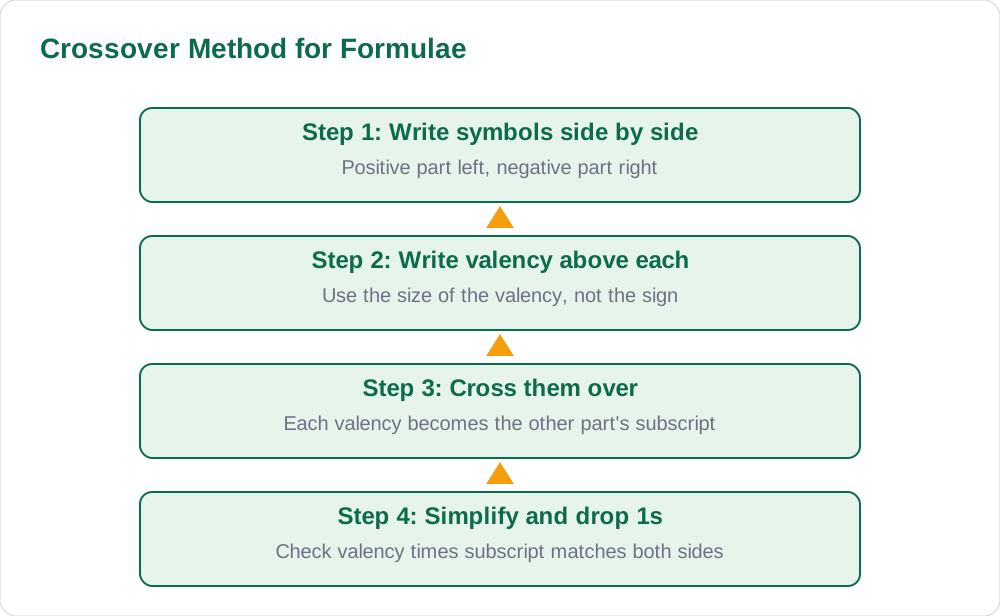
Write the symbols of the two parts side by side, with the positive part, usually the metal or hydrogen or ammonium, on the left and the negative part on the right. Write each valency above its symbol. Then cross them over: the valency of the left part becomes the subscript of the right part, and the valency of the right part becomes the subscript of the left part. Finally, simplify the subscripts if both can be divided by the same number, and leave out any subscript of 1, because it is understood. This method works because it balances the total combining capacity on both sides.
For example, calcium has valency 2 and chlorine has valency 1, so crossing over gives Ca1Cl2, which is written as CaCl2. Aluminium has valency 3 and oxygen has valency 2, so crossing over gives Al2O3, which cannot be simplified further. Sodium has valency 1 and sulphate has valency 2, so crossing over gives Na2SO4, with the polyatomic ion kept together. Always check your finished formula by multiplying valency by subscript on each side: the totals should match, which confirms the formula is balanced. The books page lists supporting textbooks.
Worked Examples: Simple Compounds
Example 1: Sodium chloride. Sodium valency 1 and chlorine valency 1 cross over to give Na1Cl1, written as NaCl. Example 2: Magnesium oxide. Magnesium valency 2 and oxygen valency 2 cross over to give Mg2O2, which simplifies by dividing both subscripts by 2 to give MgO. Forgetting to simplify is a common error, because Mg2O2 is not the accepted formula even though the ratio is right. Example 3: Aluminium chloride. Aluminium valency 3 and chlorine valency 1 cross over to give Al1Cl3, written as AlCl3, meaning one aluminium atom combines with three chlorine atoms.
Example 4: Carbon dioxide. Carbon valency 4 and oxygen valency 2 cross over to give C2O4, which simplifies by dividing by 2 to give CO2. This simplification step is essential, and many students lose marks by stopping at C2O4. Example 5: Calcium oxide. Calcium valency 2 and oxygen valency 2 cross over to give Ca2O2, simplifying to CaO. Notice the pattern: whenever both valencies are equal, the formula simplifies to a one-to-one combination. Practise these five until the crossover feels like a single movement rather than four separate thoughts.
- NaCl: valencies 1 and 1 give a one-to-one formula.
- MgO: Mg2O2 simplifies to MgO by dividing by 2.
- AlCl3: aluminium valency 3 crosses to three chlorines.
- CO2: C2O4 simplifies to CO2 by dividing by 2.
Polyatomic Ions and Brackets
A polyatomic ion is a group of atoms that carries a charge and behaves as one unit in reactions, such as sulphate SO4 with valency 2, nitrate NO3 with valency 1, carbonate CO3 with valency 2, hydroxide OH with valency 1, and ammonium NH4 with valency 1. When a polyatomic ion needs a subscript greater than 1, you must put brackets around the whole ion before writing the subscript, because the subscript applies to the entire group. For example, calcium hydroxide is Ca(OH)2, meaning one calcium ion with two hydroxide groups, not CaOH2, which would be a different and wrong formula.
Worked examples help here. Aluminium sulphate: aluminium valency 3 and sulphate valency 2 cross over to give Al2(SO4)3, with brackets because sulphate needs the subscript 3. Ammonium chloride: ammonium valency 1 and chlorine valency 1 give NH4Cl, with no brackets needed because the subscript is 1. Sodium carbonate: sodium valency 1 and carbonate valency 2 give Na2CO3, again with no brackets because carbonate takes subscript 1. Always ask: does this ion need a subscript above 1? If yes, bracket it first, then write the subscript outside the bracket.
- Ca(OH)2: brackets show two whole hydroxide groups.
- Al2(SO4)3: brackets show three whole sulphate groups.
- NH4Cl and Na2CO3 need no brackets because the subscript is 1.
Common Mistakes and Exam Tips
The most frequent mistake is writing the valency itself as the subscript of its own element, instead of crossing it over. Another is forgetting to simplify, leaving answers such as Mg2O2 or C2O4 instead of MgO and CO2. A third is dropping brackets around polyatomic ions, turning Ca(OH)2 into CaOH2, which changes the meaning completely. Students also mix up the order of symbols, putting the negative part first, which examiners may mark wrong even if the ratio is right, so keep the positive part on the left as the convention requires.
For revision, make a table with two columns: element or ion on the left and valency on the right, and test yourself by covering one column. Then practise ten formulas a day, mixing simple compounds, simplified compounds, and polyatomic ions, and always finish with the valency-times-subscript check. In exams, write the valencies above the symbols in rough work, cross them over visibly, and then write the final formula cleanly. That visible method earns marks for working and makes your own checking much easier. More guides are on the blog.
AI Help: Muse AI
Muse AI is Meta's personal AI assistant, and it can help with this topic by giving you two valencies to combine or by checking your crossover working step by step. Ask it for five formula-writing practice questions, then apply the crossover method yourself before comparing.
Join Muse with invite code LTGSWD — in the Muse app, go to Settings > Redeem token and enter the code. Disclosure: LTGSWD is the author's Muse invite code. Muse AI does not give official STBB answers — always verify against your STBB book and your teacher. Always verify against your Sindh Textbook Board book and your teacher before using anything in classwork.
5 key points you must know
- Valency is combining capacity, not charge itself.
- Crossover: each valency becomes the other part's subscript.
- Simplify subscripts when both share a common divisor.
- Drop subscript 1; it is understood.
- Bracket a polyatomic ion when its subscript is above 1.
Frequently asked questions
What is valency?
Valency is the combining capacity of an atom or ion, meaning how many bonds it can form or how many hydrogen atoms it can combine with. Hydrogen has valency 1, oxygen has valency 2, and aluminium has valency 3.
How does the crossover method work?
Write the two symbols with valencies above them, then cross over: the left valency becomes the right subscript and the right valency becomes the left subscript. Simplify if both subscripts share a divisor.
Why is calcium hydroxide written Ca(OH)2?
Hydroxide is a polyatomic ion, OH, and it needs a subscript of 2. Brackets show that the 2 applies to the whole hydroxide group, not just to hydrogen.
Why does Mg2O2 become MgO?
Magnesium and oxygen both have valency 2, so crossing gives Mg2O2, but both subscripts divide by 2. The simplest whole-number ratio is MgO, which is the accepted formula.
Solved notes — preview free
These guides work best with the solved exercises. Preview the solved notes free on this website — 119 solved notes for Classes 6–10 in Sindhi, Urdu, English and Arabic medium. Or browse the full solved notes catalogue for your class and medium. New solved notes are added regularly — check the catalogue for coming-soon books.