Class 9 Chemistry: Solutions and Concentration

The class 9 chemistry solutions concentration topic is about mixtures you meet every day: salt water, sugar syrup, and fizzy drinks are all solutions. A solution has a solute dissolved in a solvent, and concentration tells you how much solute is present. This guide explains the key words, the percent concentration formulas, and worked problems, so you can solve mass percent, volume percent, and simple dilution questions without confusion about which mass goes where.
Solute, Solvent and Solution
A solution is a homogeneous mixture, meaning it looks the same throughout and its composition is uniform in every part. The solute is the substance that dissolves, and the solvent is the substance that does the dissolving, usually present in the larger amount. In salt water, salt is the solute and water is the solvent. In a sugar syrup, sugar is the solute and water is the solvent. In air, which is a gaseous solution, oxygen and other gases are solutes dissolved in nitrogen, the main solvent gas. Naming solute and solvent correctly is the first mark in many questions, so always identify them before calculating.
Solutions can be solid, liquid, or gaseous, and the solvent decides the type. Brass is a solid solution of zinc in copper, fizzy drinks are liquid solutions with dissolved carbon dioxide gas, and air is a gaseous solution. A solution is different from a suspension, where particles settle out, and from a colloid, where tiny particles scatter light. In a true solution, the solute particles are so small that they do not settle, cannot be filtered out by ordinary filter paper, and do not scatter a beam of light in the same way. If a question asks why salt water is a solution, the answer is its uniformity and stability. See the solved notes for more guides.
What Concentration Really Means
Concentration describes how much solute is dissolved in a given amount of solution or solvent. A concentrated solution has a large amount of solute, while a dilute solution has a small amount. Concentration is not the same as amount: a large glass of weak sugar water may contain more total sugar than a small glass of strong sugar water, but the small glass is more concentrated because its sugar is packed into less water. This distinction matters in questions that ask you to compare two solutions, because you must compare ratios, not just total amounts.
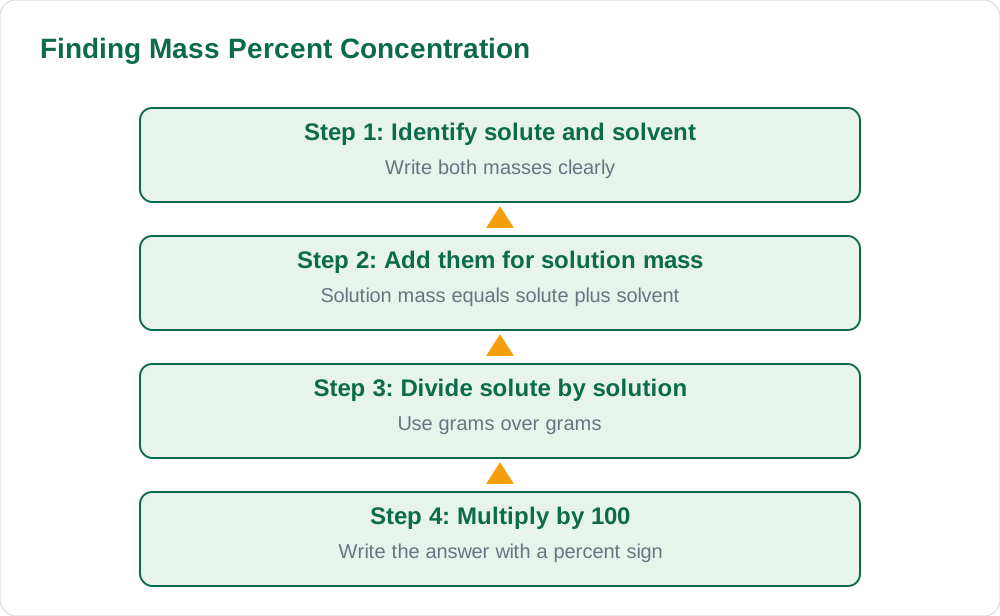
At Class 9 level, percent concentration is the most common measure. Mass percent means grams of solute per 100 grams of solution, and volume percent means cubic centimetres of solute per 100 cubic centimetres of solution. The word solution in the denominator is crucial: mass percent divides by the mass of the whole solution, solute plus solvent, not by the mass of solvent alone. Students who divide by solvent mass get a higher, wrong percentage, especially when the solute mass is large. Always add solute and solvent masses first to find the solution mass. Check the books page for textbooks.
Worked Example 1: Mass Percent
Question: What is the mass percent of salt in a solution made by dissolving 10 grams of salt in 90 grams of water? First find the solution mass: 10 plus 90 equals 100 grams. Then mass percent equals solute mass divided by solution mass multiplied by 100, which is 10 divided by 100 multiplied by 100, giving 10 percent. Question: What is the mass percent when 20 grams of sugar dissolve in 180 grams of water? Solution mass is 20 plus 180, which is 200 grams. Mass percent is 20 divided by 200 multiplied by 100, giving 10 percent again, even though the amounts are larger, because the ratio is the same.
A harder version asks for the solute mass from a percent. Question: How much salt is needed to make 250 grams of a 20 percent salt solution? Let the salt mass be the unknown: 20 equals salt mass divided by 250 multiplied by 100, so salt mass equals 20 multiplied by 250 divided by 100, which is 50 grams. The water needed is then 250 minus 50, which is 200 grams. This reverse question appears often, so practise both directions: percent from masses, and mass from percent and total. Always check that your solute mass is smaller than the solution mass, or something has gone wrong.
- 10 g salt in 90 g water: solution 100 g, concentration 10 percent.
- 20 g sugar in 180 g water: solution 200 g, concentration 10 percent.
- 250 g of 20 percent solution needs 50 g salt and 200 g water.
Worked Example 2: Volume Percent and Dilution
Volume percent works the same way with volumes instead of masses. Question: What is the volume percent of alcohol in a solution with 25 cubic centimetres of alcohol in 75 cubic centimetres of water? Solution volume is 25 plus 75, which is 100 cubic centimetres, so volume percent is 25 divided by 100 multiplied by 100, giving 25 percent. Remember that volumes are not always perfectly additive in real mixtures, but Class 9 questions treat them as additive unless told otherwise, so add them in the same way as masses.
Dilution means adding more solvent to lower the concentration without changing the amount of solute. If you have 100 grams of a 20 percent salt solution, it contains 20 grams of salt. Add 100 grams of water, and the solution mass becomes 200 grams, but the salt stays at 20 grams, so the new percent is 20 divided by 200 multiplied by 100, giving 10 percent. Dilution halves the concentration when you double the total mass, and this pattern is a useful sense check. Evaporation does the opposite: removing solvent raises concentration while solute mass stays the same.
- 25 cm3 alcohol in 75 cm3 water: 25 percent by volume.
- Dilution adds solvent, so solute mass stays the same.
- Doubling solution mass by adding solvent halves the percent.
Common Mistakes and Exam Tips
The most common mistake is dividing by solvent mass instead of solution mass, which gives a percentage that is too high. Another is forgetting to multiply by 100, leaving a decimal such as 0.10 instead of 10 percent. Students also mix mass and volume, dividing grams by cubic centimetres, which gives a meaningless number unless the question explicitly asks for that ratio. Always check units first: grams with grams for mass percent, and cubic centimetres with cubic centimetres for volume percent. If the units do not match, convert or stop and re-read the question.
In exams, write solute, solvent, solution mass or volume, formula, substitution, and answer with the percent sign, each on a clear line. If the question gives percent and total and asks for solute mass, rearrange the formula before substituting numbers, so you do not get lost in arithmetic. Practise one mass percent, one volume percent, one reverse, and one dilution question each day for a week, and concentration problems will become routine. End by sorting five household mixtures into solute and solvent pairs from memory, since naming the parts correctly is half the skill. More guides are on the blog.
AI Help: Muse AI
Muse AI is Meta's personal AI assistant, and it can help with this topic by giving you a new solution problem or by checking whether you divided by solution mass or solvent mass. Ask it for a dilution example, then work out the new percent yourself.
Join Muse with invite code LTGSWD — in the Muse app, go to Settings > Redeem token and enter the code. Disclosure: LTGSWD is the author's Muse invite code. Muse AI does not give official STBB answers — always verify against your STBB book and your teacher. Always verify against your Sindh Textbook Board book and your teacher before using anything in classwork.
5 key points you must know
- Solute dissolves; solvent does the dissolving; solution is uniform.
- Mass percent divides by whole solution mass, not solvent mass.
- Volume percent uses volumes in the same way as mass percent.
- Dilution adds solvent and lowers percent; solute mass stays same.
- Always write the percent sign and check units match.
Frequently asked questions
What is the solute in salt water?
Salt is the solute because it dissolves, and water is the solvent because it does the dissolving. The salt water itself is the solution.
How do I find mass percent?
Add solute and solvent masses to get solution mass, then divide solute mass by solution mass and multiply by 100. The answer is a percentage.
What happens to concentration on dilution?
It falls, because you add solvent while the solute amount stays the same. If you double the total solution mass by adding solvent, the percent halves.
Why is salt water a true solution?
Because it is uniform throughout, the salt does not settle out, and it cannot be separated by ordinary filtration. Its composition is the same in every part.
Solved notes — preview free
These guides work best with the solved exercises. Preview the solved notes free on this website — 119 solved notes for Classes 6–10 in Sindhi, Urdu, English and Arabic medium. Or browse the full solved notes catalogue for your class and medium. New solved notes are added regularly — check the catalogue for coming-soon books.