Class 9 Chemistry: Types of Chemical Reactions
The class 9 chemistry chemical reactions types topic sorts every reaction you meet into four clear families. Combination joins substances together, decomposition breaks one substance apart, displacement swaps one element for another, and double displacement swaps partners between two compounds. This guide explains each type with balanced examples, shows how to recognise it from the equation, and gives the quick tests examiners love, so classification questions become fast and certain.
How to Recognise a Reaction Type
The fastest way to classify a reaction is to count reactants and products and look at what changes. Combination usually has two or more reactants joining into one product. Decomposition has one reactant breaking into two or more products. Displacement has an element plus a compound giving a new element plus a new compound. Double displacement has two compounds swapping partners to give two new compounds, often with a precipitate or a gas. Learning these patterns matters more than memorising long example lists, because examiners often invent a new equation and ask you to classify it from its shape.
Always write the equation first, even for a word question, because the pattern is invisible in words alone. Then ask: how many substances are on each side, and did an element replace another element, or did two compounds swap parts? If a reaction looks like two types at once, check the details: burning is a combination with oxygen, but it is classified as combustion, and a reaction that forms a precipitate from two solutions is double displacement even if it also looks like a simple swap. State the type, then the evidence from the equation, and your answer will be convincing. See the solved notes for more guides.
Combination Reactions: Joining Together
A combination reaction joins two or more substances into a single product. The general pattern is A plus B gives AB. Examples include hydrogen plus oxygen giving water, 2H2 plus O2 gives 2H2O, calcium oxide plus water giving calcium hydroxide, CaO plus H2O gives Ca(OH)2, and iron plus sulphur giving iron sulphide, Fe plus S gives FeS. Combination reactions often release heat, which is why burning, a combination with oxygen, feels hot, though not every combination is a combustion reaction.
Combination is easy to spot because the product count is smaller than the reactant count, usually just one product. In exams, a question may give a word equation such as magnesium burns in oxygen to form magnesium oxide, and ask for the type and the balanced equation: 2Mg plus O2 gives 2MgO. Always balance the equation after classifying, because the type mark and the equation mark are often awarded separately. A common mistake is calling every reaction with oxygen a displacement reaction; if oxygen joins rather than replaces, it is combination. Check the books page for supporting books.
Decomposition Reactions: Breaking Apart
A decomposition reaction breaks one substance into two or more simpler products, usually with heat, light, or electricity. The general pattern is AB gives A plus B. Examples include calcium carbonate breaking down on heating to calcium oxide plus carbon dioxide, CaCO3 gives CaO plus CO2, and hydrogen peroxide breaking down to water plus oxygen. Electrolysis of water, using electricity to split water into hydrogen and oxygen, 2H2O gives 2H2 plus O2, is also decomposition, driven by electrical energy rather than heat.
Decomposition is the mirror image of combination, so the two are easy to confuse if you only look at the substances and not the direction. Ask whether one substance splits or several join: one reactant splitting is decomposition, several reactants joining is combination. Thermal decomposition is a useful phrase for breakdown by heat, and it appears often in questions about limestone and metal carbonates. If a question mentions heating a single compound and getting a gas, think decomposition first, then check the products to confirm.
- CaCO3 heated gives CaO + CO2: thermal decomposition.
- 2H2O by electricity gives 2H2 + O2: electrical decomposition.
- One reactant splitting means decomposition, not combination.
Displacement and Double Displacement
In a displacement reaction, a more reactive element pushes a less reactive element out of its compound. The pattern is A plus BC gives AC plus B. A classic example is zinc plus copper sulphate giving zinc sulphate plus copper, Zn plus CuSO4 gives ZnSO4 plus Cu, because zinc is more reactive than copper. The colour change, from blue copper sulphate solution to colourless zinc sulphate with reddish-brown copper deposit, is a visible clue. If the element is less reactive than the one in the compound, no reaction happens, which is itself a useful test of the reactivity series.
In double displacement, two compounds swap partners: AB plus CD gives AD plus CB. A classic example is barium chloride plus sodium sulphate giving barium sulphate precipitate plus sodium chloride, BaCl2 plus Na2SO4 gives BaSO4 plus 2NaCl. The white precipitate of barium sulphate is the clue that a reaction happened. Another example is silver nitrate plus sodium chloride giving silver chloride precipitate plus sodium nitrate. Double displacement often involves a precipitate, a gas, or water forming, which drives the swap to completion. Learn one example of each type with its visible clue, and classification becomes much easier.
- Zn + CuSO4 gives ZnSO4 + Cu: zinc displaces copper.
- BaCl2 + Na2SO4 gives BaSO4 precipitate + 2NaCl.
- No reaction means the element is less reactive than the displaced one.
Common Mistakes and Exam Tips
The most common mistake is confusing displacement with double displacement, because both involve swapping. Remember the count: displacement has one element and one compound as reactants, while double displacement has two compounds. Another mistake is calling combustion a displacement reaction; burning is combination with oxygen, not replacement. Students also forget to balance equations after classifying, losing the equation mark even when the type is right. Always give the type, the balanced equation, and one observation, such as a precipitate, gas, or colour change, where the question allows it.
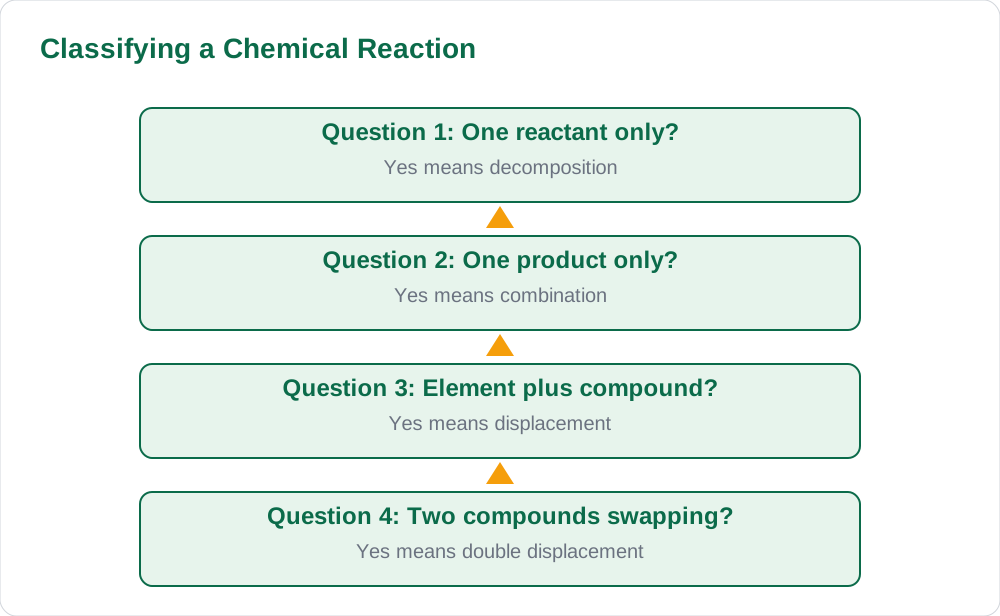
For revision, make a four-row table with type, pattern, one example equation, and one clue, and test yourself by covering columns. Practise classifying ten equations a day, mixing all four types and including one no-reaction case, until the pattern check is instant. In exams, if you are unsure, write the equation, count reactants and products, and follow the classification questions in order: one reactant, one product, element plus compound, or two compounds. That methodical check beats guessing and shows working the examiner can follow. More guides are on the blog.
AI Help: Muse AI
Muse AI is Meta's personal AI assistant, and it can help with this topic by giving you an equation to classify or by explaining why zinc displaces copper. Ask it for five mixed equations, then classify each one yourself before checking.
Join Muse with invite code LTGSWD — in the Muse app, go to Settings > Redeem token and enter the code. Disclosure: LTGSWD is the author's Muse invite code. Muse AI does not give official STBB answers — always verify against your STBB book and your teacher. Always verify against your Sindh Textbook Board book and your teacher before using anything in classwork.
5 key points you must know
- Combination joins reactants into one product: A + B gives AB.
- Decomposition splits one reactant: AB gives A + B.
- Displacement: a reactive element replaces a less reactive one.
- Double displacement: two compounds swap partners.
- Use reactant and product counts plus clues to classify.
Frequently asked questions
How do I tell displacement from double displacement?
Displacement starts with an element plus a compound, while double displacement starts with two compounds. Count the reactant types first, then look for swapping.
Is burning a combination reaction?
Yes, burning is combination with oxygen. A fuel joins with oxygen to form products such as carbon dioxide and water, so substances join rather than replace each other.
What is a precipitate in double displacement?
A precipitate is an insoluble solid that forms in a solution during the reaction. Barium sulphate in the barium chloride and sodium sulphate reaction is a white precipitate.
Why does zinc displace copper but not the reverse?
Zinc is more reactive than copper, so it can push copper out of copper sulphate. Copper is less reactive than zinc, so it cannot push zinc out of zinc sulphate.
Solved notes — preview free
These guides work best with the solved exercises. Preview the solved notes free on this website — 119 solved notes for Classes 6–10 in Sindhi, Urdu, English and Arabic medium. Or browse the full solved notes catalogue for your class and medium. New solved notes are added regularly — check the catalogue for coming-soon books.