Class 9 Chemistry: Periodic Table Trends

The class 9 chemistry periodic table trends topic turns a large table of elements into a map you can read. Elements are arranged by atomic number, with groups as vertical columns and periods as horizontal rows, and properties change in predictable ways across a row and down a column. This guide explains groups, periods, atomic size, metallic character, and reactivity trends, with the reasons behind each pattern, so you can predict properties instead of memorising every element separately.
Groups and Periods: Reading the Map
The modern periodic table arranges elements in order of increasing atomic number, which is the number of protons. Vertical columns are called groups, and elements in the same group have the same number of electrons in their outer shell, which is why they behave similarly. For example, Group 1 contains lithium, sodium, and potassium, all with one outer electron and similar reactive metal behaviour. Horizontal rows are called periods, and the period number tells you how many electron shells an atom has. Sodium is in Period 3 because its electrons occupy three shells.
Two special features help you read the table quickly. First, metals are mostly on the left and centre, non-metals are on the right, and metalloids sit along the dividing staircase between them. Second, Group 18 contains the noble gases, which have full outer shells and are very unreactive, while Group 17 contains the halogens, which are reactive non-metals. When a question asks you to place an element, use its atomic number to find its electrons, shells, and outer electrons, then match those to period and group. That method is far more reliable than guessing from the element's name. See the solved notes for more guides.
Atomic Size Across and Down the Table
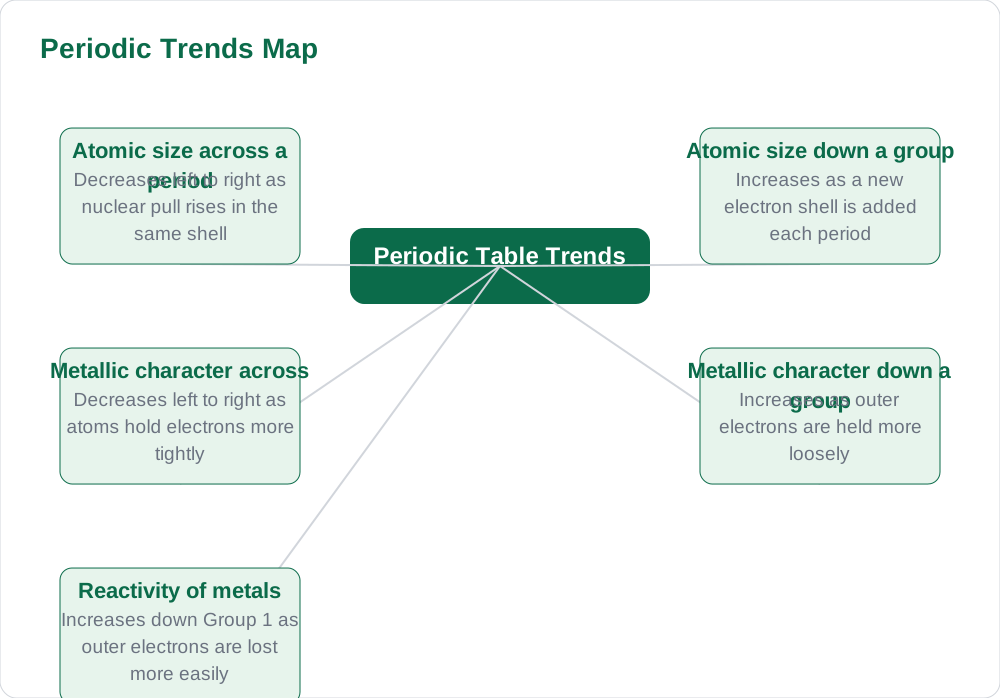
Atomic size, or atomic radius, generally decreases across a period from left to right and increases down a group. Across a period, protons are added to the nucleus while electrons go into the same shell, so the stronger nuclear pull draws the shell closer and the atom shrinks. For example, in Period 3, sodium is larger than magnesium, which is larger than aluminium, and the size keeps falling toward chlorine. Down a group, each new period adds a whole electron shell, so the atom grows even though nuclear charge also rises, because the extra shell outweighs the extra pull.
This trend explains many later patterns, because a smaller atom holds its outer electrons more tightly, while a larger atom holds them more loosely. That is why elements on the left, with larger atoms and fewer outer electrons, tend to lose electrons easily, while elements on the right hold theirs tightly or gain electrons instead. A common exam mistake is saying size increases across a period because more electrons are added; the key point is that they enter the same shell while nuclear charge rises, so attraction wins. Always state the trend, then the reason, then an example, for full marks. Check the books page for supporting books.
Metallic Character and Reactivity
Metallic character describes how easily an element behaves like a metal, especially by losing electrons to form positive ions. It decreases across a period from left to right, because atoms on the right hold their electrons more tightly and are less willing to lose them. It increases down a group, because larger atoms hold their outer electrons more loosely, so losing them becomes easier. That is why potassium is more reactive than sodium, and sodium is more reactive than lithium, even though all three are in Group 1 and all lose one outer electron.
Non-metallic character is the mirror image: it increases across a period and decreases down a group. Halogens on the right are strongly non-metallic because they tend to gain an electron to complete their outer shell. Fluorine is more reactive than chlorine, and chlorine is more reactive than bromine, because the smaller atom attracts the incoming electron more strongly. When comparing reactivity, always say whether you are talking about metals losing electrons or non-metals gaining electrons, because the trends run in opposite directions for the two cases, and mixing them up is a common error.
- Group 1 reactivity increases down the group: Li < Na < K.
- Halogen reactivity decreases down the group: F > Cl > Br.
- Metallic character falls across a period and rises down a group.
Trends in One Row: Period 3 Example
Period 3 is the best example for exam questions because it shows the full change from metal to non-metal in one row. Sodium and magnesium are metals that lose electrons easily, aluminium is a metal with a protective oxide layer, silicon is a metalloid, phosphorus and sulphur are non-metals, chlorine is a reactive non-metal gas, and argon is an unreactive noble gas. As you move left to right, atomic size falls, metallic character falls, and the tendency to gain rather than lose electrons rises. The oxides also change: metal oxides tend to be basic, while non-metal oxides tend to be acidic.
Use Period 3 to answer comparison questions without memorising every element. If asked whether magnesium or sulphur is more metallic, place them in the row: magnesium is on the left, sulphur is on the right, so magnesium is more metallic. If asked which is larger, sodium or chlorine, use the size trend: sodium is on the left, so it is larger. Always link the position to shells and nuclear pull in your explanation, rather than just naming the trend, because examiners award marks for the reason. Practise by covering the table and predicting three properties for an element from its position alone.
- Period 3 runs from sodium metal to argon noble gas.
- Oxides change from basic on the left to acidic on the right.
- Position plus shells and nuclear pull explains most trends.
Common Mistakes and Exam Tips
The most common mistake is stating a trend without its direction, such as saying atomic size changes across a period without saying it decreases. Another is confusing across with down, claiming size increases across a period when it actually decreases. Students also forget the noble gases when describing reactivity, saying reactivity always rises to the right, when in fact Group 18 elements are almost unreactive because their shells are full. Always check the group before applying a reactivity trend, and remember that metal and non-metal reactivity trends run in opposite directions down a group.
In exams, draw a tiny table sketch in rough work with arrows for across and down, then read your answer off the arrows. State the trend, give the reason in terms of shells or nuclear pull, and give one example pair, such as sodium versus chlorine for size or lithium versus potassium for metal reactivity. That three-part structure, trend plus reason plus example, earns full marks on most trend questions. Revise by testing yourself on five element pairs a day until the arrows feel automatic. More revision is on the blog.
AI Help: Muse AI
Muse AI is Meta's personal AI assistant, and it can help with this topic by quizzing you on element pairs or by explaining why atomic size falls across a period. Ask it to compare sodium and chlorine, then explain the reason yourself before checking.
Join Muse with invite code LTGSWD — in the Muse app, go to Settings > Redeem token and enter the code. Disclosure: LTGSWD is the author's Muse invite code. Muse AI does not give official STBB answers — always verify against your STBB book and your teacher. Always verify against your Sindh Textbook Board book and your teacher before using anything in classwork.
5 key points you must know
- Groups are columns with the same outer electrons; periods are rows with the same shells.
- Atomic size decreases across a period and increases down a group.
- Metallic character decreases across and increases down a group.
- Group 1 metal reactivity increases down; halogen reactivity decreases down.
- Always give trend, reason, and example for full marks.
Frequently asked questions
Why does atomic size decrease across a period?
Electrons enter the same shell while protons increase, so stronger nuclear pull draws the shell closer. The atom therefore shrinks from left to right.
Why does atomic size increase down a group?
Each new period adds a whole electron shell, making the atom larger. The extra shell outweighs the extra nuclear charge.
Why is potassium more reactive than lithium?
Both lose one outer electron, but potassium's outer electron is farther from the nucleus and held more loosely, so it is lost more easily.
Why are noble gases unreactive?
They have full outer shells, so they neither need to gain nor lose electrons to become stable. That is why Group 18 elements rarely react.
Solved notes — preview free
These guides work best with the solved exercises. Preview the solved notes free on this website — 119 solved notes for Classes 6–10 in Sindhi, Urdu, English and Arabic medium. Or browse the full solved notes catalogue for your class and medium. New solved notes are added regularly — check the catalogue for coming-soon books.