Class 9 Chemistry: Percentage Composition Numericals

The class 9 chemistry percentage composition topic asks a simple question: what fraction of a compound's mass comes from each element? If you know the formula and the atomic masses, you can find the percent of every element with one reliable method. This guide explains the formula, works through water, carbon dioxide, calcium carbonate, and ammonia, and shows the mistakes that turn an easy numerical into a lost mark. Keep your working visible and your units clear, and these questions become quick, safe marks.
The Percentage Composition Formula
Percentage composition means the mass of one element in a compound expressed as a percentage of the total mass of the compound. The formula is: percentage of an element equals the total mass of that element in one mole of the compound divided by the molar mass of the compound, multiplied by 100. The total mass of the element is its atomic mass multiplied by how many atoms of it appear in the formula, which is the subscript. For example, in water, H2O, hydrogen appears twice, so its total mass is 2 multiplied by 1, which is 2, while oxygen appears once at 16.
This method works because one mole of a compound always contains the same ratio of atoms, so the mass ratio is fixed no matter how large the sample is. Whether you have 18 grams or 180 grams of water, hydrogen still makes up the same percentage of the mass. Always calculate the molar mass first and write it down, because every percentage in the question will divide by that same total. If your percentages do not add up to 100, or very close to 100 after rounding, you have made an arithmetic error somewhere, and that check alone can save a question. Find more methods on the solved notes page.
Step-by-Step Method That Never Changes
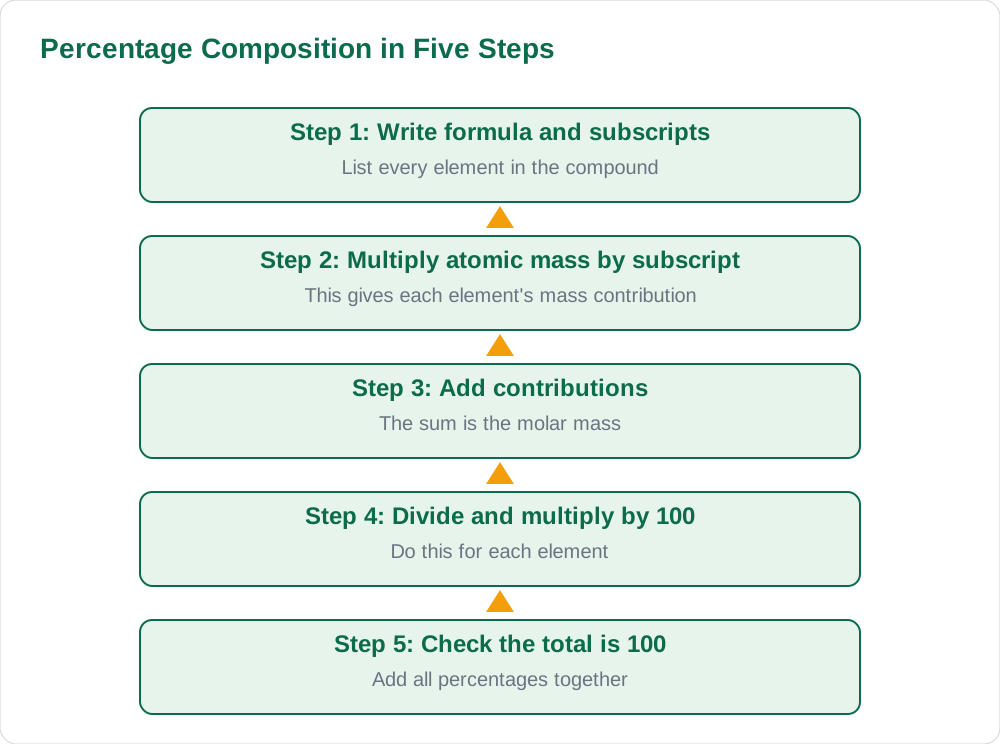
First, write the chemical formula and list each element with its subscript. Second, multiply each atomic mass by its subscript to get the mass contributed by that element. Third, add all the contributions to get the molar mass of the compound. Fourth, for each element, divide its contribution by the molar mass and multiply by 100. Fifth, add the percentages together to check that they total 100. This five-step order never changes, whether the compound has two elements or four, so you can use it under exam pressure without deciding on a new plan each time.
Rounding needs care: keep at least one decimal place during the working and round only at the end, because early rounding can push the total away from 100. If a question asks only for one element, you still need the molar mass, so do not skip that step. Also watch for brackets in formulas such as calcium hydroxide, Ca(OH)2, where the subscript 2 outside the bracket applies to both oxygen and hydrogen inside it. That gives two oxygen atoms and two hydrogen atoms, not one of each, and missing the bracket is one of the most common percentage errors. See the books page for the books behind these examples.
Worked Example 1: Water, H2O
Question: Find the percentage composition of water, H2O. Molar mass: hydrogen contributes 2 multiplied by 1, which is 2, and oxygen contributes 1 multiplied by 16, which is 16, giving a total of 18 grams per mole. Percentage of hydrogen equals 2 divided by 18 multiplied by 100, which is 11.1 percent. Percentage of oxygen equals 16 divided by 18 multiplied by 100, which is 88.9 percent. Add them: 11.1 plus 88.9 equals 100, so the answer checks out. Notice that oxygen dominates the mass even though there are more hydrogen atoms, because each oxygen atom is much heavier.
This example teaches an important lesson about counting: number of atoms and mass contribution are different things. Water has twice as many hydrogen atoms as oxygen atoms, yet hydrogen is only about 11 percent of the mass. Students who guess from atom counts alone get this badly wrong. Always let the masses decide, not the atom counts. A good habit is to write the contribution beside each element before dividing, so the examiner can follow your method and award method marks even if one division slips.
- H2O molar mass: 2 + 16 = 18 g/mol.
- Hydrogen: 2 divided by 18 times 100 = 11.1 percent.
- Oxygen: 16 divided by 18 times 100 = 88.9 percent.
Worked Example 2: Carbon Dioxide and Calcium Carbonate
Question: Find the percentage of carbon in carbon dioxide, CO2. Molar mass: carbon 12 plus two oxygen atoms at 16 each, which is 32, giving 44 grams per mole. Percentage of carbon equals 12 divided by 44 multiplied by 100, which is 27.3 percent. Percentage of oxygen equals 32 divided by 44 multiplied by 100, which is 72.7 percent, and the total is 100 percent. Question: Find the percentage of calcium in calcium carbonate, CaCO3. Molar mass: calcium 40 plus carbon 12 plus three oxygen atoms at 48, giving 100 grams per mole. Percentage of calcium equals 40 divided by 100 multiplied by 100, which is 40 percent.
Calcium carbonate is a favourite exam example because its molar mass is a round 100, which makes the percentages easy to check. Carbon is 12 percent and oxygen is 48 percent, and 40 plus 12 plus 48 equals 100, confirming the working. When you meet a compound with a round molar mass, use it as a confidence check, but do not expect every compound to be so neat. For ammonia, NH3, the molar mass is 14 plus 3, which is 17, so nitrogen is 14 divided by 17 times 100, which is 82.4 percent, and hydrogen is 3 divided by 17 times 100, which is 17.6 percent. Practise one two-element and one three-element compound each day.
- CO2: carbon 27.3 percent, oxygen 72.7 percent.
- CaCO3: calcium 40 percent, carbon 12 percent, oxygen 48 percent.
- NH3: nitrogen 82.4 percent, hydrogen 17.6 percent.
Common Mistakes and Exam Tips
The most common mistake is forgetting to multiply by the subscript, so H2O is treated as HO and CO2 is treated as CO, which changes every percentage. Another error is dividing by the atomic mass instead of the molar mass, which can give a percentage above 100 and should immediately warn you that something is wrong. A third error is forgetting to multiply by 100, leaving the answer as a decimal fraction such as 0.111 instead of 11.1 percent. Always end with the percent sign and a total check, because a missing percent sign can cost a mark even when the number is right.
In exams, show the molar mass working first, then each percentage on its own line, then the total check. If the question asks for only one element, still show the molar mass, then that one percentage, and you will earn method marks. Practise with compounds you already know, such as water, carbon dioxide, sodium chloride, and calcium carbonate, before trying longer formulas with brackets. Speed comes from the fixed five-step method, not from skipping steps, so keep every step visible until the method is automatic. More practice guides are on the blog.
AI Help: Muse AI
Muse AI is Meta's personal AI assistant, and it can help with this topic by checking your percentage working or by giving you a new compound to practise on. Ask it to show the molar mass step first, then work out each percentage yourself and compare answers.
Join Muse with invite code LTGSWD — in the Muse app, go to Settings > Redeem token and enter the code. Disclosure: LTGSWD is the author's Muse invite code. Muse AI does not give official STBB answers — always verify against your STBB book and your teacher. Always verify against your Sindh Textbook Board book and your teacher before using anything in classwork.
5 key points you must know
- Percentage equals element mass divided by molar mass times 100.
- Multiply atomic mass by the subscript for each element.
- Always find the molar mass before any percentage.
- Percentages for all elements must add to 100.
- Brackets multiply every atom inside them, as in Ca(OH)2.
Frequently asked questions
What is percentage composition?
It is the mass of each element in a compound shown as a percentage of the total mass. It tells you how much of the compound's mass comes from each element.
How do I find the percentage of hydrogen in water?
Water has a molar mass of 18, and hydrogen contributes 2, so divide 2 by 18 and multiply by 100 to get 11.1 percent.
Why must percentages add to 100?
Because the elements together make up the whole compound. If your percentages do not add to about 100, one contribution, the molar mass, or a division is wrong.
What if the formula has brackets?
Multiply the subscript outside the bracket by every atom inside it. In Ca(OH)2 there are two oxygen atoms and two hydrogen atoms, not one of each.
Solved notes — preview free
These guides work best with the solved exercises. Preview the solved notes free on this website — 119 solved notes for Classes 6–10 in Sindhi, Urdu, English and Arabic medium. Or browse the full solved notes catalogue for your class and medium. New solved notes are added regularly — check the catalogue for coming-soon books.