Class 9 Chemistry: Ionic and Covalent Bonding
The class 9 chemistry ionic covalent bonding topic explains how atoms join together to become stable. Ionic bonding transfers electrons from a metal to a non-metal, while covalent bonding shares electrons between non-metals. This guide explains both types with dot diagrams, compares their properties, and shows how to decide which type a compound uses, so you can answer bonding questions with diagrams and reasons, not just memorised labels.
Why Atoms Bond at All
Atoms bond because they seek a stable electron arrangement, usually a full outer shell like that of a noble gas. An atom with one outer electron can lose it to reach the shell below, an atom with seven outer electrons can gain one to complete its shell, and atoms with four outer electrons often share to reach stability. Bonding is therefore not about atoms wanting to stick together for no reason; it is about reaching a lower-energy, more stable arrangement. Once you see bonding as a route to stability, ionic and covalent bonding become two different routes to the same goal.
The route an atom takes depends on its position in the periodic table. Metals on the left lose electrons easily, non-metals on the right gain or share electrons, and the combination decides the bond type. A metal plus a non-metal usually gives ionic bonding by transfer, while two non-metals usually give covalent bonding by sharing. Hydrogen is a special case: it can share in covalent compounds such as water and methane, even though it appears on the metal side of some tables. Always check the elements involved before naming the bond type. See the solved notes for more guides.
Ionic Bonding: Electron Transfer
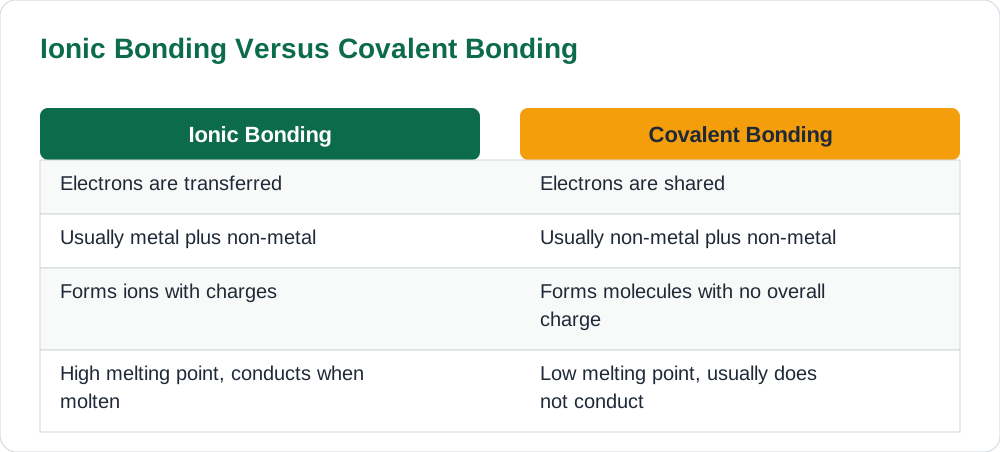
In ionic bonding, a metal atom transfers one or more electrons to a non-metal atom. The metal becomes a positive ion because it loses negative electrons, and the non-metal becomes a negative ion because it gains them. Opposite charges attract strongly, and that electrostatic attraction is the ionic bond. The compound formed is neutral overall, because the total positive charge equals the total negative charge. For example, sodium loses one electron to chlorine, forming Na+ and Cl-, which attract to give sodium chloride, NaCl.
A second example makes the ratio clear. Magnesium loses two electrons, but each chlorine atom can gain only one, so one magnesium atom transfers electrons to two chlorine atoms, giving MgCl2. The dot diagram shows magnesium with two outer dots giving one dot to each chlorine, leaving magnesium with a stable shell below and each chlorine with a full outer shell. Ionic compounds form giant structures of many ions, not single molecules, which explains their high melting points and their ability to conduct electricity when molten or dissolved, because the ions can then move freely. Check the books page for supporting books.
Covalent Bonding: Electron Sharing
In covalent bonding, two non-metal atoms share pairs of electrons so that both reach a full outer shell. A single covalent bond is one shared pair, a double bond is two shared pairs, and a triple bond is three shared pairs. In a hydrogen molecule, H2, each hydrogen atom shares its single electron, so both atoms experience two electrons and feel stable like helium. In water, H2O, oxygen shares one pair with each hydrogen atom, giving oxygen a full outer shell of eight electrons and each hydrogen a full shell of two.
Carbon dioxide, CO2, shows double bonds: carbon shares two pairs with each oxygen atom, so carbon has eight outer electrons and each oxygen also has eight. Methane, CH4, shows four single bonds: carbon shares one pair with each of four hydrogen atoms, giving carbon eight outer electrons and each hydrogen two. Dot-and-cross diagrams are the best way to show sharing: draw the outer electrons of one atom as dots and the other as crosses, then circle the shared pairs. Always count the electrons around each atom after sharing to prove that each has a full shell.
- H2: one shared pair gives each hydrogen two electrons.
- H2O: oxygen shares one pair with each hydrogen.
- CO2: carbon shares two pairs with each oxygen.
- CH4: carbon shares one pair with each of four hydrogens.
Dot Diagrams Done Correctly
A good dot diagram starts with the correct number of outer electrons for each atom, drawn around its symbol. For ionic bonding, show the transfer with an arrow, then draw the ions with their charges and full outer shells in square brackets where your teacher requires them. For covalent bonding, draw the shared pairs between the symbols, with dots for one atom and crosses for the other, and check that every atom ends with a full shell. A diagram that shows the right number of electrons but forgets charges in an ionic case, or forgets a shared pair in a covalent case, will lose marks even if the formula is correct.
Practise four diagrams until they are automatic: NaCl for ionic transfer, MgCl2 for two-to-one ionic transfer, H2O for covalent sharing with two single bonds, and CO2 for covalent sharing with double bonds. For each, write the electron count before and after bonding beside the diagram in rough work. That counting habit catches the most common slip, which is drawing an extra electron or missing one from an outer shell. In exams, label the diagram clearly as ionic or covalent and name the bond type in words as well, so the examiner does not have to guess your intention.
- Ionic diagrams must show transfer, ions, and charges.
- Covalent diagrams must show shared pairs with dots and crosses.
- Count outer electrons before and after bonding every time.
Properties and Exam Tips
Ionic compounds usually have high melting and boiling points because strong attractions between many ions need much energy to break. They conduct electricity when molten or dissolved because ions can move, but not as solids because ions are fixed in place. They are often soluble in water and brittle when hit, because shifting layers bring like charges together and repel. Covalent compounds usually have low melting and boiling points because only weak forces between molecules need breaking, not the strong bonds inside molecules. They usually do not conduct electricity because they have no free ions or electrons.
For exam answers, always link property to structure: do not just say ionic compounds have high melting points, say the strong ionic attractions in the giant structure need much energy to overcome. Do not just say covalent compounds do not conduct, say they have no charged particles free to move. When asked to decide a bond type, name the elements, say metal plus non-metal or non-metal plus non-metal, and give the electron behaviour, transfer or sharing. That three-part answer is complete and safe. More guides are on the blog.
AI Help: Muse AI
Muse AI is Meta's personal AI assistant, and it can help with this topic by describing a dot diagram in words or by giving you a compound to classify as ionic or covalent. Ask it to check your electron count for water, then draw the diagram yourself.
Join Muse with invite code LTGSWD — in the Muse app, go to Settings > Redeem token and enter the code. Disclosure: LTGSWD is the author's Muse invite code. Muse AI does not give official STBB answers — always verify against your STBB book and your teacher. Always verify against your Sindh Textbook Board book and your teacher before using anything in classwork.
5 key points you must know
- Atoms bond to reach a full, stable outer shell.
- Ionic bonding transfers electrons; covalent bonding shares them.
- Metal plus non-metal usually gives ionic bonding.
- Non-metal plus non-metal usually gives covalent bonding.
- Properties follow structure: ions move and conduct; molecules do not.
Frequently asked questions
What is ionic bonding?
Ionic bonding is the strong attraction between positive and negative ions formed when a metal transfers electrons to a non-metal. Sodium chloride is a classic example.
What is covalent bonding?
Covalent bonding is the sharing of electron pairs between non-metal atoms so both reach a full outer shell. Water, methane, and carbon dioxide are covalent compounds.
Why does MgCl2 need two chlorine atoms?
Magnesium loses two electrons, but each chlorine can gain only one. Two chlorine atoms are therefore needed to accept both electrons and balance the charges.
Why do ionic compounds conduct when molten?
In the solid, ions are fixed in place and cannot move. When molten or dissolved, ions move freely and carry electric charge through the liquid.
Solved notes — preview free
These guides work best with the solved exercises. Preview the solved notes free on this website — 119 solved notes for Classes 6–10 in Sindhi, Urdu, English and Arabic medium. Or browse the full solved notes catalogue for your class and medium. New solved notes are added regularly — check the catalogue for coming-soon books.