Class 9 Chemistry: Gas Laws in Simple Words
The class 9 chemistry gas laws simple topic explains how gases change when you squeeze them, heat them, or let them expand. Boyle's law links pressure and volume, Charles's law links volume and temperature, and both laws come alive with balloon examples you can picture. This guide explains each law in plain words, shows the formula, works through simple numericals, and warns you about the temperature mistake that catches almost every student at least once.
Why Gases Behave Differently
Gases are different from solids and liquids because their particles are far apart and move freely, so a gas fills its container and can be compressed into a smaller volume. Pressure is the force of gas particles hitting the walls of the container, volume is the space the gas occupies, and temperature measures how fast the particles move on average. When you change one of these, at least one other usually changes too, and the gas laws describe exactly how. Keeping one quantity fixed while studying the other two is the trick that makes each law simple.
For all gas law numericals, you must keep the amount of gas fixed and use the same units on both sides of the equation. Pressure can be measured in atmospheres or other units, but both pressures in one question must use the same unit. Volume can be in litres or cubic centimetres, but again both volumes must match. Temperature is the special case: gas laws require Kelvin, not Celsius, because Kelvin starts at absolute zero, where particle motion is at its minimum. Forgetting to convert Celsius to Kelvin is the single most common gas law error. See the solved notes for more revision.
Boyle's Law: Squeeze It, Pressure Rises
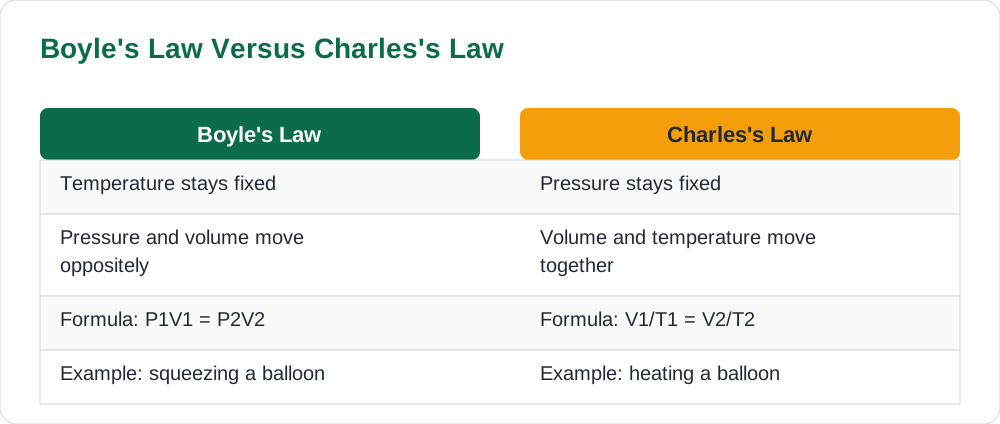
Boyle's law states that at fixed temperature, the pressure of a fixed amount of gas is inversely proportional to its volume. In simple words, if you halve the volume, the pressure doubles, and if you double the volume, the pressure halves. The formula is P1V1 equals P2V2, where P1 and V1 are the starting pressure and volume and P2 and V2 are the new pressure and volume. This happens because squeezing the gas into a smaller space makes particles hit the walls more often, which increases pressure without changing temperature.
A balloon example makes it clear. Imagine a balloon with a volume of 4 litres at a pressure of 1 atmosphere. If you squeeze it gently to 2 litres without letting air escape and without changing temperature, the new pressure becomes 2 atmospheres, because 1 times 4 divided by 2 equals 2. If you instead let it expand to 8 litres, the pressure falls to 0.5 atmosphere. A real-world use is a syringe: pushing the plunger reduces volume and increases pressure, which is why medicine can be forced out. Remember the inverse pattern: one goes up, the other goes down. Check the books page for supporting books.
Charles's Law: Heat It, It Expands
Charles's law states that at fixed pressure, the volume of a fixed amount of gas is directly proportional to its temperature in Kelvin. In simple words, heating a gas makes it expand, and cooling it makes it shrink, as long as pressure stays the same. The formula is V1 divided by T1 equals V2 divided by T2, where temperatures must be in Kelvin. This happens because hotter particles move faster and push outward harder, so the gas needs more space to keep the same pressure against the container walls.
Picture a balloon left in warm sunlight: the air inside warms up, particles move faster, and the balloon swells slightly. Put the same balloon in a cold place and it shrinks, because slower particles need less space. A worked example: a gas occupies 300 cubic centimetres at 300 Kelvin. If it is heated to 600 Kelvin at fixed pressure, its new volume is 300 multiplied by 600 divided by 300, which is 600 cubic centimetres, exactly double, because the Kelvin temperature doubled. If you had used Celsius, 27 degrees and 327 degrees, without converting, you would have got a completely wrong answer.
- Charles's law: V1/T1 = V2/T2 at fixed pressure.
- Always convert Celsius to Kelvin by adding 273.
- Doubling Kelvin temperature doubles volume at fixed pressure.
Worked Problems: Boyle's and Charles's Together
Boyle's problem: A gas at 2 atmospheres occupies 6 litres. What is its volume at 3 atmospheres at the same temperature? Using P1V1 equals P2V2, we get 2 times 6 equals 3 times V2, so V2 equals 12 divided by 3, which is 4 litres. The pressure rose, so the volume fell, which matches the inverse pattern and confirms the answer makes sense. Always do this sense check: if pressure goes up, volume must go down in a Boyle's law question, and if your answer shows both rising, you have swapped the numbers.
Charles's problem: A gas occupies 200 cubic centimetres at 27 degrees Celsius. What is its volume at 127 degrees Celsius at fixed pressure? First convert: 27 plus 273 equals 300 Kelvin, and 127 plus 273 equals 400 Kelvin. Then V2 equals 200 multiplied by 400 divided by 300, which is about 267 cubic centimetres. Notice that the Celsius temperatures roughly quadrupled, but the Kelvin temperatures only rose by a third, so the volume rose by a third, not four times. That contrast shows why the Kelvin conversion is not a small detail but the heart of the calculation.
- Boyle's example: 2 atm and 6 L become 4 L at 3 atm.
- Charles's example: 200 cm3 at 300 K becomes 267 cm3 at 400 K.
- Sense-check every answer against the law's pattern.
Common Mistakes and Exam Tips
The biggest mistake is using Celsius in Charles's law instead of Kelvin, which ruins an otherwise perfect method. The second mistake is mixing units, such as using litres for one volume and cubic centimetres for the other without converting. The third is forgetting which quantity is fixed: Boyle's law needs fixed temperature, while Charles's law needs fixed pressure, and naming the wrong law loses marks even if the arithmetic is right. Always write the law, the fixed quantity, the conversion to Kelvin if needed, and the substitution on separate lines.
For revision, draw two small graphs from memory: pressure against volume for Boyle's law falls as a curve, while volume against Kelvin temperature for Charles's law rises as a straight line. Sketching the shape helps you recall whether the relationship is direct or inverse under pressure. Practise two Boyle's and two Charles's problems a day, always converting temperature first, and you will stop making the Celsius mistake. Finish by explaining each law with a balloon example to a friend, because a law you can explain in plain words is a law you will remember in exams. More guides are on the blog.
AI Help: Muse AI
Muse AI is Meta's personal AI assistant, and it can help with this topic by giving you a fresh balloon problem or by checking whether you converted Celsius to Kelvin correctly. Ask it to explain Boyle's law in one simple sentence, then try a numerical yourself.
Join Muse with invite code LTGSWD — in the Muse app, go to Settings > Redeem token and enter the code. Disclosure: LTGSWD is the author's Muse invite code. Muse AI does not give official STBB answers — always verify against your STBB book and your teacher. Always verify against your Sindh Textbook Board book and your teacher before using anything in classwork.
5 key points you must know
- Boyle's law: pressure and volume are inversely proportional at fixed temperature.
- Charles's law: volume and Kelvin temperature are directly proportional at fixed pressure.
- Convert Celsius to Kelvin by adding 273 before using Charles's law.
- Boyle's formula is P1V1 = P2V2; Charles's is V1/T1 = V2/T2.
- Sense-check: pressure up means volume down in Boyle's law.
Frequently asked questions
What is Boyle's law in simple words?
At fixed temperature, squeezing a gas into a smaller volume raises its pressure, and letting it expand lowers its pressure. Pressure and volume move in opposite directions.
What is Charles's law in simple words?
At fixed pressure, heating a gas makes it expand and cooling it makes it shrink. Volume changes in the same direction as temperature, measured in Kelvin.
Why must temperature be in Kelvin?
Kelvin starts at absolute zero, where particle motion is lowest, so volume is truly proportional to Kelvin temperature. Celsius starts at the freezing point of water, so the proportion does not hold in Celsius.
How do I convert Celsius to Kelvin?
Add 273 to the Celsius value. For example, 27 degrees Celsius becomes 300 Kelvin, and 127 degrees Celsius becomes 400 Kelvin.
Solved notes — preview free
These guides work best with the solved exercises. Preview the solved notes free on this website — 119 solved notes for Classes 6–10 in Sindhi, Urdu, English and Arabic medium. Or browse the full solved notes catalogue for your class and medium. New solved notes are added regularly — check the catalogue for coming-soon books.