Class 9 Chemistry: Balancing Chemical Equations
The class 9 chemistry balancing equations skill is really about counting atoms honestly: a balanced equation must have the same number of each atom on both sides, because atoms are neither created nor destroyed in a chemical reaction. The hit-and-trial method means you try coefficients, count again, and adjust until both sides match. This guide teaches a calm order for balancing, then works through five examples from easy to harder, so you can handle the equations that appear in class tests with confidence.
Why Equations Must Balance
A chemical equation is a shorthand story of a reaction: reactants on the left, products on the right, and an arrow showing the change. If the numbers of atoms do not match, the story is claiming that atoms appeared or vanished, which never happens in an ordinary chemical reaction. Balancing does not change the substances involved; it only changes how many molecules or formula units of each substance take part. That is why you may change coefficients, the big numbers in front of formulas, but you must never change subscripts inside a formula, because that would invent a different substance altogether.
Unbalanced equations also hide useful information. A balanced equation tells you the reacting ratio, so you can see, for example, that two molecules of hydrogen react with one molecule of oxygen to make two molecules of water. This ratio is the starting point for later mole calculations, so balancing well now pays off in every later chapter. Examiners check balancing carefully, and a single unbalanced atom can lose the mark for the whole equation, so treat counting as part of the answer, not as an optional extra. Find more study help on the solved notes page.
The Hit-and-Trial Method in Order
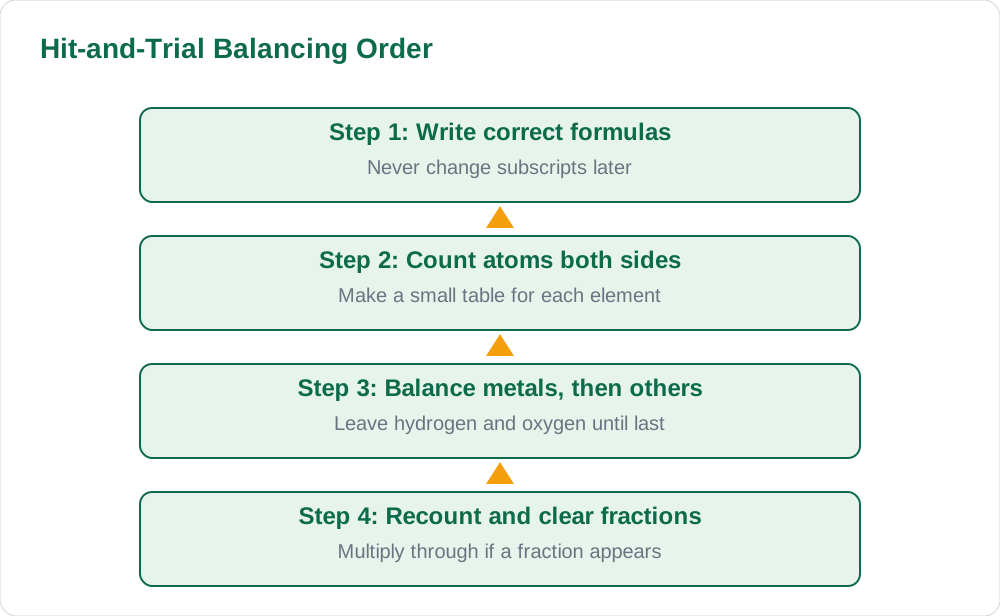
Start by writing the correct formulas for every reactant and product, then count the atoms of each element on both sides in a small table. Balance metals first, then non-metals other than hydrogen and oxygen, then hydrogen, and finally oxygen, because hydrogen and oxygen appear in many compounds and are easier to fix last. Choose the element that appears in the fewest compounds first, and use the smallest whole-number coefficient that fixes it. After each change, recount everything, because fixing one element often disturbs another.
Work with whole numbers only, and if you end up with a fraction, multiply the whole equation by the denominator to clear it. Never change a subscript to make the numbers fit, and never add a new substance that was not in the original reaction. When you think you are finished, do a final count of every element on both sides and write the counts beside the equation in rough work. This final check takes less than a minute and catches most slips, especially with oxygen in combustion equations. The books page lists the books this method supports.
Worked Examples 1 and 2: Simple Reactions
Example 1: H2 plus O2 gives H2O. Count first: left has 2 hydrogen and 2 oxygen, right has 2 hydrogen and 1 oxygen. Oxygen is short on the right, so put 2 in front of H2O, giving 2 hydrogen on the left and 4 hydrogen on the right, and 2 oxygen on both sides. Now fix hydrogen by putting 2 in front of H2 on the left. The balanced equation is 2H2 plus O2 gives 2H2O, with 4 hydrogen and 2 oxygen on each side. Notice that balancing oxygen first forced a change in hydrogen, which is exactly why you must recount after every step.
Example 2: Methane combustion, CH4 plus O2 gives CO2 plus H2O. Carbon is already balanced with one on each side. Hydrogen has 4 on the left and 2 on the right, so put 2 in front of H2O, giving 4 hydrogen and 2 oxygen from water plus 2 oxygen from carbon dioxide on the right. Oxygen on the right is now 4 in total, so put 2 in front of O2 on the left. The balanced equation is CH4 plus 2O2 gives CO2 plus 2H2O. Check: 1 carbon, 4 hydrogen, and 4 oxygen on both sides, so the equation is complete.
- 2H2 + O2 gives 2H2O: 4 H and 2 O on each side.
- CH4 + 2O2 gives CO2 + 2H2O: 1 C, 4 H, 4 O each side.
- Recount every element after each coefficient change.
Worked Examples 3, 4 and 5: Harder Cases
Example 3: Iron plus oxygen gives iron oxide, Fe plus O2 gives Fe2O3. Iron has 1 on the left and 2 on the right, oxygen has 2 on the left and 3 on the right. Balance iron with 2Fe and oxygen with 3O2 on the left and 2Fe2O3 on the right, then fix iron again: 4Fe plus 3O2 gives 2Fe2O3, with 4 iron and 6 oxygen on each side. Example 4: Aluminium plus hydrochloric acid gives aluminium chloride plus hydrogen, Al plus HCl gives AlCl3 plus H2. Chlorine needs 3HCl, hydrogen then needs 3H2 on the right, and aluminium needs 2Al and 2AlCl3 to balance: 2Al plus 6HCl gives 2AlCl3 plus 3H2, with 2 aluminium, 6 hydrogen, and 6 chlorine on each side.
Example 5: Calcium carbonate plus hydrochloric acid gives calcium chloride plus water plus carbon dioxide, CaCO3 plus HCl gives CaCl2 plus H2O plus CO2. Carbon and calcium are already balanced at one each. Chlorine needs 2HCl, which gives 2 hydrogen on the left, matching the 2 hydrogen in H2O on the right. Oxygen has 3 on the left and 3 on the right, one in water and two in carbon dioxide. The balanced equation is CaCO3 plus 2HCl gives CaCl2 plus H2O plus CO2. Practise these five until the order feels natural, then try similar equations without looking at the solutions.
- 4Fe + 3O2 gives 2Fe2O3: 4 Fe and 6 O each side.
- 2Al + 6HCl gives 2AlCl3 + 3H2: all elements balanced.
- CaCO3 + 2HCl gives CaCl2 + H2O + CO2: check oxygen last.
Common Mistakes and Exam Tips
The worst mistake is changing a subscript, for example writing H2O2 instead of H2O to balance oxygen, because that changes water into a different substance. Another common slip is balancing only one element and forgetting to recount the rest, which leaves hydrogen or oxygen unbalanced in the final answer. Students also forget that some elements exist as diatomic molecules, so O2 counts as two oxygen atoms and H2 counts as two hydrogen atoms, not one. Finally, do not leave a coefficient of one unwritten in the wrong place: an unwritten coefficient means one, and that is fine, but it must still be counted.
In exams, write the unbalanced equation first, then do your counting table in the margin, then write the balanced equation cleanly. If time is short, balance the equation that looks easiest first to secure marks, then return to the harder one. After balancing, read the equation aloud as a sentence: two molecules of hydrogen react with one molecule of oxygen to form two molecules of water. If the sentence sounds balanced in numbers, your counting is probably right. More revision guides are on the blog.
AI Help: Muse AI
Muse AI is Meta's personal AI assistant, and it can help with this topic by checking your counting step by step or by giving you a fresh unbalanced equation to practise balancing. Ask it to show the atom count on both sides, then try to fix the imbalance yourself before reading its hint.
Join Muse with invite code LTGSWD — in the Muse app, go to Settings > Redeem token and enter the code. Disclosure: LTGSWD is the author's Muse invite code. Muse AI does not give official STBB answers — always verify against your STBB book and your teacher. Always verify against your Sindh Textbook Board book and your teacher before using anything in classwork.
5 key points you must know
- Balanced means equal atoms of each element on both sides.
- Change coefficients only, never subscripts.
- Balance metals first, hydrogen and oxygen last.
- Recount every element after each change.
- Clear fractions by multiplying the whole equation.
Frequently asked questions
What is the hit-and-trial method?
You try coefficients, count the atoms on both sides, and adjust the numbers until every element matches. It is called hit-and-trial because you test and correct, rather than using a formula.
Can I change H2O to H2O2 to balance oxygen?
No, because that changes water into hydrogen peroxide, a different substance. You may only change the coefficient in front of the formula, never the subscript inside it.
Why do we balance oxygen last?
Oxygen appears in many reactants and products, so fixing it early often gets disturbed when you fix other elements. Balancing it last usually needs fewer corrections.
What should I do if I get a fraction?
Multiply every coefficient in the whole equation by the denominator of the fraction. This clears the fraction while keeping the ratios exactly the same.
Solved notes — preview free
These guides work best with the solved exercises. Preview the solved notes free on this website — 119 solved notes for Classes 6–10 in Sindhi, Urdu, English and Arabic medium. Or browse the full solved notes catalogue for your class and medium. New solved notes are added regularly — check the catalogue for coming-soon books.