Class 9 Chemistry: Atomic Mass and Mole Numericals
The class 9 chemistry atomic mass mole topic becomes easy once you see the mole as a counting unit, just like a dozen counts twelve items. One mole of any substance contains the same number of particles, and its mass in grams equals its atomic or molecular mass. This guide explains atomic mass, molecular mass, and the mole with simple gram-to-mole conversions that you can use in class tests and board-style questions. Work through each example slowly, write every unit, and check whether your answer makes sense before moving on.
What Atomic Mass Really Means
Atomic mass tells you how heavy one atom of an element is compared with a standard reference atom. In Class 9 chemistry, you usually use the rounded atomic masses given in your textbook table, for example hydrogen is 1, carbon is 12, oxygen is 16, sodium is 23, and calcium is 40. These numbers are not weights you can measure with a balance for a single atom, because one atom is far too light. Instead, they tell you the relative mass, so an oxygen atom is sixteen times heavier than a hydrogen atom. When you add the atomic masses in a compound, you get its molecular mass or formula mass, which is the bridge to real, weighable amounts in the laboratory.
A common confusion is mixing up atomic mass, mass number, and atomic number. Atomic number is the number of protons, mass number is protons plus neutrons in one isotope, and atomic mass is the average relative mass shown in the periodic table. For numericals, use the atomic mass from the table unless the question gives a different value. Always write the unit carefully: atomic mass itself is relative and has no unit, but molar mass is expressed in grams per mole. Keeping this distinction clear prevents the most frequent early mistakes, and it makes later mole calculations much smoother. Visit the solved notes for more Class 9 guides.
The Mole: A Chemist's Dozen
One mole is a fixed number of particles, just as one dozen is twelve items and one gross is 144 items. Chemists use the mole because atoms are too small to count one by one, so they count them in huge groups instead. One mole of hydrogen atoms, one mole of water molecules, and one mole of sodium ions all contain the same number of particles, but they have different masses because each particle has a different mass. That is why one mole of hydrogen gas has a mass of about 2 grams while one mole of oxygen gas has a mass of about 32 grams, even though both contain the same number of molecules.
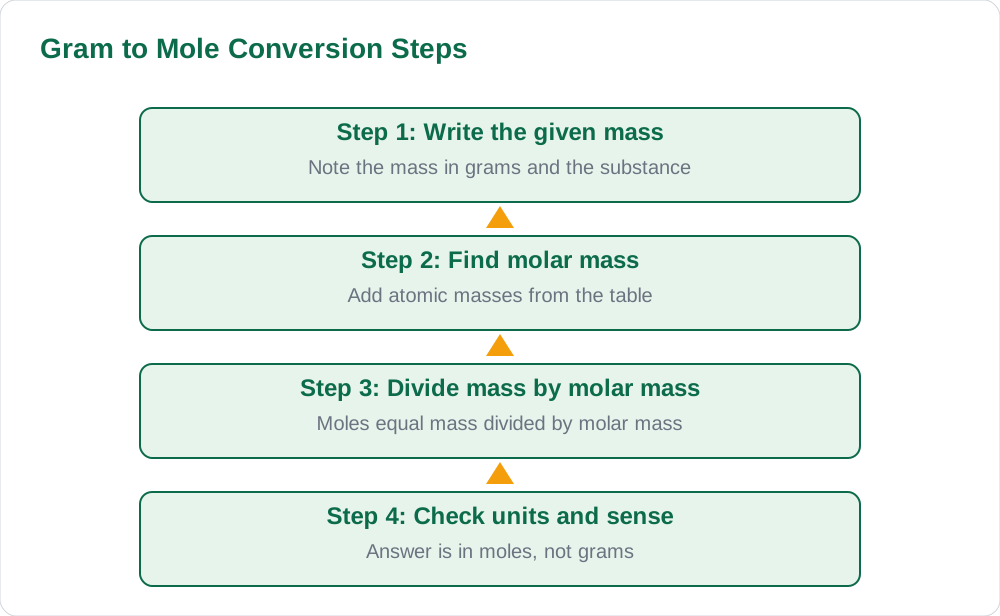
The key formula is simple: number of moles equals given mass divided by molar mass. Molar mass is the mass of one mole, found by adding atomic masses, and it is written in grams per mole. If you are given moles and asked for mass, rearrange the formula to mass equals moles multiplied by molar mass. Always start by writing what is given, what is asked, and the molar mass you will use. This three-line habit catches unit errors early and turns a long question into a short, safe calculation. See the books page for the textbooks these methods support.
Worked Example 1: Grams to Moles
Question: How many moles are present in 46 grams of sodium? Solution: The atomic mass of sodium is 23, so its molar mass is 23 grams per mole. Number of moles equals given mass divided by molar mass, which is 46 divided by 23, giving 2 moles. Notice how the grams cancel and leave moles behind. This cancelling of units is your best check: if grams do not cancel, you have divided the wrong way round. Try the same idea with 8 grams of oxygen atoms, where the molar mass is 16 grams per mole, giving 8 divided by 16, which is 0.5 mole. A value below one mole simply means less than a full mole, and that is perfectly normal.
Now try a compound. Question: How many moles are in 36 grams of water? First find the molar mass of water, H2O: two hydrogen atoms give 2 times 1, plus one oxygen atom at 16, making 18 grams per mole. Then divide 36 by 18 to get 2 moles of water. Many students forget to multiply by the subscript, so they use 17 instead of 18 and get the wrong answer. Always write the formula, put the atomic mass under each symbol, multiply by the subscript, and only then add. That slow, visible working is exactly what earns full marks, even if the final number is simple.
- Sodium: 46 g divided by 23 g/mol equals 2 mol.
- Water: molar mass 18 g/mol, so 36 g equals 2 mol.
- Oxygen atoms: 8 g divided by 16 g/mol equals 0.5 mol.
Worked Example 2: Moles to Grams and Particles
Question: What is the mass of 3 moles of calcium carbonate, CaCO3? First find its molar mass: calcium 40, plus carbon 12, plus three oxygen atoms at 16 each, which is 48, giving a total of 100 grams per mole. Then mass equals moles multiplied by molar mass, so 3 multiplied by 100 gives 300 grams. This reverse direction is just as common in exams, so practise both directions until neither feels new. If a question gives 0.25 mole of carbon dioxide, CO2, its molar mass is 12 plus 32, which is 44 grams per mole, and the mass is 0.25 multiplied by 44, giving 11 grams.
Questions about particles use the same mole idea: one mole always contains the same number of particles, so two moles contain twice that number and half a mole contains half. You do not need to memorise a huge number for most Class 9 numericals; the point is the comparison. For example, 2 moles of hydrogen molecules contain twice as many molecules as 1 mole, and 0.5 mole of water contains half as many molecules as 1 mole. When a question mixes mass and particles, convert mass to moles first, then compare moles. That two-step order keeps the working tidy and avoids jumping straight to a guessed number.
- CaCO3: molar mass 100 g/mol, so 3 mol equals 300 g.
- CO2: molar mass 44 g/mol, so 0.25 mol equals 11 g.
- Always convert mass to moles before comparing particle counts.
Common Mistakes and Exam Tips
The most common mistake is using the atomic mass of one atom when the formula contains two or more of that atom, especially in H2, O2, H2O, and CO2. Another frequent error is dividing molar mass by given mass instead of the other way round, which gives an answer with the wrong unit and usually a strange size. A third error is forgetting that diatomic gases such as hydrogen and oxygen exist as H2 and O2 molecules, so their molar masses are 2 and 32 grams per mole, not 1 and 16, when the question is about the gas. Read the question twice: does it say oxygen atoms or oxygen gas? That one word changes the molar mass completely.
For exams, write the formula, the molar mass working, the substitution, and the final answer with its unit on separate lines. Show the division or multiplication clearly rather than writing only the answer, because method marks are often awarded even when a small arithmetic slip occurs. Practise five numericals a day for a week, mixing grams to moles, moles to grams, and compounds with subscripts, and the method will become automatic. End your revision by explaining the mole to a classmate in your own words, since teaching a concept is the fastest way to find the part you still need to practise. Browse more guides on the blog.
AI Help: Muse AI
Muse AI is Meta's personal AI assistant, and it can help with this topic by walking you through a gram-to-mole numerical step by step or by giving you fresh practice questions with similar numbers. Ask it to explain why the molar mass of water is 18 grams per mole, then try the next question yourself before checking the method.
Join Muse with invite code LTGSWD — in the Muse app, go to Settings > Redeem token and enter the code. Disclosure: LTGSWD is the author's Muse invite code. Muse AI does not give official STBB answers — always verify against your STBB book and your teacher. Always verify against your Sindh Textbook Board book and your teacher before using anything in classwork.
5 key points you must know
- Atomic mass is relative mass; molar mass is grams per mole.
- Moles equal given mass divided by molar mass.
- Always multiply atomic mass by the subscript in a formula.
- Diatomic gases H2 and O2 have molar masses 2 and 32 g/mol.
- Write formula, molar mass, substitution, and unit for full marks.
Frequently asked questions
What is the difference between atomic mass and molar mass?
Atomic mass is the relative mass of one atom compared with a standard atom. Molar mass is the mass of one mole of that substance in grams per mole, and it has the same number as the atomic or molecular mass.
How do I find the molar mass of water?
Water is H2O, so add two hydrogen atoms at 1 each plus one oxygen atom at 16, giving 18 grams per mole. Always multiply by the subscript before adding.
How many moles are in 46 grams of sodium?
Sodium has a molar mass of 23 grams per mole, so 46 divided by 23 gives 2 moles. The grams cancel and leave moles as the unit.
Why is 0.5 mole a valid answer?
A mole is a counting unit, so half a mole simply means half the particles in a full mole. Many real samples are smaller than one mole, so answers below one are common and correct.
Solved notes — preview free
These guides work best with the solved exercises. Preview the solved notes free on this website — 119 solved notes for Classes 6–10 in Sindhi, Urdu, English and Arabic medium. Or browse the full solved notes catalogue for your class and medium. New solved notes are added regularly — check the catalogue for coming-soon books.