Class 9 Chemistry: Acids, Bases and pH
The class 9 chemistry acids bases ph topic explains why lemon juice tastes sour, soap feels slippery, and a pH strip changes colour. Acids release hydrogen ions in water, bases release hydroxide ions, and the pH scale measures how acidic or basic a solution is. This guide explains definitions, the pH scale, indicators, and neutralisation with everyday examples, so you can answer definition, comparison, and reaction questions confidently without memorising long lists blindly.
What Makes a Substance Acidic or Basic
An acid is a substance that produces hydrogen ions when dissolved in water, while a base produces hydroxide ions in water. Common laboratory acids include hydrochloric acid, sulphuric acid, and nitric acid, and common bases include sodium hydroxide, potassium hydroxide, and calcium hydroxide. Many everyday substances fit the same pattern: vinegar contains acetic acid, citrus fruits contain citric acid, and washing soda and soap solutions are basic. The strength of an acid depends on how completely it releases hydrogen ions, so a strong acid releases almost all of them while a weak acid releases only a small fraction.
Bases are often described as the chemical opposites of acids, but they are not simply the absence of acid. A base reacts with an acid to form a salt and water, which is why basic substances can neutralise acidity. Alkalis are a special group of bases that dissolve in water, so all alkalis are bases but not all bases are alkalis. For example, sodium hydroxide dissolves and is an alkali, while copper oxide is a base that does not dissolve well in water. Keeping this distinction clear helps in questions that ask whether a substance is an acid, a base, or an alkali. See the solved notes for more guides.
The pH Scale from 0 to 14
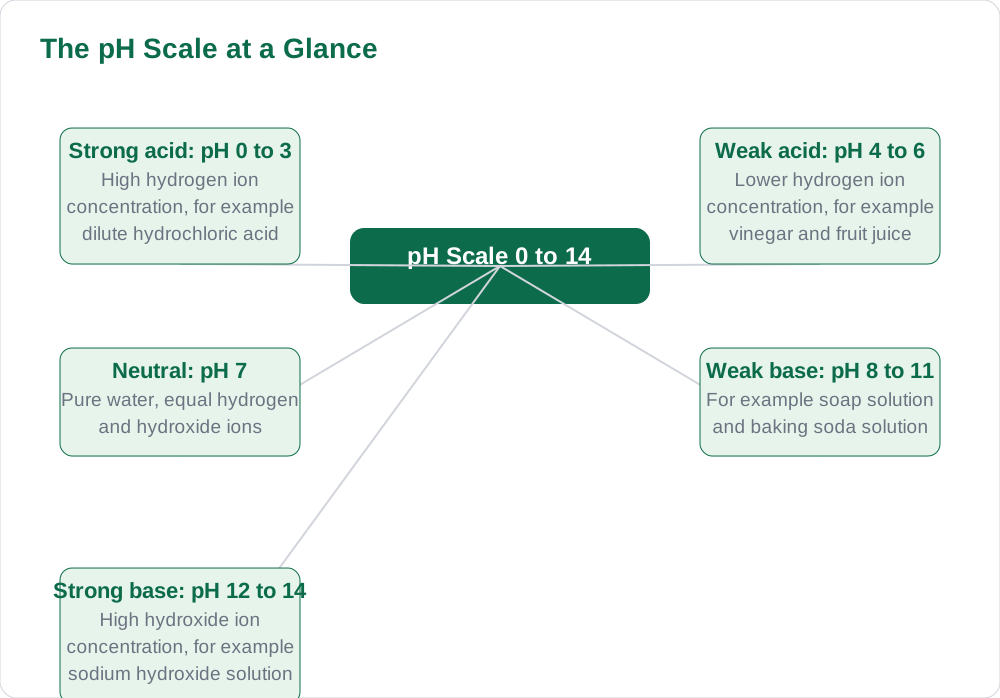
The pH scale runs from 0 to 14 and measures the concentration of hydrogen ions in a solution. A pH of 7 is neutral, values below 7 are acidic, and values above 7 are basic or alkaline. The lower the number, the stronger the acid, and the higher the number, the stronger the base, so pH 1 is a strong acid, pH 4 is a weak acid, pH 10 is a weak base, and pH 13 is a strong base. Pure water is neutral at pH 7 because it contains equal, very small amounts of hydrogen and hydroxide ions. Remember that pH is a scale, not a substance, so you should always say the pH of a solution, not the pH of a solid on its own.
Each whole-number step on the pH scale represents a tenfold change in hydrogen ion concentration, which is why a small pH difference can mean a large chemical difference. A solution at pH 3 has ten times more hydrogen ions than a solution at pH 4, and one hundred times more than a solution at pH 5. This is why strong acids must be handled with care even in dilute form, and why a small amount of acid can change the pH of a weakly protected solution sharply. In exams, always place the value correctly: below 7 means acidic, 7 means neutral, and above 7 means basic, and never write pH 7 as weakly acidic or weakly basic. Check the books page for supporting textbooks.
Indicators: Colour Clues to Acidity
An indicator is a substance that changes colour in acids and bases, giving a quick visual test without measuring pH exactly. Litmus is the classic school indicator: blue litmus turns red in acid and stays blue in base, while red litmus turns blue in base and stays red in acid. Neutral solutions do not change either colour. Universal indicator is more informative because it shows a range of colours across the pH scale, from red in strong acid through green at neutral to purple in strong base. A pH strip soaked in universal indicator can therefore estimate pH, not just tell acid from base.
Natural indicators work the same way and make good home observations, though they are not used for precise measurement. Red cabbage juice turns pink-red in acid and green-yellow in base, and turmeric turns reddish-brown in base while staying yellow in acid. When using any indicator, always test a small sample, record the starting colour, and compare after adding the solution. A common exam mistake is claiming that an indicator proves strength exactly; litmus only shows acid, base, or neutral, while universal indicator gives an approximate pH value. State which indicator you used and what it showed, and your answer will be precise.
- Blue litmus turns red in acid; red litmus turns blue in base.
- Universal indicator gives an approximate pH by colour.
- Neutral solutions cause no litmus colour change.
Neutralisation Reactions Explained
Neutralisation happens when an acid reacts with a base to form a salt and water. The hydrogen ions from the acid join with hydroxide ions from the base to make water, while the remaining ions join to form the salt. A classic example is hydrochloric acid plus sodium hydroxide giving sodium chloride plus water: HCl plus NaOH gives NaCl plus H2O. Another example is sulphuric acid plus potassium hydroxide giving potassium sulphate plus water, where the coefficients must be balanced so that hydrogen and hydroxide match. The product is called a salt even when it is not table salt, because salt is the general name for the compound formed from an acid and a base.
Neutralisation is useful far beyond the laboratory. Farmers add lime, a base, to soil that is too acidic, so crops can grow better. Antacid tablets contain a mild base that neutralises excess stomach acid and relieves acidity. Bee stings are acidic and are often treated with a mild base, while wasp stings are basic and are treated with a mild acid such as vinegar, though you should always follow medical advice for real stings. In exams, always name the salt and water products, balance the equation, and explain neutralisation as hydrogen plus hydroxide forming water, not simply as mixing two liquids together.
- Acid + base gives salt + water.
- HCl + NaOH gives NaCl + H2O.
- Lime neutralises acidic soil; antacids neutralise stomach acid.
Everyday Acids, Bases and Exam Tips
Everyday revision works best when you sort substances into three columns: acid, neutral, and base, with one example and one pH idea for each. Acids include lemon juice, vinegar, and fizzy drinks; neutral substances include pure water and table salt solution; bases include soap solution, baking soda solution, and oven cleaner. Do not taste laboratory chemicals to test them, and never guess from appearance alone, because many acids and bases are colourless liquids. The safe school test is an indicator or a pH strip, with safety glasses and teacher supervision, and any spill should be reported at once rather than cleaned up casually.
For exam answers, define the term first, give the pH rule, then give an example and a reaction if asked. A strong answer to a neutralisation question names the acid, the base, the salt, and water, and shows the balanced equation. A strong answer to a pH question states the number, says acidic, neutral, or basic, and explains what that means for hydrogen ions. Avoid vague phrases such as very acidic without a pH value or indicator result, because examiners award marks for evidence. Finish by practising ten quick classifications a day until the pH scale feels like a number line you can picture. More tips are on the blog.
AI Help: Muse AI
Muse AI is Meta's personal AI assistant, and it can help with this topic by quizzing you on pH values or by explaining why soap solution is basic in simple words. Ask it for five everyday substances to classify, then check each one against the pH rules you have learned.
Join Muse with invite code LTGSWD — in the Muse app, go to Settings > Redeem token and enter the code. Disclosure: LTGSWD is the author's Muse invite code. Muse AI does not give official STBB answers — always verify against your STBB book and your teacher. Always verify against your Sindh Textbook Board book and your teacher before using anything in classwork.
5 key points you must know
- Acids give hydrogen ions; bases give hydroxide ions in water.
- pH below 7 is acidic, pH 7 is neutral, pH above 7 is basic.
- Each pH step means a tenfold change in hydrogen ions.
- Blue litmus turns red in acid; red litmus turns blue in base.
- Acid + base gives salt + water by neutralisation.
Frequently asked questions
Is pH 6 acidic or basic?
pH 6 is weakly acidic because it is below 7. It has more hydrogen ions than neutral water, but far fewer than a strong acid at pH 1 or 2.
What is the difference between a base and an alkali?
All alkalis are bases, but only bases that dissolve in water are called alkalis. Sodium hydroxide is an alkali, while insoluble copper oxide is a base but not an alkali.
What are the products of neutralisation?
The products are a salt and water. Hydrogen ions from the acid join hydroxide ions from the base to make water, and the other ions form the salt.
Why does universal indicator help more than litmus?
Litmus only shows acid, base, or neutral by two colours. Universal indicator shows a range of colours, so it gives an approximate pH value across the whole scale.
Solved notes — preview free
These guides work best with the solved exercises. Preview the solved notes free on this website — 119 solved notes for Classes 6–10 in Sindhi, Urdu, English and Arabic medium. Or browse the full solved notes catalogue for your class and medium. New solved notes are added regularly — check the catalogue for coming-soon books.