BSEK 40% Pass Rule 2026: What Changed for Class 9 Science Students

The Board of Secondary Education Karachi changed the rules of the game for Class 9 students in 2026, and many families only discovered the change when the result arrived. From the 2026 annual examinations, the pass threshold for Class 9 was raised from 33% to 40%, which means a paper scored below 40% is now recorded as ungraded rather than passed. The Board of Secondary Education Karachi announced the Class 9 Science Group result on 28 October 2026, and the new rule shaped that result in ways students and parents need to understand clearly. This guide explains exactly what changed, what ungraded means for your mark sheet, how the rule differs from the old 33% system, and what happens when Class 10 comes under the same scheme from 2027.
From 33% to 40%: What Actually Changed
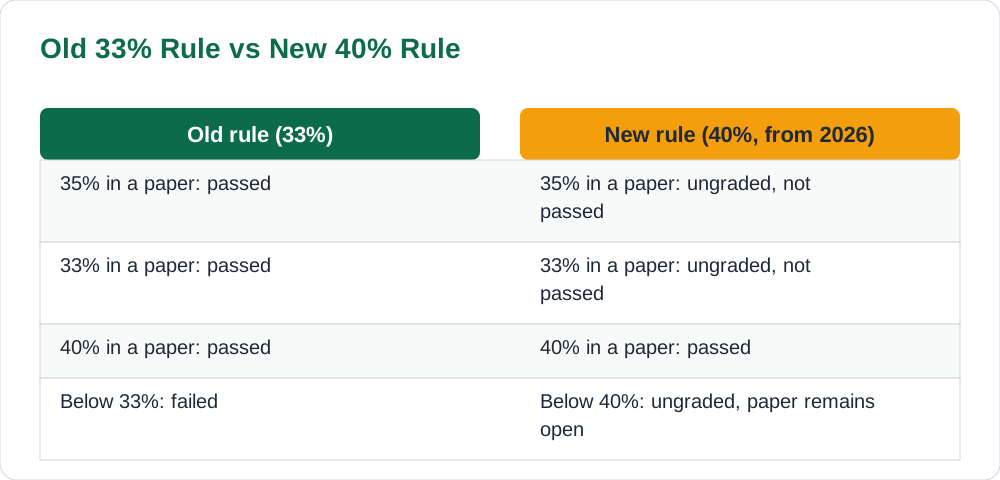
For years, Sindh board students grew up with a simple number in their heads: 33% was the pass mark. A student who scored 35% in a paper passed it, and a student who scored 30% failed it, and everyone understood where the line stood. From the 2026 annual examinations, that line moved for Class 9. The pass threshold is now 40%, so a paper must be scored at 40% or above to count as passed, and anything below 40% is recorded as ungraded. This is not a small administrative adjustment; it changes the outcome for every student whose marks fall in the 33% to 39% band, because papers that would have passed under the old rule now stand open and must be cleared.
The change applies to Class 9 from the 2026 annual examinations, and Class 10 follows from 2027, so current Class 9 students will meet the same standard again next year. That timing matters for planning, because it means there is no point in treating 40% as a one-year hurdle to scrape past and forget. Students who build study habits that aim comfortably above 40% this year will carry that margin into Class 10, while students who aim only at the borderline risk falling below it again when a paper turns out harder than expected. The sensible response is to treat 40% as the floor and to aim for a clear pass in every paper, using the book collection and solved notes to strengthen weak chapters rather than relying on guesswork.
What Ungraded Really Means on Your Mark Sheet
The word ungraded causes confusion because it sounds softer than failed, but students should understand it precisely. Under the new grading scheme, a paper in which a student scores below 40% is marked ungraded, which means the student is unsuccessful in that paper and has not passed it. It does not mean the paper is ignored, and it does not mean the marks disappear; it means the paper remains open and the student reappears in it subject to eligibility, following the board's official process. Parents sometimes read ungraded as a partial credit or a near pass, but the practical meaning is straightforward: that paper still needs to be cleared before the student's record for the class is complete.
Ungraded also changes how a student should read the rest of the mark sheet. A student who passed some papers and has one or two ungraded papers is in a different position from a student who failed everything, and the plan for each case is different. The first step is always to list every paper, mark each one as passed or ungraded, and note how far below 40% each ungraded paper fell, because a gap of two marks needs a different revision plan from a gap of twenty marks. Students should check their result on the board's official website and keep a printed or saved copy of the mark sheet, since every later step, from reappearance to admission, will ask for exactly what that sheet shows.
How the New Rule Shaped the 28 October 2026 Result
The Class 9 Science Group result announced on 28 October 2026 gives the first full picture of the new rule in action. According to the figures shared by Controller of Examinations Ahmed Khan Chhutto, 180,054 students registered and 177,923 appeared, while 123,757 passed all papers and 53,849 failed. The overall pass percentage was 69.56%, compared with 78.26% in 2025, when 137,350 of 175,511 students who appeared passed all papers. That is a fall of about 8.7 percentage points, and it is tempting to blame the new threshold alone, but the board has published no single official reason for the fall, and this guide does not present one cause as fact. Several factors can move a pass rate, and students should be careful about explanations circulating without an official source.
What can be said safely is that the higher threshold mechanically changes outcomes for students in the 33% to 39% band, and that the large partial-pass groups in the 2026 figures show how many students were affected at the margins. The board reported 21,999 students passing six papers, 11,006 passing five, 7,431 passing four, 4,409 passing three, 3,101 passing two and 2,439 passing one paper, which together describe a very large group of students with open papers. Chairman Professor Musharraf Ali Rajput congratulated students who passed all papers and said transparency remained among the board's top priorities, and the result was available on the board's official website from 5:30 PM on 28 October 2026. For students, the lesson is practical rather than statistical: read your own mark sheet against the 40% line, not against last year's headlines.
What Class 9 Students Should Do Now
The first task after the result is a careful, paper-by-paper review. Take your mark sheet and write down every paper with its marks, marking each one passed or ungraded against the 40% threshold, and calculate the gap for each ungraded paper. Papers missed by a few marks need focused revision of the chapters where marks were lost, while papers with a wide gap need a fresh study plan built from the textbook. Keep your admit card, mark sheet and registration details safe, because the reappearance process will require them, and watch the board's official website for the next official notice rather than trusting dates shared on social media, since no reappearance date for these papers was stated in the 28 October announcement.
The second task is to set a revision target with a margin of safety. Aiming for exactly 40% leaves no room for a hard paper, an off day, or a strict marking scheme, so aim for a comfortable pass well above the line in every open paper. Work from your Sindh Textbook Board book, use solved exercises to check your method, and test yourself under timed conditions so that exam pressure does not eat into your margin. If your school offers extra classes for students clearing papers, attend them and ask teachers which chapters carried the most marks. The blog carries study guides for revising science subjects chapter by chapter, and building that margin now also prepares you for Class 10, where the same 40% standard will apply from 2027.
Class 10 From 2027: Preparing Under the Same Standard
Class 10 comes under the new grading scheme from 2027, which means the current Class 9 cohort will face the 40% threshold again in their matric year. This is genuinely useful information, because it turns this year's result into a rehearsal rather than a one-off event. Students who learn now how to revise to a comfortable pass, how to read a mark sheet paper by paper, and how to close a gap in a weak subject will use exactly those skills next year, when the stakes are higher because Class 10 results feed into college admission. There is no separate trick for Class 10 under the new rule; the same habits of textbook-based revision, timed practice and honest gap measurement apply, only with more syllabus to cover.
Parents can help by treating the threshold as a planning tool rather than a source of panic. Ask your child to show you the mark sheet, go through the open papers together, and agree on a weekly revision timetable that protects time for both Class 10 schoolwork and the open Class 9 papers. Encourage your child to talk to subject teachers about the chapters that cost the most marks, and avoid agents or unofficial channels that promise shortcuts around the board's process. The board's official website remains the only reliable source for notices about reappearance, fees and dates, and the about page of this site explains how our study guides are organised for Sindh board students working under the new grading scheme.
AI Help: Muse AI
Muse AI is Meta's personal AI assistant, and it can help you study by explaining a difficult concept in simple words or by turning a chapter into short practice questions. For this topic, you can ask Muse AI to explain the difference between the old 33% rule and the new 40% rule with a simple example, then check the explanation against your own mark sheet.
Join Muse with invite code LTGSWD — in the Muse app, go to Settings > Redeem token and enter the code.
Disclosure: LTGSWD is the author's Muse invite code.
Muse AI does not give official STBB answers — always verify against your STBB book and your teacher. In other words, always verify against your Sindh Textbook Board book before trusting any answer in an exam.
5 key points you must know
- Class 9 pass threshold rose from 33% to 40% from the 2026 annual examinations.
- Scoring below 40% in a paper means ungraded, not passed, and the paper remains open.
- Class 10 comes under the same new grading scheme from 2027.
- The 2026 Science Group pass rate was 69.56%, down from 78.26% in 2025, with no single official reason published.
- Aim comfortably above 40% in every paper so a hard paper does not push you below the line again.
Frequently asked questions
What is the new pass mark for BSEK Class 9 in 2026?
The pass threshold for Class 9 from the 2026 annual examinations is 40%. A paper scored below 40% is recorded as ungraded rather than passed. This replaces the old 33% threshold for Class 9.
I scored 35% in one paper. Did I pass it?
No. Under the new rule, 35% is below the 40% threshold, so the paper is marked ungraded and remains open. You will need to reappear in that paper subject to eligibility, following the board's official notice on its website.
Does the 40% rule apply to Class 10 as well?
Class 10 comes under the new grading scheme from 2027. Current Class 9 students will therefore meet the same 40% standard in their matric year, which is why building a margin above 40% now is so important.
Why did the Class 9 Science pass rate fall in 2026?
The overall pass percentage was 69.56% in 2026, compared with 78.26% in 2025, a fall of about 8.7 percentage points. The board has published no single official reason for the fall, so no single cause should be presented as fact. The higher threshold does change outcomes for students in the 33% to 39% band.
Where do I check official notices about reappearing in ungraded papers?
On the Board of Secondary Education Karachi official website, bsek.edu.pk, and your school notice board. No reappearance date for these papers was stated in the 28 October 2026 announcement, so treat dates circulating on social media as unverified.
Solved notes — preview free
These guides work best with the solved exercises. Preview the solved notes free on this website — 119 solved notes for Classes 6–10 in Sindhi, Urdu, English and Arabic medium. Or browse the full solved notes catalogue for your class and medium. New solved notes are added regularly — check the catalogue for coming-soon books.