The 40% Rule Reaches Class 10 in 2027: What Class 9 Students Must Learn Now

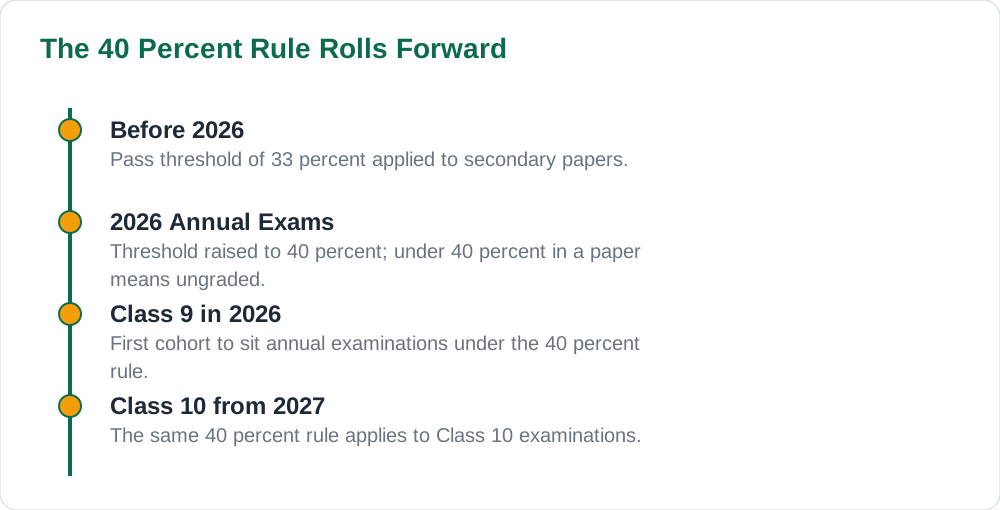
The pass threshold in Karachi's secondary examinations has changed, and Class 9 students are the first to feel it in full. From the 2026 annual examinations, the pass threshold rose from 33 percent to 40 percent, with under 40 percent in a paper marked ungraded, and Class 10 follows the same rule from 2027. That means today's Class 9 students will sit their Class 10 examinations under the higher standard, and the habits they build now will decide how smoothly they make that transition. This guide explains what changed, what the Class 9 Science result already teaches about the new standard, and how students can prepare for Class 10 so that the 40 percent rule is a comfortable bar rather than a barrier.
What Changed: From 33 Percent to 40 Percent
Under the old system, a student needed 33 percent in a paper to pass it. From the 2026 annual examinations, the threshold is 40 percent, and a paper scored under 40 percent is marked ungraded, meaning not passed in that paper. The change is part of the new grading introduced with the IBCC and the Sindh Universities and Boards Department framework, and it applies across the board's examinations as each class transitions. For students, the practical meaning is straightforward: the margin for a weak paper has shrunk, and scores in the 33 to 39 percent range, which once passed, now fall short and leave the paper outstanding.
The change should not be read as a punishment, but as a higher expectation that rewards solid preparation. A student who genuinely understands the core chapters of a subject will usually clear 40 percent without difficulty, while a student who relied on scraping through with partial knowledge will now find that strategy failing. That is the lesson of the transition: preparation must aim at understanding, not at the minimum. Students who adjust their study habits now, in Class 9, will find Class 10 under the same rule far less daunting than students who wait until Class 10 to discover the new standard.
What the Class 9 Science Result Already Shows
The Class 9 Science Group (Regular) result announced on 28 October 2026 gives the first large-scale picture of the new rule in action. The overall pass percentage was 69.56 percent, compared with 78.26 percent in 2025, a fall of about 8.7 percentage points, and 123,757 students passed all papers out of 177,923 who appeared. The board has published no single official reason for the fall, so it would be wrong to attribute it entirely to the threshold change, but the direction is clear: under a higher bar, weak preparation is more likely to show up as an ungraded paper. Students reading their own 2026 marksheet should check whether any paper fell in the 33 to 39 percent range, because those are the papers the new rule caught.
The partial-pass figures also show that many students were close: 21,999 passed six papers, 11,006 passed five, and thousands more passed four or fewer. For those students, the gap to a full pass is often one or two papers, and the lesson is that a small improvement in a weak subject would have changed the outcome. That is encouraging, because it means the next attempt does not require starting over; it requires targeted work on the specific papers that fell short. Class 9 students heading into Class 10 should carry that lesson with them: identify weak subjects early, fix them while there is time, and do not let a borderline subject drift until examination season.
Why Class 10 in 2027 Needs Preparation Now
Class 10 follows the 40 percent rule from 2027, which means the students currently in Class 9 will face the higher threshold in their board class. Board classes carry extra weight because their results shape the next stage of education, so a student who enters Class 10 with weak foundations and a habit of scraping through will face the new standard at the worst possible moment. The time to build stronger habits is now, while Class 9 is still in progress and the stakes of each test are lower. Teachers, parents, and students should treat the rest of Class 9 as preparation for Class 10, not as a separate year that can be coasted through.
Preparation now also means using the Class 9 experience honestly. A student who received an ungraded paper in 2026 already knows which subject needs work, and that knowledge is more valuable than any general advice. Rather than forgetting the weak paper once the result is absorbed, the student should keep working on that subject alongside current studies, so that the gap closes before Class 10 begins. Solved notes can support that steady work, and the collection on Solved Notes covers Class 9 subjects for targeted revision, while Books lists the full range of available books.
Study Habits That Clear 40 Percent Comfortably
The habits that clear the new threshold are not exotic; they are the basics done consistently. First, master the core chapters of each subject rather than memorising summaries of everything, because core chapters carry the marks that push a score past 40 percent. Second, practise past papers under timed conditions, since examination technique, writing complete answers, managing time, and attempting every question, often accounts for the difference between 35 and 45 percent. Third, test yourself regularly with short quizzes instead of only re-reading notes, because self-testing reveals gaps while there is still time to fix them.
Fourth, treat borderline subjects as the priority, not the afterthought. Students naturally prefer subjects they are good at, but under a 40 percent rule, the subject closest to the line deserves the most attention, because it is the one most likely to become ungraded. A weekly slot dedicated to the weakest subject, with a teacher's help where needed, will do more for the overall result than extra hours on an already strong subject. Finally, keep attendance and homework steady throughout the year, since the 40 percent rule punishes the student who only starts serious study in the final month, when there is no longer time to build real understanding.
A Message for Parents and Teachers
Parents and teachers have a role in this transition that goes beyond telling students to work harder. The first task is to explain the rule itself clearly, so that families understand that under 40 percent means ungraded and that a score in the high thirties is no longer a pass. Many families still think in terms of the old 33 percent line, and that misunderstanding leads to false reassurance when a child scores 35 percent in a test. Once the rule is understood, families can set realistic expectations: a test score of 45 percent is a pass with a thin margin, not a comfortable result, and the goal should be to build well above the line.
The second task is to respond to ungraded papers with a plan rather than blame. A student who has just learned that a paper is ungraded needs help diagnosing the weakness and a schedule for fixing it, not a lecture that adds anxiety to an already difficult moment. Teachers can help by identifying the chapters where marks were lost, and parents can help by protecting study time and checking progress calmly each week. The 40 percent rule, handled this way, becomes a prompt for better preparation rather than a source of fear, and students who experience that support in Class 9 will enter Class 10 in 2027 ready for the standard. Further guidance for families is listed on Blog.
AI Help: Muse AI
Muse AI is Meta's personal AI assistant, and it can help you prepare for the 40 percent standard by testing you on your weakest chapters and explaining difficult topics in simple words. You can ask it to make practice questions for one subject, to summarise a chapter you find hard, or to help you build a weekly plan that gives your borderline subjects the most time. Muse AI does not give official STBB answers — always verify against your STBB book and your teacher. Always verify against your Sindh Textbook Board book and your teacher before using anything in classwork.
Join Muse with invite code LTGSWD — in the Muse app, go to Settings > Redeem token and enter the code. Disclosure: LTGSWD is the author's Muse invite code.
5 key points you must know
- Pass threshold rose from 33 percent to 40 percent from the 2026 annual examinations.
- Under 40 percent in a paper means ungraded, which means not passed in that paper.
- Class 10 follows the same 40 percent rule from 2027.
- Class 9 Science 2026 passed at 69.56 percent, against 78.26 percent in 2025, with no single official reason published.
- Preparation should aim comfortably above 40 percent, with borderline subjects given priority.
Frequently asked questions
What is the new pass threshold for board papers?
From the 2026 annual examinations, the pass threshold is 40 percent, raised from the previous 33 percent. Scoring under 40 percent in a paper means the paper is marked ungraded, which means not passed in that paper. The change comes with the new grading framework introduced with the IBCC and the Sindh Universities and Boards Department.
When does the 40 percent rule apply to Class 10?
Class 10 follows the 40 percent rule from 2027. That means students currently in Class 9 will sit their Class 10 examinations under the higher threshold. Building strong study habits in Class 9 is therefore the best preparation for the Class 10 examinations under the new standard.
Does a score of 35 percent pass under the new rule?
No, a score of 35 percent does not pass under the new rule, because the threshold is now 40 percent. Scores in the 33 to 39 percent range, which passed under the old system, are now marked ungraded. Students should aim comfortably above 40 percent rather than at the line itself.
What did the Class 9 Science 2026 result show about the new rule?
The overall pass percentage was 69.56 percent, compared with 78.26 percent in 2025, a fall of about 8.7 percentage points. The board has published no single official reason for the fall, so it cannot be attributed to the threshold change alone. The figures do show many students close to a full pass, with 21,999 passing six papers.
How should a Class 9 student prepare for Class 10 under the 40 percent rule?
Focus on core chapters, practise past papers under timed conditions, test yourself regularly, and give borderline subjects priority study time each week. Keep homework and attendance steady through the year rather than cramming in the final month. A student who builds these habits in Class 9 will enter Class 10 ready for the higher standard.
Solved notes — preview free
These guides work best with the solved exercises. Preview the solved notes free on this website — 119 solved notes for Classes 6–10 in Sindhi, Urdu, English and Arabic medium. Or browse the full solved notes catalogue for your class and medium. New solved notes are added regularly — check the catalogue for coming-soon books.