BSEK 9th Science Result 2026: Why the Pass Rate Fell to 69.56% — and What It Means
The Board of Secondary Education Karachi announced the Class 9 Science Group result on 28 October 2026 with an overall pass percentage of 69.56%, down from 78.26% in 2025 — a fall of about 8.7 percentage points. That single comparison has understandably worried students and parents, and it has also produced a wave of confident explanations online, most of which the board has never stated. This article separates what is actually known from what is only guessed: the verified figures, the one confirmed rule change that reshaped this year's result, and the limits of what the numbers can tell us. It also explains what the lower pass rate does and does not mean for students who passed, students with partial passes, and students entering Class 10.
The 2026 Figures in Full
The figures shared by Controller of Examinations Ahmed Khan Chhutto give a complete picture of the 2026 Science Group result. Of 180,054 registered students, 177,923 appeared and 2,131 were absent. A total of 123,757 students passed all papers, while the partial-pass bands were 21,999 students with six papers, 11,006 with five, 7,431 with four, 4,409 with three, 3,101 with two and 2,439 with one paper passed. The board recorded 53,849 students as failed. The overall pass percentage of 69.56% is the share of appeared students who passed all papers, which is the standard way these results are reported, and it is worth remembering that the partial-pass students sit outside that headline figure even though they passed most of their papers.
Two features of the breakdown deserve attention before any explanation is attempted. First, the partial-pass bands are large: added together, more than 50,000 students passed some papers but not all, which means the headline pass rate understates how much of the cohort actually succeeded in most subjects. Second, the absent figure of 2,131 is small relative to the registered total, so absence does not explain the change in the pass rate. Any honest reading of the result has to start from these numbers rather than from a single percentage, because the percentage alone hides the very students — the partial passes — who most need guidance. The solved notes and the book collection can help those students revise the papers they still have open.
The Comparison With 2025
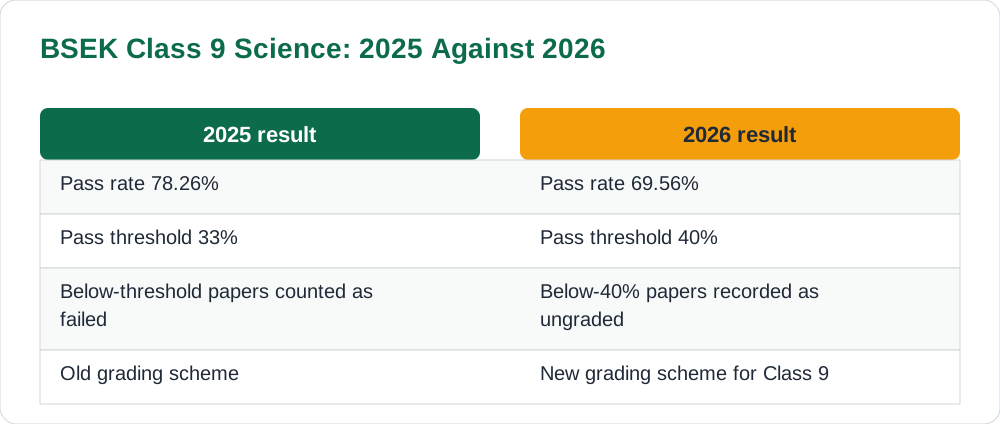
The 2025 Science Group pass rate was 78.26%, according to Aaj English's reporting, which puts the 2026 figure of 69.56% about 8.7 percentage points lower. That is a real and noticeable fall, and it is fair for students and parents to ask why it happened. What is not fair, and not supported by the record, is to present any single cause as the board's explanation, because the board has published no single official reason for the fall. Articles and social media posts that blame one factor — a harder paper, stricter marking, or the new grading scheme alone — are guessing, however confidently they are written, and students should treat them as opinion rather than fact.
Comparisons across years also need care for a second reason: the rules changed between the two years. The 2025 result was produced under the old pass threshold of 33%, while the 2026 result uses the new threshold of 40%. When the bar moves, the pass rate is expected to move with it, so a straight comparison of 78.26% with 69.56% does not measure the same thing in both years. That does not prove the threshold change caused the whole fall — the board has not said that either — but it does mean the two percentages cannot be read as a simple measure of how much weaker or stronger this year's students were. The blog has more guides on reading board results without being misled by headlines.
The One Confirmed Change: The 40% Threshold
The clearest verified change behind the 2026 result is the new grading scheme. Class 9 from the 2026 annual examinations uses a pass threshold of 40%, raised from 33%, and a paper scored below 40% is recorded as ungraded rather than passed. This change was decided at the level of the Inter Board Coordination Commission and the Sindh Universities and Boards Department, and it applies across the Karachi boards, with Class 10 following from 2027. It is the only structural change to the pass rule that the reporting on this result confirms, and it directly affects how many students count as having passed all papers, because every paper in the 33% to 39% range that would previously have passed now counts as ungraded.
Understanding the threshold also explains why so many students landed in the partial-pass bands. A student who scored, say, 37% in one paper and passed the rest would previously have been counted among those who passed all papers, but in 2026 that student appears in the six-paper band instead. Multiply that effect across a cohort of nearly 178,000 appeared students, and a visible fall in the headline pass rate is exactly what a higher threshold produces, even if the students' actual performance is unchanged. Again, this is an explanation of how the arithmetic works, not a claim that the board attributes the whole fall to the threshold; the board has published no such attribution, and this article does not invent one.
What the Figures Cannot Tell Us
It is tempting to read a pass rate as a verdict on students, teachers, or schools, but the published figures do not support that kind of conclusion. The board has not published a subject-wise breakdown of this result in the reporting available, so nobody can say from these figures which subjects pulled the rate down, or whether the fall was spread evenly or concentrated in one or two papers. Nor has it published any analysis linking the fall to paper difficulty, marking strictness, syllabus changes, or student preparation, so each of those theories remains unproven. Responsible reporting means saying so plainly rather than filling the gap with the most popular theory of the week.
Students should also be wary of statistics that appear without a source. If a post claims a subject-wise failure rate, a school ranking, or a reason for the fall, check whether it names the board's release or a named board official; if it does not, treat it as unverified. The verified record for this result is narrow: the announcement date of 28 October 2026, the availability of results on bsek.edu.pk from 5:30 PM that day, the figures above, the threshold change, and the chairman's statement that transparency remained among the board's top priorities. Everything beyond that is interpretation, and interpretation should be labelled as such. For reliable study help rather than rumours, the [home page](/) gathers the site's verified guides.
What the Lower Rate Means for Students
For students who passed all papers, the lower overall rate changes nothing about their own result; their pass stands, and they move to Class 10 under the new grading scheme that begins there in 2027. The practical lesson for them is the same as for everyone else: Class 10 will also be marked against the 40% threshold, so the habit of aiming comfortably above the pass line, rather than at it, is now essential. Students who passed with narrow margins in Class 9 should treat Class 10 as the year to build that margin, revising from the textbook and testing themselves regularly instead of relying on last-minute preparation.
For partial-pass and failed students, the lower rate carries a different message, which is reassurance rather than blame. When the headline rate falls by nearly nine points in the year the threshold rises, a partial pass is a common outcome shared by tens of thousands of students, not a personal disgrace. The useful response is the practical one: identify the open papers, revise them to a comfortable margin above 40%, and watch the board's official website for the reappearance notice. And for students now entering Class 9, the lesson is to start the year knowing the bar is 40% in every paper, so no subject can safely be left to chance. A lower pass rate is a signal to study differently, not a reason to give up.
AI Help: Muse AI
Muse AI is Meta's personal AI assistant. You can ask it to explain a concept in simple words, summarise a lesson, or make practice questions for revision.
To understand a result like this one, you can ask Muse AI to explain what a pass percentage means and how a higher pass threshold changes it, using simple examples, then compare that explanation with your own mark sheet.
Join Muse with invite code LTGSWD — in the Muse app, go to Settings > Redeem token and enter the code.
Disclosure: LTGSWD is the author's Muse invite code.
Muse AI does not give official STBB answers — always verify against your Sindh Textbook Board book and your teacher.
5 key points you must know
- BSEK Class 9 Science pass rate: 69.56% in 2026, down from 78.26% in 2025.
- The board has published no single official reason for the fall — do not accept invented causes.
- The confirmed rule change is the pass threshold rising from 33% to 40%.
- Over 50,000 students sit in partial-pass bands, so a partial pass is common, not exceptional.
- Class 10 follows the new grading scheme from 2027, so aim comfortably above 40% in every paper.
Frequently asked questions
Why did the BSEK Class 9 Science pass rate fall in 2026?
The board has published no single official reason for the fall from 78.26% to 69.56%. The confirmed change is the pass threshold rising from 33% to 40%, which mechanically moves some students from full pass to partial pass, but the board has not attributed the whole fall to that change.
What is the new pass threshold for Class 9?
From the 2026 annual examinations, Class 9 papers require 40% to pass. Scoring below 40% in a paper means the paper is recorded as ungraded, not passed.
Does the lower pass rate mean this year's students were weaker?
No such conclusion can be drawn from the published figures. The threshold changed between the two years, so the two percentages do not measure the same thing, and the board has published no subject-wise analysis.
How many students passed all papers in 2026?
According to the Controller of Examinations, 123,757 students passed all papers out of 177,923 who appeared, with 53,849 recorded as failed and large numbers in the partial-pass bands.
Will Class 10 use the same 40% rule?
Yes, Class 10 comes under the new grading scheme from 2027. Students moving into Class 10 should plan their revision to clear 40% comfortably in every paper.
Solved notes — preview free
These guides work best with the solved exercises. Preview the solved notes free on this website — 119 solved notes for Classes 6–10 in Sindhi, Urdu, English and Arabic medium. Or browse the full solved notes catalogue for your class and medium. New solved notes are added regularly — check the catalogue for coming-soon books.