BSEK 9th Science Result 2026: What to Do If You Passed Some Papers Only

The Board of Secondary Education Karachi announced the Class 9 Science Group result on 28 October 2026, and the headline figure hides a very large middle group: tens of thousands of students passed some papers but not all of them. According to the figures shared by Controller of Examinations Ahmed Khan Chhutto, 123,757 students passed all papers, while 21,999 passed six papers, 11,006 passed five, 7,431 passed four, 4,409 passed three, 3,101 passed two and 2,439 passed one paper. If you are in one of these groups, your result is neither a full pass nor a total failure, and it needs a clear plan rather than panic. This guide explains what a partial pass means under the new 40% rule, how to find out exactly which papers are still open, and how to clear them while keeping your Class 10 year on track.
Reading Your Result: Passed, Partial, or Failed
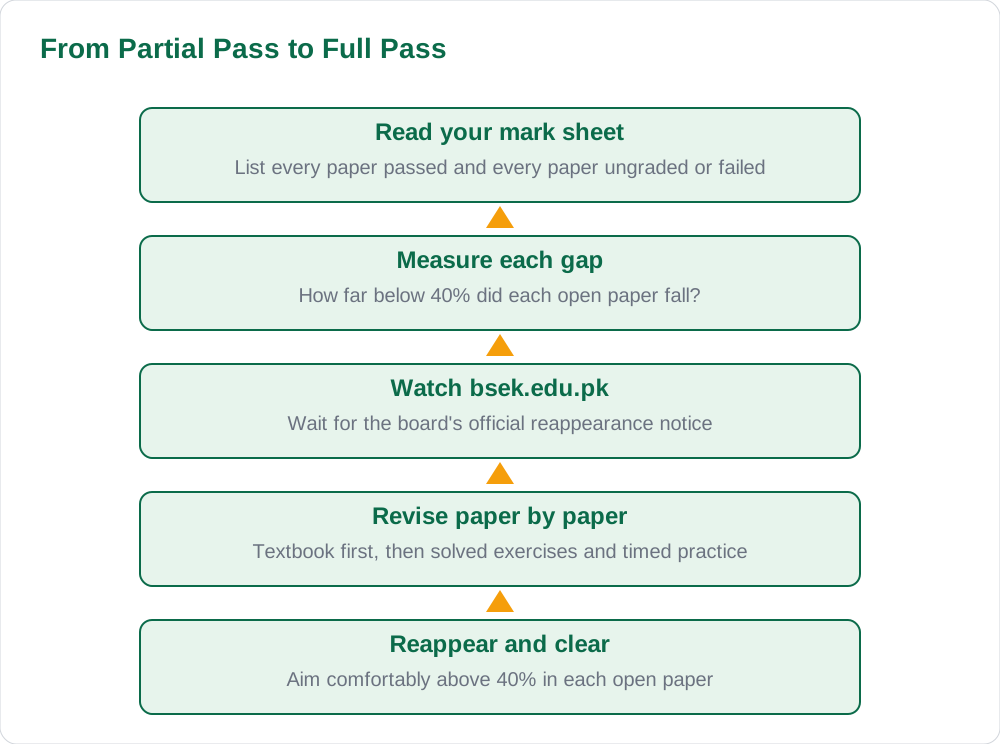
Start by reading your own mark sheet, not the headline pass percentage. The board's figures show that 177,923 students appeared out of 180,054 registered, and 53,849 students failed, but those totals say nothing about your individual position. What matters for you is the list of papers you passed and the papers marked ungraded or failed, because each paper is now a separate item to deal with. Under the new grading scheme that applies to Class 9 from the 2026 annual examinations, scoring under 40% in a paper means you are ungraded in that paper rather than passed, since the pass threshold was raised from 33% to 40%. A paper you scored 35% in may feel close, but under the new rule it still counts as not passed, and you should treat it as a paper to clear.
Count your open papers carefully before you make any plan. A student who passed six papers has a very different workload from a student who passed two, and the board's own breakdown shows both kinds of students in large numbers. Write down each open paper by name, the marks you obtained, and how far below 40% you fell, because that gap decides how much revision each paper needs. Papers where you missed by a few marks need targeted revision of weak chapters, while papers with a wide gap need a fresh study plan from the start. Do not rely on memory or on what friends say about their results; your mark sheet is the only record that counts. For study material matched to your subjects, browse the book collection and the solved notes.
What the 40% Rule Changes for Partial Passes
The most important change behind this year's result is the pass threshold itself. In earlier years a student could pass a paper with 33%, but from the 2026 annual examinations the threshold for Class 9 is 40%, and anything below that is recorded as ungraded. This matters for partial-pass students in two ways. First, a paper you might have expected to pass under the old rule may now be open, so do not compare your marks with an older sibling's result and assume the same outcome. Second, the rule raises the bar for the papers you still have to clear, which means revision must aim comfortably above 40%, not just at the borderline, so that a difficult paper does not push you below the line again.
The same rule will follow you into Class 10, which comes under the new grading scheme from 2027, so learning to work to the 40% standard now is an investment rather than a one-off effort. Students who treat the threshold as a minimum to scrape past often find themselves back in the same position next year, while students who build a margin of safety tend to stay clear of it. Aim for a comfortable pass in every paper you reappear in, and use your Class 9 textbooks as the base for that preparation rather than short notes alone. The blog carries study guides that explain how to revise science subjects chapter by chapter, and the [home page](/) links to the full set of resources for Sindh board students.
Clearing Your Remaining Papers: The Practical Route
Clearing open papers is a formal process, and the safest approach is to follow the board's own notices rather than rumours. When the board announces the next opportunity to reappear in failed or ungraded papers, it will publish the eligibility rules, the fee, and the last date on its official website, bsek.edu.pk, and students should check that notice directly. No confirmed supplementary or reappearance date for these papers is stated in the board's 28 October announcement, so this guide does not invent one; watch the official website and your school's notice board instead of trusting social media dates. In the meantime, keep your admit card, mark sheet, and registration details safe, because you will need them when the reappearance process opens.
Use the waiting time well instead of letting it slip away. Make a simple timetable that gives each open paper a fixed daily slot, starting with the paper where your gap is smallest, so you bank an early success and build momentum. Revise from your Sindh Textbook Board book, work through the solved exercises for that subject, and test yourself with past-paper style questions under timed conditions. If your school offers extra classes or remedial sessions for students clearing papers, attend them, and ask your subject teacher which chapters carried the most marks in the paper you missed. Regular, short revision beats a last-minute rush, especially when you are also starting Class 10 work alongside it.
Planning Class 10 Alongside Clearing Papers
Most partial-pass students face the same dilemma: Class 10 has already begun, and the open Class 9 papers still need attention. The practical answer is to treat the two as one timetable rather than two competing ones. Give Class 10 its normal school hours and homework time, and protect one or two focused hours a day for the open Class 9 papers, with the heaviest weight on the paper you will reappear in first. Science subjects overlap a great deal between Class 9 and Class 10, so revision of a Class 9 physics or chemistry chapter often strengthens the Class 10 chapter built on it, and that overlap is worth using deliberately rather than studying the two years as if they were unrelated.
Be honest with yourself about how many open papers you can carry at once. A student with one or two open papers can usually clear them while keeping up with Class 10, but a student with four or five open papers may need to slow down, prioritise the papers closest to passing, and talk to teachers about a realistic sequence. There is no shame in taking longer to clear a paper properly; the costly mistake is to ignore the open papers until the next examination arrives and then face them unprepared. Keep a weekly checklist of chapters revised and practice tests completed, and review it every weekend so slippage shows up early, while there is still time to correct it.
Mistakes Partial-Pass Students Should Avoid
The first mistake is to assume a paper is passed because the marks feel close to passing, or because an older marking scheme would have passed it. Under the 40% rule, close is still ungraded, and the only safe check is your official mark sheet read against the 40% line. The second mistake is to trust unofficial dates, fee claims, or agents who promise a shortcut to clearing papers; the board's official website is the only source for reappearance notices, and anything else should be treated as unverified. The third mistake is to stop studying the open papers entirely while waiting for a notice, which turns a small gap into a forgotten subject by the time the examination comes round.
A fourth mistake is to hide the result from parents and teachers out of embarrassment. A partial pass is common this year — the board's own figures show more than 50,000 students in the partial-pass bands combined — and teachers deal with it every year. Telling your teacher which papers are open lets them point you to the right chapters and practice material, and telling your parents lets them support a study timetable instead of discovering the problem late. Finally, do not compare yourself with classmates who passed everything; your task is narrower and clearer than theirs, which is to close a known list of papers, one at a time, with a plan you can actually follow.
AI Help: Muse AI
Muse AI is Meta's personal AI assistant. You can ask it to explain a concept in simple words, summarise a lesson, or make practice questions for revision.
For a partial pass, you can ask Muse AI to make a short revision plan for one open paper, or to explain a chapter you scored lowest in using simple examples, then check everything against your textbook.
Join Muse with invite code LTGSWD — in the Muse app, go to Settings > Redeem token and enter the code.
Disclosure: LTGSWD is the author's Muse invite code.
Muse AI does not give official STBB answers — always verify against your Sindh Textbook Board book and your teacher.
5 key points you must know
- Read your own mark sheet paper by paper; the headline pass rate does not describe your result.
- Under the new rule, under 40% in a paper means ungraded, not passed.
- Watch bsek.edu.pk for the official reappearance notice; no date has been announced yet.
- Revise open papers daily from the textbook, starting with the smallest gap.
- Plan Class 10 and paper-clearing as one timetable, and tell your teachers which papers are open.
Frequently asked questions
I passed six papers out of the Class 9 Science set. What does that mean?
It means you still have open papers to clear, even though most of your result is passed. List the papers you did not pass, check each one against the 40% threshold, and prepare to reappear in those papers when the board announces the next opportunity on bsek.edu.pk.
Does scoring 35% pass a paper under the new rule?
No. From the 2026 annual examinations, Class 9 papers require 40% to pass, and anything below 40% is recorded as ungraded. The old 33% threshold no longer applies to Class 9.
When can I reappear in my failed or ungraded papers?
The board's 28 October 2026 announcement did not state a reappearance date for these papers. Check bsek.edu.pk and your school notice board for the official notice, and do not rely on dates circulating on social media.
Can I study Class 10 while clearing Class 9 papers?
Yes, and most students must. Give Class 10 its school hours and protect one or two focused hours a day for the open Class 9 papers, using the overlap between Class 9 and Class 10 science chapters to your advantage.
Should I tell my teacher about my partial pass?
Yes. Partial passes are common this year, and your teacher can point you to the chapters and practice material for exactly the papers you need to clear, which is far more useful than revising blindly.
Solved notes — preview free
These guides work best with the solved exercises. Preview the solved notes free on this website — 119 solved notes for Classes 6–10 in Sindhi, Urdu, English and Arabic medium. Or browse the full solved notes catalogue for your class and medium. New solved notes are added regularly — check the catalogue for coming-soon books.