BSEK Class 9 Science Result: How to Read Your Marksheet and Partial-Pass Categories
The Board of Secondary Education Karachi (BSEK) announced the Class 9 Science Group (Regular) First Annual Examinations 2026 result on Wednesday 28 October 2026, and it was available on bsek.edu.pk from 5:30 PM that day. For many students, the result page raises as many questions as it answers: what does it mean to have passed six papers but not all, what happens to a paper marked ungraded, and what comes next for a paper that is failed? This guide explains how to read the marksheet, what each partial-pass category means in plain language, and what the new 40 percent pass threshold changes. It is written for students and parents looking at a real result, not for announcing the result itself, which is already three days old.
The Headline Numbers Behind Your Result
The board's figures give useful context for reading an individual result. Of 180,054 registered students, 177,923 appeared and 2,131 were absent, while 123,757 passed all papers and 53,849 failed. The overall pass percentage was 69.56 percent, compared with 78.26 percent for the Science Group in 2025, a fall of about 8.7 percentage points. The board has published no single official reason for the fall, so students should not accept any one claimed cause as fact, whether it is blamed on the new threshold, the papers, or preparation. What matters for an individual student is not the overall percentage but their own combination of passed and failed papers, which decides their exact next step.
The partial-pass figures show how common it is to pass most papers but not all: 21,999 students passed six papers, 11,006 passed five, 7,431 passed four, 4,409 passed three, 3,101 passed two, and 2,439 passed one. A student in any of these categories has not failed everything, and that distinction matters, because the next step is about clearing the remaining papers, not about starting again from zero. Parents reading a marksheet should therefore look first at which papers are cleared and which are not, rather than reacting to the overall label alone. The marksheet is a list of subjects with individual outcomes, and each subject has its own next step.
What Each Pass Category Actually Means
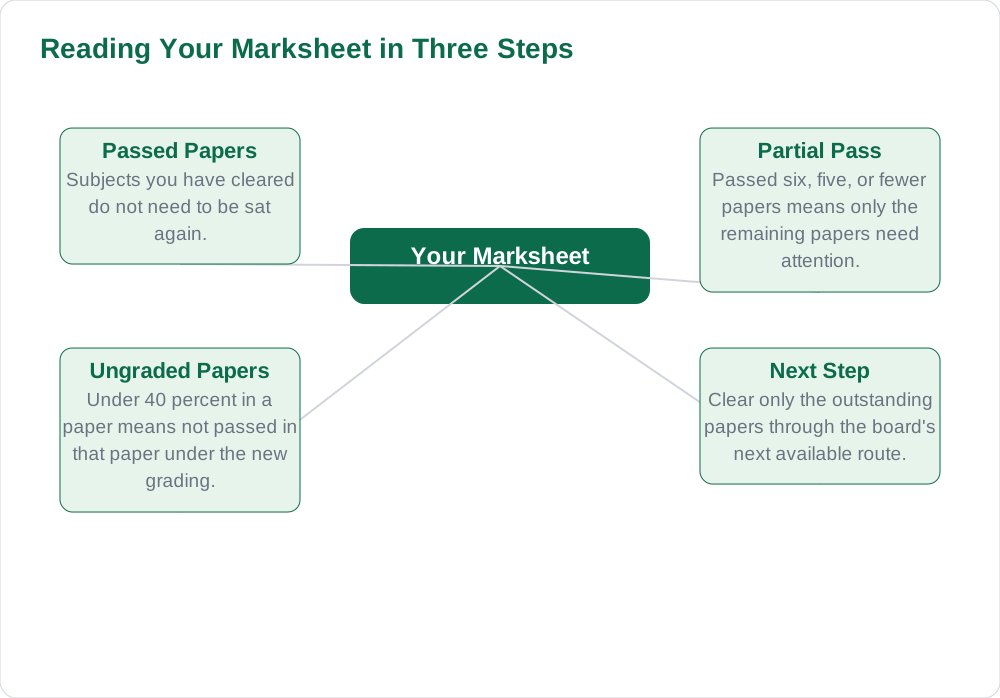
Passing all papers means the student has cleared Class 9 Science completely and moves forward without any outstanding subject from this examination. Passing six papers, the largest partial category with 21,999 students, means one paper remains, and the student's task is now focused entirely on that one subject. Passing five papers means two remain, and so on down the categories, with each step down meaning one more subject to clear. The smaller the number of passed papers, the broader the revision task, but the principle stays the same: only the outstanding papers need to be addressed, and the passed papers are already banked.
The category of 53,849 failed students needs careful reading too, because it sits alongside the partial-pass categories in the board's figures and can be misread as meaning every paper failed. A student's own marksheet is the authority, not the headline figure: it shows subject by subject what was passed and what was not. Whatever the category, the response should be subject-specific, starting with the weakest papers and the subjects where the gap is smallest and therefore quickest to close. A student who passed five papers and needs one more push in a single subject is in a very different position from a student with several papers to clear, and the plan should reflect that.
The New 40 Percent Rule and Ungraded Papers
From the 2026 annual examinations, the pass threshold was raised from 33 percent to 40 percent, and scoring under 40 percent in a paper means the paper is marked ungraded, which means not passed in that paper. This is the single most important change for students reading a 2026 marksheet, because a score that would have passed under the old 33 percent rule may now fall short. Students who scored in the 33 to 39 percent range in a paper should therefore understand their position clearly: under the new grading, that paper is not passed, and it needs to be cleared through the board's next available route, even though the score looks close to a pass.
The new grading also changes how students should prepare for the next attempt. Revision should aim comfortably above 40 percent, not at the line itself, because a paper prepared to just scrape the threshold is vulnerable to a single difficult question or a marking variation. Building a margin, by mastering the core chapters and practising past papers, is the practical response to a higher threshold. Class 10 follows the same 40 percent rule from 2027, so Class 9 students who learn this lesson now will carry it into their next class, where the same standard will apply. Solved notes for Class 9 subjects are available on Solved Notes for targeted revision.
What to Do About Failed or Ungraded Papers
The first step is to list the outstanding papers honestly and rank them by how close each one is to passing. A paper at 38 percent needs a different plan from a paper at 20 percent: the first needs consolidation and exam technique, while the second needs a fuller re-study of the subject's core chapters. Students should also ask a subject teacher to look at the marksheet with them, because a teacher can often spot whether the weakness is in a particular chapter, in presentation, or in time management during the paper. That diagnosis is worth more than simply re-reading the whole book from the first page.
The second step is to build a short, focused plan for each outstanding paper, with daily study slots and regular self-testing, rather than vague promises to study harder. Past papers are especially useful here, because they show the question patterns and the standard of answer the paper requires. Parents can help by keeping the plan realistic and by checking progress weekly, not daily, so that the student feels supported rather than pressured. The full book collection for revision is on Books, and further result guides are listed on Blog.
What This Result Does Not Cover
It is important to be precise about the scope of the 28 October announcement, because confusion here leads to wasted worry. The announcement covers the Class 9 Science Group (Regular) First Annual Examinations 2026 only. The Class 9 General Group result came earlier, on 10 September 2026, and General Group and Private Science results are not part of the 28 October announcement. A student in one of those categories should therefore not expect their result to be explained by the Science Regular figures, and should check the board's own announcements for their category instead of drawing conclusions from this one.
Students should also avoid two common mistakes when discussing the result. The first is accepting a single claimed reason for the overall pass percentage fall, when the board has published no single official reason. The second is comparing a 2026 result directly with an older sibling's or friend's result from a different grading system, since the threshold change means the two results were judged by different standards. The fair comparison is within the 2026 system: which papers are passed, which are ungraded, and what the next step is for each. That is the reading that actually helps a student move forward.
AI Help: Muse AI
Muse AI is Meta's personal AI assistant, and it can help you make sense of your Class 9 Science marksheet by explaining each pass category in simple words and building a revision plan for your outstanding papers. You can ask it to summarise a weak chapter, to create practice questions for one subject at a time, or to help you set a realistic weekly study schedule. Muse AI does not give official STBB answers — always verify against your STBB book and your teacher. Always verify against your Sindh Textbook Board book and your teacher before using anything in classwork.
Join Muse with invite code LTGSWD — in the Muse app, go to Settings > Redeem token and enter the code. Disclosure: LTGSWD is the author's Muse invite code.
5 key points you must know
- BSEK Class 9 Science (Regular) result was announced on 28 October 2026, available from 5:30 PM on bsek.edu.pk.
- 123,757 students passed all papers; partial passes range from 21,999 passing six papers down to 2,439 passing one.
- Overall pass percentage 69.56 percent, against 78.26 percent in 2025 — no single official reason published.
- From 2026, under 40 percent in a paper means ungraded, not passed in that paper.
- The 28 October announcement covers Science Regular only, not General Group or Private Science.
Frequently asked questions
When was the BSEK Class 9 Science result announced?
The Class 9 Science Group (Regular) First Annual Examinations 2026 result was announced on Wednesday 28 October 2026 and was available on bsek.edu.pk from 5:30 PM that day. This guide explains how to read that result; it is not a fresh announcement. Students should check their individual marksheet on the board's website.
What does passing six papers mean?
Passing six papers means the student has cleared all but one paper, and only the remaining paper needs attention. The board's figures show 21,999 students in this category, the largest partial-pass group. Passed papers do not need to be sat again, so revision should focus entirely on the outstanding subject.
What does ungraded mean under the new grading?
From the 2026 annual examinations, the pass threshold rose from 33 percent to 40 percent, and scoring under 40 percent in a paper means the paper is marked ungraded, which means not passed in that paper. A score between 33 and 39 percent therefore no longer passes. Students should aim comfortably above 40 percent when preparing for the next attempt.
Why is the 2026 pass percentage lower than 2025?
The overall pass percentage was 69.56 percent in 2026, compared with 78.26 percent for the Science Group in 2025, a fall of about 8.7 percentage points. The board has published no single official reason for the fall, so no one cause should be presented as fact. Individual students should focus on their own marksheet rather than the overall figure.
Does the 28 October result include General Group or Private Science students?
No, the 28 October announcement covers the Class 9 Science Group (Regular) only. The Class 9 General Group result came earlier, on 10 September 2026, and General Group and Private Science results are not part of this announcement. Students in those categories should check the board's own announcements for their category.
Solved notes — preview free
These guides work best with the solved exercises. Preview the solved notes free on this website — 119 solved notes for Classes 6–10 in Sindhi, Urdu, English and Arabic medium. Or browse the full solved notes catalogue for your class and medium. New solved notes are added regularly — check the catalogue for coming-soon books.