BSEK 9th Science: Failed Papers? What to Do Next After the 2026 Result
The Board of Secondary Education Karachi announced the Class 9 Science Group result on 28 October 2026, and one figure has worried thousands of families: 53,849 students failed. That number sits alongside a much larger and more hopeful picture, because the board's own breakdown shows tens of thousands of students who passed some papers but not all of them, and each of those students has a different, manageable path forward. This guide explains what the 28 October figures actually mean for a student who failed or passed only some papers, how the new 40% rule affects the result, and what practical steps to take now, without inventing supplementary dates or promises the board has not made.
Reading the 28 October 2026 Figures Honestly
Start with the board's own numbers, shared by Controller of Examinations Ahmed Khan Chhutto. Of 180,054 students who registered, 177,923 appeared and 2,131 were absent. A total of 123,757 students passed all papers, while the remaining appeared students fall into two groups that are often confused: the partial-pass bands and the failed group. The partial-pass bands are 21,999 students passing six papers, 11,006 passing five, 7,431 passing four, 4,409 passing three, 3,101 passing two and 2,439 passing one paper, and separately 53,849 students are recorded as failed. The overall pass percentage was 69.56%, down from 78.26% in 2025, but the board has published no single official reason for that fall, and families should not accept any single explanation presented as fact.
Why does this breakdown matter to you? Because the label on your own mark sheet decides your next step, and the headline figure does not. A student who passed six papers has one or two open papers and a short, focused job ahead, while a student in the failed group has a bigger job that still starts the same way: by listing every paper and its marks. Do not let the size of the failed figure convince you that your case is hopeless, and do not let a partial pass convince you that nothing more is needed. Both situations are common this year, both are dealt with through the board's formal processes, and both improve fastest when the student knows exactly which papers are open and by how many marks each one was missed.
Failed vs Partial Pass: Know Which Group You Are In
The distinction between a partial pass and a failed result is practical, not just a label. A partial pass means you have passed at least one paper and have specific open papers left to clear, so your plan can be built paper by paper, starting with the paper closest to passing. A failed result means no paper was passed or the result is recorded as failed overall, so the plan must be broader: a fresh, full revision of the subjects, usually with the school's guidance on whether to reappear in the papers or repeat the class as the board's rules allow. In both cases the new 40% rule applies, because from the 2026 annual examinations a paper scored below 40% is recorded as ungraded rather than passed, and Class 10 follows the same scheme from 2027.
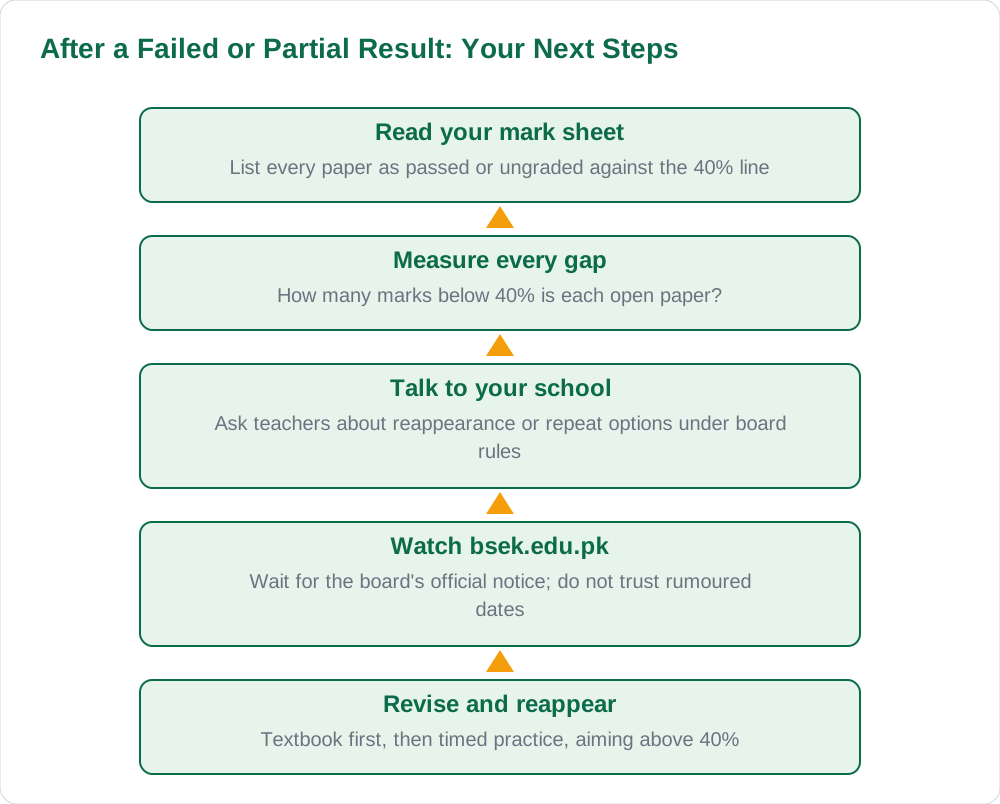
The first action is identical for both groups: read your official mark sheet, not a summary from a friend or a social media post. Write down each paper, the marks obtained, and whether it is passed or ungraded, and calculate the gap below 40% for each open paper. This list becomes your study plan, because it tells you where to spend time and where not to. A student who failed by narrow margins in several papers needs steady revision across those subjects, while a student with one wide gap needs to rebuild that subject from the textbook. For subject-wise study material, see the book collection and the solved notes, and talk to your subject teachers about which chapters carried the most marks in the papers you missed.
What to Do This Week: Practical First Steps
This week, do four concrete things. First, save and print your result from the board's official website, bsek.edu.pk, where the result has been available since 5:30 PM on 28 October 2026, and keep your admit card and registration details with it. Second, make the paper-by-paper list described above and share it with a parent and a teacher, because an adult who sees the exact gaps can help you plan realistically. Third, ask your school what support exists for students clearing papers, such as extra classes or remedial sessions, and whether the school expects you to continue into Class 10 while clearing open papers or to follow another route under the board's rules. Fourth, set a daily study slot for the open papers immediately, even before any official notice arrives, because revision started now is worth far more than revision started in a panic later.
At the same time, avoid the traps that waste this week. Do not pay any agent who promises to change a result or arrange a pass, because the board's process is formal and no unofficial channel can alter a mark sheet. Do not trust supplementary examination dates, fee figures or form links shared on social media unless they appear on the board's official website or your school notice board, since no reappearance date for these papers was stated in the 28 October announcement. Do not hide the result from your parents or teachers out of embarrassment; the board's figures show that tens of thousands of students are in the same position this year, and teachers deal with clearing papers every year. A result shared early gets help early, while a result hidden until the next examination becomes a crisis.
Building a Revision Plan That Actually Closes the Gaps
A good revision plan for failed or ungraded papers starts from the textbook, not from short notes or guess papers. For each open paper, list the chapters, mark the ones where you lost the most marks, and work through them in order of marks weight, using solved exercises to check that your method is correct. Study in short, daily sessions rather than rare marathon sessions, and test yourself after each chapter with questions answered under timed conditions, because the examination rewards students who can produce answers under pressure, not students who have merely read the chapter. Keep a weekly checklist of chapters completed and practice tests taken, and review it every weekend so that slippage shows up while there is still time to correct it.
Balance is the hardest part of this plan, because Class 10 schoolwork continues at the same time for most students. Protect Class 10 school hours and homework time, and give the open Class 9 papers one or two focused hours a day, starting with the paper closest to passing so that an early success builds momentum. Science subjects overlap heavily between Class 9 and Class 10, so revising a Class 9 physics or chemistry chapter often strengthens the Class 10 chapter built on it, and that overlap should be used deliberately. If the number of open papers is large, be honest about the load: prioritise the papers closest to passing, talk to teachers about a realistic sequence, and remember that clearing papers properly, even if it takes longer, is far better than facing the next examination unprepared.
Staying Steady: Results, Rumours and the Next Examination
A failed or partial result is emotionally hard, and students should be honest about that instead of pretending it does not matter. It is normal to feel disappointed, especially when classmates passed everything, but the board's figures prove that this year's result was difficult for a very large number of students, and a single examination does not fix a student's ability or future. Chairman Professor Musharraf Ali Rajput congratulated students who passed all papers and said transparency remained among the board's top priorities, and the fair way to read that message is that the system is meant to be navigable: open papers can be cleared through the board's own process, and students who follow that process do move forward. Comparing yourself with toppers helps no one; comparing today's marks with your own next attempt is the comparison that matters.
The steady approach is to keep two habits running until the next opportunity arrives: daily revision of the open papers, and weekly checks of the board's official website and your school notice board for the reappearance notice. When that notice appears, read it fully, noting eligibility, fee, last date and examination centre instructions, and complete the process through your school or the board's official channel as the notice directs. Until then, treat every unofficial date, fee claim or shortcut offer as unverified, keep your documents safe, and keep studying. The blog carries further study guides for Sindh board students, and the contact page explains how to reach this site with questions about study material.
AI Help: Muse AI
Muse AI is Meta's personal AI assistant, and it can help you study by explaining a tough chapter in simple words or by making short practice questions for revision. For this topic, you can ask Muse AI to build a daily revision timetable for your open papers, starting with the paper closest to passing, then adjust it with your teacher.
Join Muse with invite code LTGSWD — in the Muse app, go to Settings > Redeem token and enter the code.
Disclosure: LTGSWD is the author's Muse invite code.
Muse AI does not give official STBB answers — always verify against your STBB book and your teacher. In other words, always verify against your Sindh Textbook Board book before trusting any answer in an exam.
5 key points you must know
- 53,849 students failed in the BSEK Class 9 Science result announced on 28 October 2026.
- Tens of thousands more passed only some papers, from 21,999 passing six papers down to 2,439 passing one.
- Below 40% in a paper means ungraded under the new rule, not passed.
- List every open paper and its gap below 40% before making any plan.
- Watch bsek.edu.pk for the official reappearance notice; no date was stated in the 28 October announcement.
Frequently asked questions
How many students failed the BSEK Class 9 Science result 2026?
According to the figures shared by Controller of Examinations Ahmed Khan Chhutto, 53,849 students failed out of 177,923 who appeared. Separately, large numbers of students passed only some papers, including 21,999 who passed six papers and 11,006 who passed five.
I passed some papers but not all. What should I do first?
Read your official mark sheet and list every paper as passed or ungraded against the 40% threshold, noting how far below 40% each open paper fell. Share that list with a parent and a teacher, then start daily revision of the open papers while watching bsek.edu.pk for the board's official reappearance notice.
Does a paper scored at 35% count as passed?
No. From the 2026 annual examinations, Class 9 papers require 40% to pass, and a paper scored below 40% is recorded as ungraded. The old 33% threshold no longer applies to Class 9.
When will the supplementary or reappearance exams be held?
No reappearance date for these papers was stated in the board's 28 October 2026 announcement. Check the board's official website, bsek.edu.pk, and your school notice board for the official notice, and treat dates circulating on social media as unverified.
Can I continue into Class 10 while clearing Class 9 papers?
Most students do continue Class 10 schoolwork while clearing open papers, giving Class 10 its school hours and protecting one or two focused hours a day for the open papers. Ask your school about its arrangement for your case, since the school can advise on the route the board's rules allow for your result.
Solved notes — preview free
These guides work best with the solved exercises. Preview the solved notes free on this website — 119 solved notes for Classes 6–10 in Sindhi, Urdu, English and Arabic medium. Or browse the full solved notes catalogue for your class and medium. New solved notes are added regularly — check the catalogue for coming-soon books.