Unfair Means Rules and Consequences in Board Exams
Every board examination runs on one promise: every candidate is judged on their own work under the same conditions. Unfair means is the board's name for anything that breaks that promise, from copying and smuggled notes to impersonation and tampering with a script. The rules sound severe because the stakes are high, but they also protect honest pupils, whose results would be devalued if cheating went unpunished. This guide explains, in general terms, what counts as unfair means, how it is detected and reported, what consequences boards generally apply, and how an honest pupil can avoid trouble entirely, including trouble caused by someone else. Exact penalties differ between boards, so treat this as general guidance and confirm the details in your board's official rules.
What Counts as Unfair Means
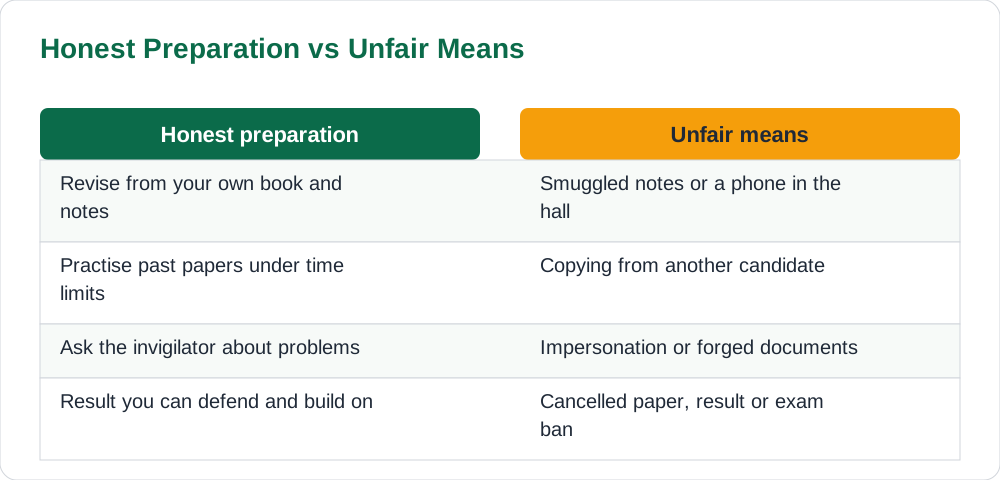
The most obvious forms are copying from another candidate, using notes, books, a mobile phone or any other unauthorised material, and communicating with another candidate during the paper. But the definition is wider than that. It also covers impersonation, where someone else sits the paper; exchanging answer sheets; writing on anything other than the permitted sheet, such as the desk or hand, in order to carry notes; and refusing to hand over material when asked. Even possessing unauthorised material, without using it, is treated as an offence in many boards, because possession alone breaks the fairness of the hall.
Less obvious forms include threatening or bribing staff, forging documents such as a roll number slip, and tampering with an answer sheet after it is collected. Outside the hall, it includes leaking a paper before the examination and paying someone to sit in your place. The common thread is simple: any act that gives a candidate an advantage not available to every other candidate, or that undermines the board's ability to trust the result, falls under unfair means. When in doubt about an item or an action, the safe rule is to ask the invigilator before the paper starts.
How Unfair Means Is Detected and Reported
Detection starts in the hall. Invigilators watch the room, check materials, and note anything unusual in a hall report. Centre superintendents may search belongings where the rules allow it, and some centres use additional checks at the gate. After the paper, examiners can spot copying from identical unusual answers, and board offices compare scripts and attendance records. Modern checks also include matching handwriting where impersonation is suspected. A case is not decided on suspicion alone: the material is seized, the candidate's statement is usually recorded, and the case is sent to the board with the centre's report.
The board then considers the case under its own procedure, which usually gives the candidate a chance to respond before a decision is made. This is why staying calm and factual matters if you are ever questioned: anything you say may be recorded and sent with the case. Pupils who are innocent should cooperate fully, hand over what is asked for, and explain plainly, because resistance or argument is itself recorded and can make a simple misunderstanding look worse. If a case is opened against you wrongly, your school is the channel for presenting your side with any evidence you have.
General Consequences Boards Apply
Consequences are graded to the offence, but they are all serious. The lightest outcomes include cancellation of the single paper concerned, so the candidate must reappear in that paper. More serious cases can lead to cancellation of the whole examination result for that year, meaning all papers are lost. The most serious cases, such as impersonation or organised cheating, can bring a ban from board examinations for one or more years, and in some cases a permanent record that affects admission elsewhere. Fines and police action are possible for offences such as paper leakage or forgery, which are also offences under the law, not only board rules.
It is important to understand that consequences usually fall on the candidate, even when someone else suggested or supplied the cheating method. A pupil who copies from a neighbour, uses notes a friend passed them, or lets someone else sit the paper cannot shift the blame to that other person. Parents should also know that pressuring a child to cheat, or paying for leaked papers or impersonation, can harm the child's record for years. The short-term gain of one paper is never worth the long-term loss of a year, a result or a reputation. For what happens after a result is affected, see supplementary exams explained.
How Honest Pupils Stay Safe
The best protection is boring: bring only allowed items, sit in your assigned seat, keep your eyes on your own paper, and do not talk or pass anything during the paper. Check your pockets and pouch before entering the hall, because an old note forgotten in a pocket counts as possession even if you never look at it. If a neighbour tries to copy from you, do not react or cover your work dramatically; shield your sheet calmly and, if it continues, raise your hand and tell the invigilator quietly. You are not responsible for another pupil's attempt, but you should not help it either.
Be careful about help offered before the paper too. Do not accept notes, photographs of papers, or offers to sit the paper for you, however friendly the offer sounds, and do not share your roll number slip or identity details with anyone who does not need them. If someone pressures you to cheat, tell a teacher or parent; the pressure itself is a problem worth reporting. Finally, never buy leaked papers or answers online: most are fake, and the genuine ones are a trap that can end a pupil's board career. Honest preparation, even when it feels slower, is the only route that cannot be taken away from you. Build that preparation from your own textbook, the books catalogue and the solved notes library, and read other board guides on the blog index.
If a Case Is Opened Against You
If you are questioned, stay calm, cooperate, and answer truthfully. Do not argue, do not refuse to hand over material, and do not leave the hall without permission, because each of these makes the record worse. Note the names of staff involved and the facts of what happened, as soon as you can after the paper, while the memory is fresh. Tell your parents and your school the same day, and ask the school how to respond under the board's procedure, including any written statement or hearing the board allows.
A written response should stick to facts: what happened, in what order, and what evidence supports your version, such as your own notes or a teacher who can confirm your preparation. Avoid blaming others without evidence, and avoid emotional language that distracts from the facts. If the decision goes against you, ask the school about the appeal or review route the board provides, and the deadline for it, because these deadlines are usually short. Whatever the outcome, learn from it: even an unfounded case is a reminder of how seriously the hall rules are taken, and why the simple habits in this guide matter.
AI Help: Muse AI
Muse AI is Meta's personal AI assistant, and it can help you prepare honestly, for example by generating practice questions from your own textbook chapters so you walk into the hall confident in your own work.
Join Muse with invite code LTGSWD — in the Muse app, go to Settings > Redeem token and enter the code.
Disclosure: LTGSWD is the author's Muse invite code.
Muse AI does not give official STBB answers — always verify against your Sindh Textbook Board book and your teacher.
5 key points you must know
- Unfair means covers copying, unauthorised material, communication, impersonation and forgery.
- Merely possessing unauthorised material in the hall can count, even if you never use it.
- Consequences range from cancelling one paper to cancelling the whole result or a multi-year ban.
- Check pockets and pouches before entry — a forgotten note still counts as possession.
- If questioned, stay calm, cooperate, note the facts, and report to your school the same day.
Frequently asked questions
Is it unfair means if I have notes in my pocket but never look at them?
In many boards, yes — possession of unauthorised material inside the hall is itself an offence, even without use. Empty your pockets and pouch of all notes before entering.
What happens if another pupil copies from my paper?
Shield your sheet calmly and, if it continues, raise your hand and tell the invigilator quietly. You are not automatically punished for another pupil's attempt, but do not help it or react in a way that disturbs the hall.
Can a board cancel my whole result for one paper's offence?
Yes, depending on the offence and the board's rules. Consequences range from cancelling one paper to cancelling the whole examination result, and serious cases can bring a ban from future examinations.
What should I do if I am accused of something I did not do?
Stay calm, cooperate, and note the facts immediately after the paper. Tell your parents and school the same day and respond through the board's procedure with a factual written statement.
Are leaked papers sold online real?
Most are fake, and any genuine leak is a trap: using leaked material is unfair means and can cost you your result or your board career. Prepare from your own book instead.
Solved notes — preview free
These guides work best with the solved exercises. Preview the solved notes free on this website — 119 solved notes for Classes 6–10 in Sindhi, Urdu, English and Arabic medium. Or browse the full solved notes catalogue for your class and medium. New solved notes are added regularly — check the catalogue for coming-soon books.