Practical Exam Day: Procedure and What to Expect
Practical examinations feel very different from written papers. Instead of sitting silently at a desk, you move around a laboratory, handle apparatus, perform an experiment, record readings and answer questions about what you did. That unfamiliarity makes many pupils nervous, but the procedure itself is orderly and predictable, and knowing it in advance removes most of the fear. This guide walks through practical exam day from arrival to viva, covering lab rules, the experiment, the record file and the viva, in general terms for science subjects in Sindh and Pakistan. Exact apparatus, experiments and marking schemes depend on your subject and board, so your teacher's briefing and your practical notebook remain your best specific guides.
Before the Day: The Record File
The practical record file, or journal, is the document the examiner checks first. It should contain the experiments you performed during the year, written in your own hand, with the aim, apparatus, procedure, observations, readings, calculations and result for each one, plus diagrams where the experiment needs them. Teachers usually check and sign the file during the year, and an unsigned or incomplete file can lose marks before you even begin. Finish the file well before the practical day, not the night before, so you have time to correct errors and get the teacher's signature.
Revise from the file, not from a new book, in the last days before the exam. Read through each experiment and ask yourself what the examiner might ask: why this apparatus, what this reading means, what would happen if a variable changed, and where errors creep in. Practise the diagrams until you can draw and label them quickly, because a labelled diagram often carries marks of its own. Pack the file the night before, together with your roll number slip, a lab coat or apron if your school requires one, and your stationery, so the morning is calm.
Arrival and the Lab Rules
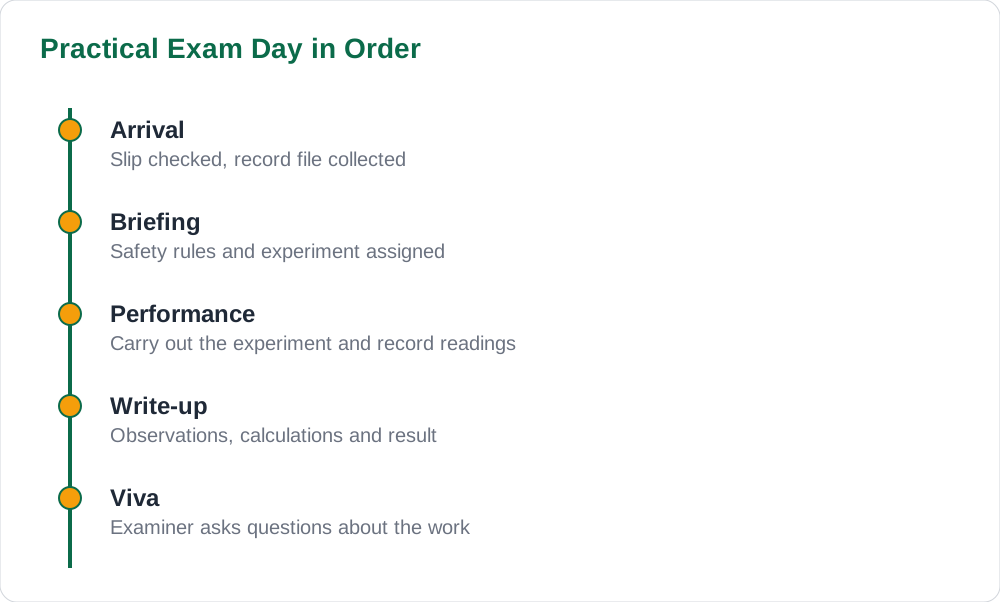
Arrive early, as for a written paper, with your roll number slip and record file. The examiner, who is usually a teacher from another school, will check attendance and may check the record file before the work begins. Listen carefully to the opening instructions, which cover safety rules, the time allowed, and how the experiments are assigned: sometimes every pupil does the same experiment, sometimes different pupils draw different experiments by lot. Either way, the procedure is explained before anyone starts, so there is no need to guess.
Lab safety rules are part of the examination, not an extra. Wear closed shoes, tie back long hair, do not eat or drink in the lab, and handle chemicals, glassware and flames exactly as instructed. Report any breakage or spill to the examiner at once rather than hiding it, because a hidden hazard is more dangerous than an admitted accident. Do not touch apparatus that is not part of your experiment, and do not borrow reagents or instruments without asking. A calm, tidy bench is itself a mark of a good practical candidate.
Performing the Experiment
Read the whole experiment instruction before touching the apparatus. Note what is to be measured, what apparatus is provided, and what result is expected, then plan the steps in your head. Set up the apparatus carefully and check it before starting: a loose connection or a wrongly zeroed instrument wastes more time later than a careful start. Take readings honestly and record them as you go, including units, because readings invented afterwards are easy for an examiner to spot and are treated as dishonest work.
If an experiment goes wrong, do not panic and do not fake the result. Tell the examiner what happened and ask whether you may repeat a step or restart, which is often allowed within the time. Examiners value honest method over a perfect-looking result: a candidate who records a genuine failed attempt, explains the likely error and repeats the measurement shows real scientific thinking. Keep your bench tidy as you work, return apparatus to its place, and clean up spills at once, because the state of your bench is part of the impression you leave.
The Write-Up: Observations and Calculations
The write-up is where the experiment becomes marks. Record observations in the order you made them, show the readings in a table with units, and show the calculation steps rather than only the final answer, so partial credit is possible even if the final figure is off. Draw diagrams with a pencil, label them fully, and keep them large enough to read. If the experiment involves a graph, choose sensible scales, label both axes with units, and plot the points carefully, because a graph drawn in a rush is a common source of lost marks.
Write the result as a clear statement with its unit, and add a short note on precautions or sources of error where the experiment calls for it, such as parallax error, heat loss or friction. Do not copy readings or results from a neighbour: examiners compare neighbouring files and identical unusual figures are a red flag. If your result differs from the expected value, say so honestly and suggest a reason, rather than altering figures to match. A truthful write-up with a small error is worth far more than a perfect-looking one the examiner does not believe.
The Viva: Questions About Your Work
The viva is a short oral test, usually a few minutes, in which the examiner asks about the experiment you performed and the theory behind it. Typical questions include why a particular apparatus was used, what a reading means, what would change if a variable were altered, and how an error could be reduced. Answer in your own words, briefly and directly, and say when you do not know rather than guessing wildly. Examiners are testing understanding, not memory of a script, and a short honest answer beats a long confused one.
Prepare for the viva by revising the theory of every experiment in your file, not only the one you performed, because the examiner may ask about any of them. Practise explaining each experiment aloud in two or three sentences, as if teaching it to a friend, which is the best preparation for answering under pressure. Stay polite and calm, listen to the whole question before answering, and do not argue with the examiner about a mark or a question. After the viva, leave the lab quietly, return any borrowed apparatus, and keep your record file safe until the result, in case it is needed again. For revision material while you wait, the solved notes library and the books catalogue are useful starting points, and other board guides sit on the blog index.
AI Help: Muse AI
Muse AI is Meta's personal AI assistant, and it can help you prepare for practicals, for example by turning an experiment's procedure into a step-by-step rehearsal or by quizzing you with likely viva questions.
Join Muse with invite code LTGSWD — in the Muse app, go to Settings > Redeem token and enter the code.
Disclosure: LTGSWD is the author's Muse invite code.
Muse AI does not give official STBB answers — always verify against your Sindh Textbook Board book and your teacher.
5 key points you must know
- Finish and get your record file signed well before practical day — it is checked first.
- Read the whole experiment instruction before touching any apparatus.
- Record readings honestly, with units, as you go — never invent figures afterwards.
- Show calculation steps and label diagrams fully so partial credit is possible.
- In the viva, answer briefly in your own words and admit what you do not know.
Frequently asked questions
What is the practical record file?
It is your journal of the year's experiments, written by hand with aim, apparatus, procedure, observations, readings, calculations and result for each experiment, usually checked and signed by your teacher.
What happens if my experiment fails during the exam?
Tell the examiner at once and ask whether you may repeat a step or restart. Honest method and an explained failure are valued far more than a faked result.
How long does the viva usually last?
Usually only a few minutes. The examiner asks about the experiment you performed and the theory behind it, so revise the theory of every experiment in your file, not just one.
Do I need to bring my own apparatus?
Usually the laboratory provides the apparatus and chemicals, and you bring your record file, roll number slip and stationery. Your teacher will confirm anything extra your subject requires.
Can I copy readings from a neighbour if my apparatus fails?
No — copied readings are treated as dishonest work and examiners compare neighbouring files. Report the failure to the examiner and ask for guidance instead.
Solved notes — preview free
These guides work best with the solved exercises. Preview the solved notes free on this website — 119 solved notes for Classes 6–10 in Sindhi, Urdu, English and Arabic medium. Or browse the full solved notes catalogue for your class and medium. New solved notes are added regularly — check the catalogue for coming-soon books.