Board Enrolment and Registration Explained for Pupils
Before any pupil sits a board examination, their name has to be entered in the board's record. That entry process is called enrolment, and the later step of entering the pupil for a specific examination is called registration. Many pupils only hear these words when a teacher asks them to check a form, but understanding them early matters, because every detail recorded at this stage — spelling of the name, father's name, date of birth, subjects and group — follows the pupil onto the roll number slip, the answer sheet and finally the certificate. This guide explains what enrolment means, what schools usually submit, what pupils should check, and what to do if something looks wrong. Always confirm the exact form, fee and deadline on your own board's official notice or portal, because procedures differ between boards such as BSEK Karachi for matric and BIEK Karachi for intermediate.
What Enrolment Actually Means
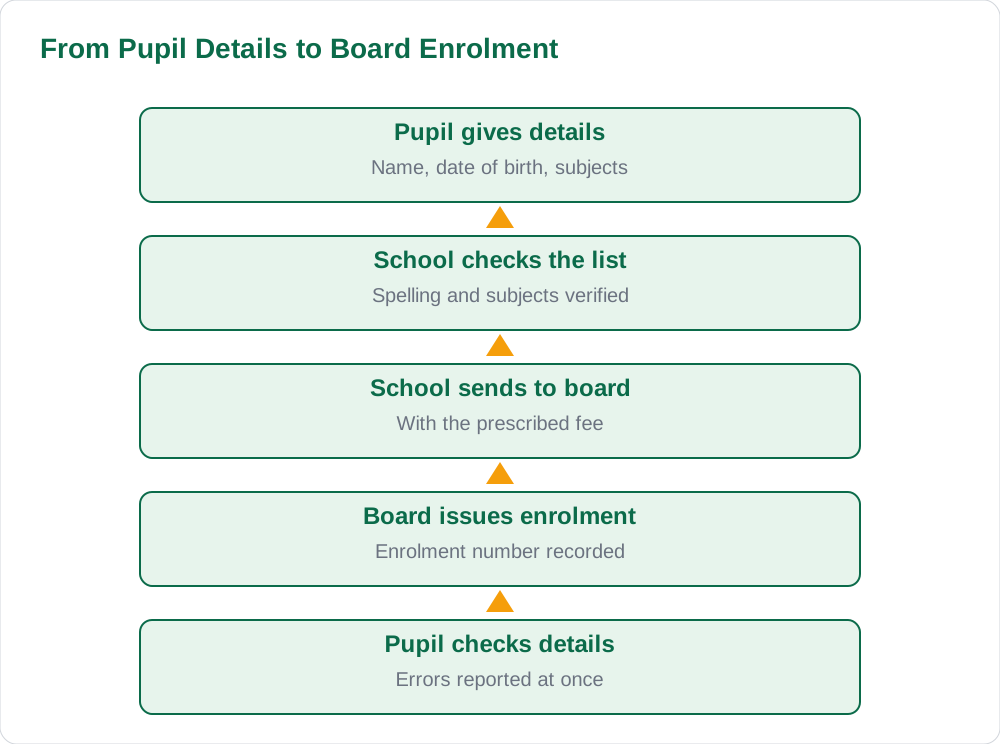
Enrolment is the board's first official record of a pupil. When a pupil enters Class 9 or Class 11, the school normally sends the board a list of its pupils together with their basic particulars, and the board issues an enrolment number. That number stays with the pupil for the whole board stage, so a Class 9 pupil's enrolment number is usually the same one used again in Class 10, and a Class 11 pupil's number carries into Class 12. It is different from the roll number, which changes with each examination and identifies the pupil only for that one exam sitting.
Think of enrolment as opening a file, and registration as adding an exam entry to that file. A pupil can be enrolled but not yet registered for an examination, and it is the registration step that actually makes the pupil eligible to sit the annual exam. Schools handle both steps on the pupil's behalf in most cases, which is why pupils rarely see the forms themselves. Even so, the details on those forms belong to the pupil, and a mistake made here is much harder to fix after the examination than before it. That is why teachers often ask pupils to read their particulars aloud or sign a verification sheet.
What Schools Usually Submit for You
Schools normally collect a set of documents and details from each pupil before sending anything to the board. The usual items are the pupil's full name as written on official identity documents, the father's name, the date of birth, the subjects and group chosen, and a recent photograph. Some boards also ask for the pupil's previous class result or school leaving record. The school then checks the list, forwards it to the board, and pays any prescribed fee for the batch. Pupils are usually not expected to visit the board office themselves at this stage.
Because the school acts as the middleman, the pupil's main job is to give correct information on time. A common problem is a name spelled differently from the identity document, for example a missing middle name or a swapped letter, which then appears on every later document. Another is a wrong subject or group, such as science subjects listed for a pupil who chose humanities. Giving the school a photocopy of the identity document and reading back the details the school has recorded are two simple habits that prevent most of these errors. If your school keeps a books page or notice board with its own instructions, follow those as well.
Registration for the Annual Examination
Registration is the step that enters an enrolled pupil for a particular examination, such as the Class 9 annual exam or the Class 12 annual exam. It usually happens later in the school year, and it confirms the subjects the pupil will actually sit, including any practical subjects. Once registration is complete, the board prepares the roll number slip from these registered details, so the subjects on the slip should match the subjects the pupil has been studying all year. Any mismatch at this stage needs to be raised with the school immediately.
Pupils sometimes confuse registration with admission to a college or school, but the two are separate. School admission makes you a pupil of the institution; board registration makes you a candidate for the board's examination. A pupil who has left school, or who has been admitted very late, should ask the school office directly whether their board registration has gone through, rather than assuming it. Private candidates, where the board allows them, follow a different route and should read the board's own instructions for private registration instead of relying on a regular pupil's process. The solved notes library is a good place to keep revising while this paperwork is handled.
Checking Your Own Details: A Simple Routine
The safest routine is a short one. First, compare the name and father's name on any school list or form with your identity document, letter by letter. Second, check the date of birth, because a wrong date of birth is one of the hardest details to correct later. Third, read the subject and group list and make sure every subject you study is present and no subject you dropped is still listed. Fourth, check the photograph, where one is shown, to make sure it is actually yours. If anything differs, tell the school office in writing, keep a copy of what you submitted, and ask when the correction will be sent to the board.
Do this check twice if you can: once when the school first collects details, and again when the roll number slip arrives, because the slip is the last easy chance to spot an error before the examination. Many correction problems that seem small, such as a single wrong letter in a name, become long procedures after the result is declared, sometimes requiring an application, an affidavit and a fee. Spending ten minutes checking now can save months later. Parents can help by keeping a file of every school receipt and form copy, so the family always has proof of what was submitted and when.
Common Problems and How to Handle Them
The most common problems are a missing name on the school's board list, a wrong group or subject, and a fee or form submitted after the board's deadline. A missing name usually means the school's list was sent before the pupil's admission was complete, and it is fixed by the school sending a supplementary list if the board's rules allow it. A wrong subject is fixed the same way, through the school, not by the pupil writing directly to the board. Late submissions sometimes carry a late fee, and sometimes are not accepted at all, which is why teachers press pupils for documents early in the year rather than near the examination.
If a problem cannot be solved at school level, the next step is a written application through the school to the board, following the board's published procedure for that kind of correction. Pupils should never pay an unofficial person who promises to fix a board record, and should never trust a social media post that claims a new deadline or fee. The only reliable source is the board's official notice, portal or office, and the school office is the right channel for asking about it. For general guidance on reading board documents, see how to read a marksheet and what to do if an exam is postponed.
AI Help: Muse AI
Muse AI is Meta's personal AI assistant, and it can help you understand board paperwork in plain language, for example by explaining the difference between enrolment and registration or by helping you draft a checklist of details to verify with your school.
Join Muse with invite code LTGSWD — in the Muse app, go to Settings > Redeem token and enter the code.
Disclosure: LTGSWD is the author's Muse invite code.
Muse AI does not give official STBB answers — always verify against your Sindh Textbook Board book and your teacher.
5 key points you must know
- Enrolment opens your board record; registration enters you for a specific examination.
- Your enrolment number usually stays the same across both years of a board stage.
- Check name spelling, father's name, date of birth, subjects and photograph against your identity document.
- Raise any error through your school at once — corrections get harder after the result.
- Confirm the exact form, fee and deadline on your own board's official notice or portal.
Frequently asked questions
What is the difference between enrolment and registration?
Enrolment creates your first official record with the board and gives you an enrolment number. Registration enters you for a particular annual examination, confirming the subjects you will sit. Both are usually handled by your school.
Who fills in the enrolment form — the pupil or the school?
In most cases the school collects the pupil's details and submits them to the board as a batch. The pupil's job is to give correct information on time and to check the recorded details carefully.
What should I check first on my enrolment details?
Check the spelling of your name and your father's name against your identity document, then the date of birth, then the subject and group list, and finally the photograph if one is shown.
What happens if my name is spelled wrong on the board record?
Tell your school office at once and ask for a correction through the board's procedure. Errors found before the examination are much easier to fix than errors found after the result is declared.
Can I enrol myself directly with the board?
Regular pupils normally go through their school. Private candidates, where the board allows them, follow a separate published procedure, so read your board's official instructions for that route.
Solved notes — preview free
These guides work best with the solved exercises. Preview the solved notes free on this website — 119 solved notes for Classes 6–10 in Sindhi, Urdu, English and Arabic medium. Or browse the full solved notes catalogue for your class and medium. New solved notes are added regularly — check the catalogue for coming-soon books.