Biology: Plant Cell vs Animal Cell Diagram
Plant cells and animal cells look similar at first glance, because both are living units with a nucleus, cytoplasm, and a surrounding membrane, yet they differ in ways that examiners test again and again. The differences are not random details; each one matches the different life of a plant and an animal. Plants make their own food, stand upright without bones, and store large amounts of sap, so their cells have extra structures for those jobs. Animals move, eat ready-made food, and have flexible bodies, so their cells stay soft and changeable. This guide compares the two cells side by side, explains every difference, and shows how to present the comparison clearly in an exam answer.
What Plant and Animal Cells Share
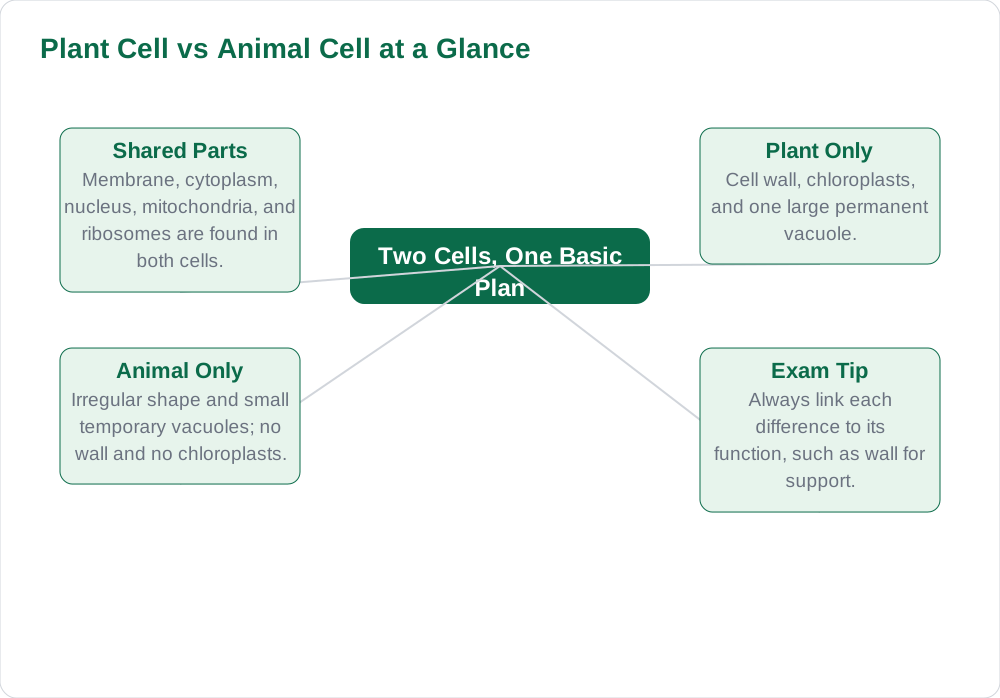
Every comparison should start with what is the same, because shared parts show that both cells are built on one basic plan. Both plant and animal cells have a cell membrane, a thin boundary that controls what enters and leaves the cell. Both have cytoplasm, the jelly-like substance where chemical reactions happen and organelles are suspended. Both have a nucleus, which controls the cell and contains genetic material, and both have mitochondria, where energy is released from food, and ribosomes, where proteins are made. These shared parts carry out the basic jobs of life in every cell, whatever organism it belongs to.
Starting with similarities also prevents a common exam mistake: listing a shared part as if it were a difference. Students sometimes write that only animal cells have mitochondria, or that only plant cells have a nucleus, and both claims are wrong. A safe habit is to memorise the shared list first, membrane, cytoplasm, nucleus, mitochondria, ribosomes, and then add the differences on top of it. When you can state the shared plan confidently, the differences become easier to explain, because each difference is an extra feature added to the same foundation, not a completely different kind of cell.
Three Features Found Only in Plant Cells
Plant cells have three features that animal cells lack, and these three are the heart of almost every plant-versus-animal question. The first is the cell wall, a tough layer made of cellulose that lies outside the cell membrane and gives the plant cell its fixed, regular shape and extra strength. The second is the chloroplast, a green organelle containing chlorophyll, which traps light energy so the plant can carry out photosynthesis. The third is the large permanent vacuole, a sac filled with cell sap that stores water and dissolved substances and pushes the cytoplasm to the edges of the cell, keeping it firm and swollen.
Each of these features matches a plant's way of life. The cell wall supports the plant so it can stand tall without a skeleton, and it protects the cell from bursting when water enters. Chloroplasts let the plant make its own food from sunlight, water, and carbon dioxide, which is why plants do not need to eat. The large vacuole stores water and helps keep leaves firm, which is why a plant wilts when it loses water and the vacuole shrinks. When you explain a difference, always add its reason like this, because examiners reward answers that link structure to function instead of just listing names.
How the Diagrams Look Different
In a diagram, the differences are visible before a single word is read. A plant cell is drawn with a regular, often rectangular shape, a double outline for the cell wall plus membrane, a large central vacuole, and small green chloroplasts scattered in the thin layer of cytoplasm. Its nucleus is pushed to one side by the vacuole, which is a realistic detail that examiners notice. An animal cell, by contrast, is drawn with a rounded, irregular outline, a single membrane boundary, a central nucleus, and only small vacuoles, if any are shown at all, with no wall and no chloroplasts anywhere.
Drawing the two cells side by side is the best revision exercise for this topic, because it forces you to decide every feature twice, once for each cell. Use the same size for both diagrams so the comparison is fair, label the same shared parts in both, and then add the three plant extras only to the plant diagram. Label the cell wall as a separate line from the membrane, or the examiner may think you drew one thick membrane. A side-by-side pair with matching labels is also an excellent exam answer when a question asks for a comparison, since it shows the differences visually as well as in words.
Writing the Comparison as a Table
In written answers, a table is the clearest way to compare plant and animal cells, and it is faster to mark than two long paragraphs. Make two columns, one for plant cells and one for animal cells, and one row for each feature: shape, cell wall, chloroplasts, vacuole, and nucleus position. Write short, exact entries, such as regular shape versus irregular shape, or large permanent vacuole versus small temporary vacuoles, rather than vague phrases like bigger or different. A table with five or six rows covers the whole topic and leaves no doubt about what you know, which is why teachers recommend it for comparison questions.
A table also helps you check your own answer before moving on. Read across each row and ask whether the two entries genuinely contrast, and read down each column and ask whether every entry belongs to that cell type. If a row says that plant cells have a nucleus and animal cells do not, you have caught an error, because both have a nucleus. If a row lists chloroplasts for animal cells, that is another error to fix. This quick self-check takes less than a minute and prevents the small slips that cost marks in an otherwise strong answer, so always leave time to re-read your table.
Common Mistakes and Quick Revision
The most frequent mistake is giving animal cells a cell wall or chloroplasts, usually because a student memorised a plant diagram and repeated it for both cells. Another common error is drawing a tiny vacuole in a plant cell, which misses the point that the plant vacuole is large and permanent. A third mistake is writing that animal cells have no vacuoles at all, when the correct statement is that they have small, temporary ones. Being precise with words like permanent, temporary, large, and small matters, because these are the words examiners use in their mark schemes, and vague answers earn only partial credit.
For quick revision, draw both cells from memory, label them, and then write one sentence for each difference explaining its function. Test yourself with questions like which cell has a wall and why, or which cell carries out photosynthesis and how. For more biology study guides and solved notes, visit Solved Notes, browse the book collection on Books, and explore other revision articles on the Blog to build a complete and organised set of notes for your exams.
AI Help: Muse AI
Muse AI is Meta's personal AI assistant, and it can help you compare plant and animal cells by turning the differences into a quick quiz, such as asking which cell has a cell wall and why. You can ask it to check a comparison table you wrote, or to explain one difference at a time in simple words. Muse AI does not give official STBB answers — always verify against your STBB book and your teacher. Always verify against your Sindh Textbook Board book and your teacher before using anything in classwork.
Join Muse with invite code LTGSWD — in the Muse app, go to Settings > Redeem token and enter the code. Disclosure: LTGSWD is the author's Muse invite code.
5 key points you must know
- Both cells share membrane, cytoplasm, nucleus, mitochondria, and ribosomes.
- Plant cells alone have a cellulose cell wall, chloroplasts, and a large permanent vacuole.
- The plant cell is regular in shape; the animal cell is rounded and irregular.
- Each difference links to function: wall for support, chloroplasts for photosynthesis, vacuole for storage.
- A two-column table is the clearest way to present the comparison in an exam.
Frequently asked questions
What are the three main differences between plant and animal cells?
Plant cells have a cell wall, chloroplasts, and a large permanent vacuole, while animal cells have none of these three features. Animal cells instead have an irregular shape and only small, temporary vacuoles. These three differences are the core of almost every plant-versus-animal exam question.
Why do plant cells have a cell wall?
The cell wall, made of cellulose, gives the plant cell strength and a fixed shape, helping the whole plant stand upright without bones. It also prevents the cell from bursting when water enters by osmosis. Animal cells do not need a wall because animals have skeletons and flexible bodies for support and movement.
Do animal cells have vacuoles?
Yes, but animal cell vacuoles are small and temporary, unlike the single large permanent vacuole of a plant cell. Animal vacuoles may store food or waste for a short time and then disappear. Saying animal cells have no vacuoles at all is imprecise, so always use the words small and temporary.
Why is the plant cell nucleus pushed to one side?
In a plant cell, the large central vacuole takes up most of the space and pushes the thin layer of cytoplasm, along with the nucleus, to the edges of the cell. This is a normal feature of a mature plant cell, not a drawing error. In an animal cell, with no large vacuole, the nucleus usually sits near the centre.
How should I answer a compare question in an exam?
Use a two-column table with one row per feature, such as shape, cell wall, chloroplasts, vacuole, and nucleus position. Write short, exact entries that genuinely contrast, and add the function where it helps, for example that the wall gives support. Then re-read each row to check that no shared part has been listed as a difference.
Solved notes — preview free
These guides work best with the solved exercises. Preview the solved notes free on this website — 119 solved notes for Classes 6–10 in Sindhi, Urdu, English and Arabic medium. Or browse the full solved notes catalogue for your class and medium. New solved notes are added regularly — check the catalogue for coming-soon books.