Biology: Photosynthesis Diagram and Process
Photosynthesis is the process by which green plants make their own food, and it is one of the most important processes on Earth, because nearly all food chains begin with it. Using light energy trapped by chlorophyll, a plant combines carbon dioxide from the air with water from the soil to produce glucose, a sugar it can use for energy and growth, and releases oxygen as a by-product. This guide explains the process step by step, shows how to draw and label a photosynthesis diagram, and explains the factors that speed it up or slow it down. By the end, you will be able to write the word equation, describe where the process happens, and explain why plants matter to every living thing.
The Word Equation Every Student Must Know
The word equation for photosynthesis is carbon dioxide plus water, in the presence of light energy and chlorophyll, gives glucose plus oxygen. Every word in this equation matters, so learn it as a sentence you can write without thinking. Carbon dioxide enters the leaf from the air through tiny pores called stomata, and water travels up from the roots through the xylem vessels. Glucose is the food produced, and oxygen is released back into the air through the same stomata. If an exam asks for the equation, write it in full, including light energy and chlorophyll, because leaving them out loses marks even when the main substances are correct.
It helps to remember what each side of the equation represents. The left side lists the raw materials, the things the plant takes in, while the right side lists the products, the things the plant makes or releases. Glucose is stored as starch in many plants, which is why a leaf tested for starch after sunlight turns blue-black with iodine, while a leaf kept in darkness does not. Oxygen, the other product, is the gas animals and plants need for respiration, so photosynthesis and respiration balance each other in nature: one takes in carbon dioxide and releases oxygen, and the other does the reverse.
Where Photosynthesis Happens: The Chloroplast
Photosynthesis takes place mainly in the leaves, inside organelles called chloroplasts, which contain the green pigment chlorophyll. Chlorophyll is the substance that traps light energy, and it is why leaves look green. Inside the leaf, most chloroplasts are found in the palisade mesophyll layer, the tightly packed cells just below the upper surface, where they receive the most light. The leaf is well adapted for this job: it is broad and thin, giving a large surface area for light and gas exchange, and it has veins that bring water in and carry glucose away to other parts of the plant.
The structure of the leaf supports every step of the process. Stomata, mostly on the lower surface, open to let carbon dioxide in and oxygen out, and guard cells around each stoma control how wide it opens, balancing gas exchange against water loss. The spongy mesophyll below the palisade layer has air spaces that let gases spread easily through the leaf. When you draw a photosynthesis diagram, showing the leaf, the chloroplast, and the movement of gases and water together gives a fuller answer than a leaf alone, because it connects the organ to the cell where the chemistry happens.
The Process Step by Step
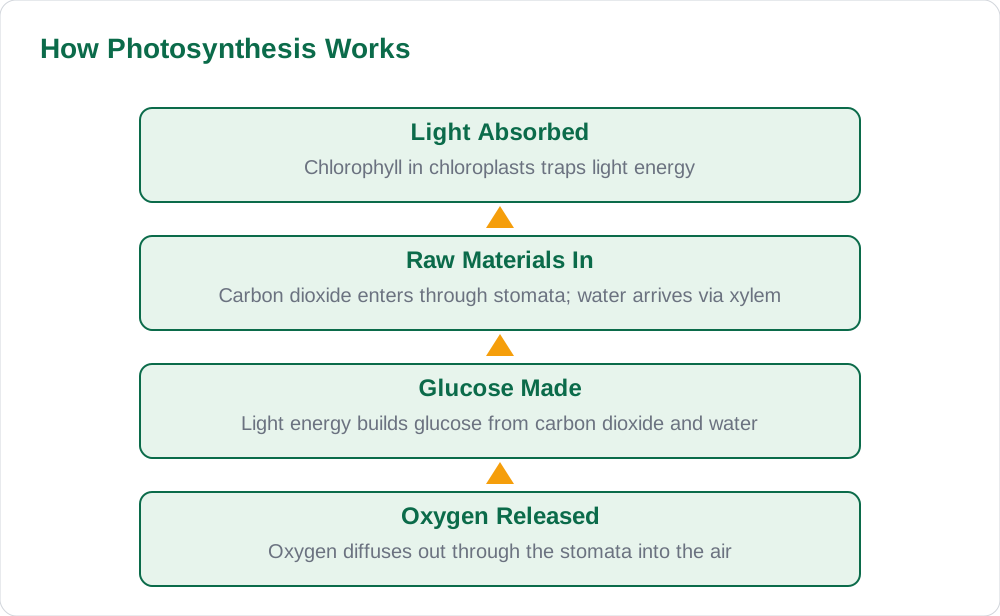
Photosynthesis can be described as a sequence of steps that is easy to follow and easy to draw. First, chlorophyll in the chloroplasts absorbs light energy, mostly from sunlight. Second, carbon dioxide diffuses into the leaf through the stomata, while water arrives from the roots through the xylem. Third, the light energy drives chemical reactions that combine carbon dioxide and water into glucose, storing the light energy as chemical energy in the sugar. Finally, oxygen produced during the reactions diffuses out of the leaf through the stomata into the air. Writing the steps in this order shows the examiner a clear understanding of cause and effect.
Students sometimes confuse photosynthesis with respiration, so keep the distinction sharp. Photosynthesis stores energy and builds glucose, and it happens only in cells with chlorophyll and only when light is available. Respiration releases energy from glucose, and it happens in all living cells, all the time, day and night. A plant therefore photosynthesises during the day and respires all the time, and at night it only respires, taking in oxygen and releasing carbon dioxide. Understanding this pair of opposite processes, and when each one dominates, answers many exam questions that ask students to compare them.
Factors That Affect the Rate
Three main factors affect how fast photosynthesis happens: light intensity, carbon dioxide concentration, and temperature. As light intensity increases, the rate increases, because more energy is available, until another factor becomes limiting and the rate levels off. Similarly, more carbon dioxide allows faster photosynthesis up to a point, after which extra carbon dioxide makes little difference. Temperature also matters, because the reactions are controlled by enzymes, so the rate rises as temperature increases towards the optimum and falls if it gets too hot and enzymes are damaged. These three factors are the classic limiting factors of photosynthesis.
The idea of a limiting factor is important for exam questions. At any moment, the slowest factor sets the pace, like the slowest worker on a production line. On a dull day, light is usually limiting, so adding carbon dioxide would not help; on a bright day with still air, carbon dioxide may be limiting instead. Greenhouse growers use this knowledge by adding extra light, extra carbon dioxide, or warmth to raise crop yields, but only the factor that is currently limiting will make a difference. Explaining an answer with the words limiting factor shows a deeper understanding than simply listing the three factors alone.
Why Photosynthesis Matters to Everyone
Photosynthesis matters far beyond the plant itself, because it is the starting point of almost every food chain. Plants, as producers, convert light energy into chemical energy stored in food, and animals obtain that energy by eating plants or by eating other animals. Without photosynthesis, there would be no food for herbivores, no prey for carnivores, and no oxygen for aerobic respiration. The oxygen we breathe is largely a product of photosynthesis by plants and algae over long periods of time, which is why forests and oceans are often described as the lungs of the planet in popular writing, even though the science is about gas exchange, not breathing.
For exam answers, link photosynthesis to the wider world whenever the question allows it. Mention that glucose is used for respiration, for growth, and stored as starch, and that oxygen released supports respiration in animals. A photosynthesis diagram with labelled arrows for carbon dioxide in, water in, glucose stored, and oxygen out captures all of this in one picture. For more biology revision guides and solved notes, explore Solved Notes, browse the full collection on Books, and read other study articles on the Blog to strengthen your understanding of plant biology.
AI Help: Muse AI
Muse AI is Meta's personal AI assistant, and it can help you learn photosynthesis by walking you through the word equation step by step or by quizzing you on limiting factors. You can ask it to explain why the rate levels off when light increases, or to give you practice questions about chloroplasts and stomata. Muse AI does not give official STBB answers — always verify against your STBB book and your teacher. Always verify against your Sindh Textbook Board book and your teacher before using anything in classwork.
Join Muse with invite code LTGSWD — in the Muse app, go to Settings > Redeem token and enter the code. Disclosure: LTGSWD is the author's Muse invite code.
5 key points you must know
- Word equation: carbon dioxide + water, with light and chlorophyll, gives glucose + oxygen.
- Photosynthesis happens in chloroplasts, mostly in the palisade layer of the leaf.
- Chlorophyll traps light energy; stomata let gases in and out of the leaf.
- Light intensity, carbon dioxide concentration, and temperature are the three limiting factors.
- Glucose is used for energy and growth or stored as starch; oxygen supports respiration.
Frequently asked questions
What is the word equation for photosynthesis?
Carbon dioxide plus water, in the presence of light energy and chlorophyll, gives glucose plus oxygen. Always include light energy and chlorophyll, because they are part of the full equation and examiners award marks for them. Carbon dioxide enters through stomata, water arrives via xylem, and oxygen leaves through stomata.
Where in the leaf does photosynthesis happen?
Photosynthesis happens inside chloroplasts, which are most numerous in the palisade mesophyll layer just below the upper surface of the leaf, where light is strongest. Chloroplasts contain chlorophyll, the green pigment that traps light energy. The leaf's broad, thin shape and its veins support the process by maximising light capture and transport.
What is a limiting factor in photosynthesis?
A limiting factor is the factor that is in shortest supply and therefore sets the rate of photosynthesis at that moment. For example, on a dull day light is usually limiting, so extra carbon dioxide will not speed the process up. Only improving the limiting factor raises the rate, which is why greenhouse growers target the factor that is currently holding production back.
How are photosynthesis and respiration different?
Photosynthesis builds glucose and stores energy, happens only in chlorophyll-containing cells, and needs light. Respiration breaks down glucose to release energy, happens in all living cells, and continues day and night. Plants photosynthesise in daylight and respire all the time, so at night they only respire.
Why do leaves kept in darkness test negative for starch?
Without light, chlorophyll cannot trap energy, so the leaf cannot carry out photosynthesis and produces no new glucose to store as starch. A leaf in sunlight, by contrast, makes glucose and stores the excess as starch, which turns blue-black with iodine solution. This classic experiment proves that light is necessary for photosynthesis.
Solved notes — preview free
These guides work best with the solved exercises. Preview the solved notes free on this website — 119 solved notes for Classes 6–10 in Sindhi, Urdu, English and Arabic medium. Or browse the full solved notes catalogue for your class and medium. New solved notes are added regularly — check the catalogue for coming-soon books.