Biology: Neuron Diagram and How Messages Travel

When you touch something hot, you pull your hand away before you have time to think, and that speed is possible because of neurons, the specialised cells that carry messages around the body. Neurons form a communication network linking sense organs, the brain and spinal cord, and muscles and glands, and they transmit signals as tiny electrical impulses. A neuron diagram is a common exam question because it tests structure, the direction of signal travel, and the synapse, all in one drawing. This guide explains the parts of a neuron, how a message travels along it and across synapses, and how to draw and label the diagram correctly.
The Parts of a Neuron
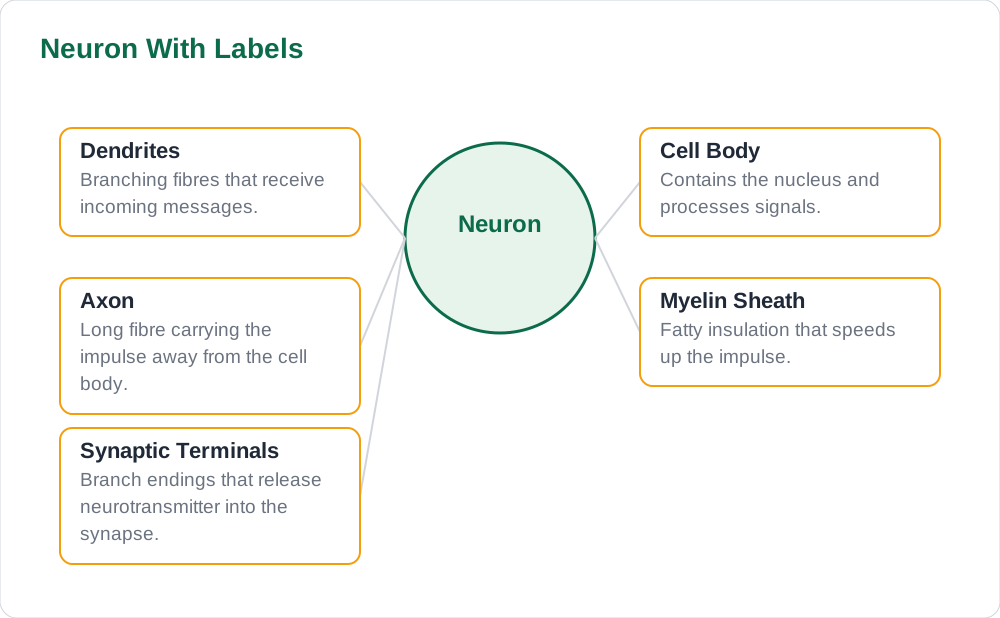
A neuron has three main parts: dendrites, a cell body, and an axon. Dendrites are short, branching fibres that receive messages from other neurons or from receptors, and they pass those messages towards the cell body. The cell body contains the nucleus and most of the cytoplasm, and it processes incoming signals and decides whether to pass them on. The axon is a single long fibre that carries the message away from the cell body towards the next neuron, muscle, or gland, and it can be very long, in humans reaching from the spinal cord all the way to a toe in the longest cases.
Many axons are wrapped in a fatty insulating layer called the myelin sheath, which is made by special supporting cells and has small gaps called nodes along its length. The myelin sheath speeds up the signal, because the electrical impulse jumps from node to node instead of travelling continuously along the whole axon, and it also protects the axon. At the end of the axon are tiny branches with swollen tips called synaptic terminals, which pass the message to the next cell. When labelling a neuron diagram, these five parts, dendrites, cell body, nucleus, axon, and myelin sheath, are the essential labels to include.
How an Electrical Impulse Travels
A nerve message travels as an electrical impulse, a wave of electrical activity that moves along the neuron from dendrites to axon terminals. When a receptor is stimulated, for example by heat on the skin, it triggers an impulse in a sensory neuron, which carries the message towards the central nervous system. The impulse moves along the axon at high speed, helped by the myelin sheath where present, and it always travels in one direction, from dendrites through the cell body and along the axon, never backwards. This one-way traffic keeps messages organised and prevents confusion in the network.
The speed of an impulse matters for survival, which is why reflexes use short, fast pathways. A myelinated axon carries impulses much faster than an unmyelinated one, because the signal jumps between nodes rather than creeping along the membrane. The strength of a stimulus does not change the size of an impulse; instead, a stronger stimulus produces more impulses per second, which the brain reads as a stronger signal. This all-or-nothing rule is a useful exam detail: impulses are always the same size, and intensity is coded by frequency, not by amplitude.
The Synapse: Crossing the Gap
Neurons do not touch each other; between one neuron's axon terminals and the next cell lies a tiny gap called the synapse. When an electrical impulse reaches the axon terminals, it triggers the release of chemical messengers, called neurotransmitters, from small vesicles into the synaptic gap. These chemicals diffuse across the gap and bind to receptors on the next cell, triggering a new electrical impulse there if the signal is strong enough. After the message passes, the neurotransmitter is broken down or taken back up, so the synapse is ready for the next signal and messages do not blur together.
The synapse is important for two reasons that examiners often test. First, it ensures one-way travel, because neurotransmitter is released only from the axon side and received only on the dendrite side, so signals cannot run backwards. Second, synapses allow the brain to process and filter information, because some synapses excite the next neuron while others inhibit it, and the balance of these effects decides whether a message continues. Drugs and poisons often act at synapses by blocking or mimicking neurotransmitters, which is why understanding the synapse also explains how some medicines and toxins affect the nervous system.
From Sense Organ to Response: The Pathway
A complete nerve pathway follows a fixed sequence: stimulus, receptor, sensory neuron, central nervous system, motor neuron, effector, and response. First, a stimulus, such as heat, light, or sound, is detected by a receptor in a sense organ. The receptor triggers an impulse in a sensory neuron, which carries it to the brain or spinal cord, the central nervous system, where a decision is made. A motor neuron then carries the instruction out to an effector, a muscle or gland, which produces the response, such as pulling a hand away or releasing a hormone. Remembering this seven-step chain in order is the key to answering coordination questions.
Reflex actions use a shorter version of this pathway that passes through the spinal cord without waiting for the brain, which is why they are so fast. In a reflex arc, the sensory neuron connects to a relay neuron in the spinal cord, which connects directly to a motor neuron, so the response happens in a fraction of a second. The brain still learns about the event afterwards, which is why you feel the pain a moment after your hand has already moved. Reflexes protect the body from harm, and they are involuntary, meaning they happen without conscious decision, unlike deliberate actions such as picking up a pen.
Drawing the Neuron Diagram and Exam Tips
Draw the neuron with dendrites branching on one side, a rounded cell body with a clear nucleus in the middle, and a long axon extending to the other side, wrapped in segments of myelin sheath with small gaps between them. Add branching synaptic terminals at the end of the axon, and optionally a second cell or muscle nearby with a labelled synaptic gap to show where the message crosses. Label the direction of the impulse with an arrow along the axon, because direction is frequently marked, and keep labels outside the diagram with straight leader lines that do not cross.
Common mistakes include drawing the impulse travelling from axon to dendrites, forgetting the myelin sheath, and labelling the synapse as if the neurons touched. Always check the arrow direction before moving on, and remember that dendrites receive while axons transmit. For more biology revision guides and solved notes, explore Solved Notes, browse the full collection on Books, and read other study articles on the Blog to complete your revision of coordination and response.
AI Help: Muse AI
Muse AI is Meta's personal AI assistant, and it can help you learn neurons by walking you through a reflex arc step by step, from stimulus to response. You can ask it to quiz you on the order of a nerve pathway, or to explain in simple words how a synapse passes a message. Muse AI does not give official STBB answers — always verify against your STBB book and your teacher. Always verify against your Sindh Textbook Board book and your teacher before using anything in classwork.
Join Muse with invite code LTGSWD — in the Muse app, go to Settings > Redeem token and enter the code. Disclosure: LTGSWD is the author's Muse invite code.
5 key points you must know
- Dendrites receive messages; the cell body processes them; the axon transmits them onwards.
- The myelin sheath insulates the axon and speeds the impulse by node-to-node jumping.
- A nerve impulse always travels dendrites, cell body, axon, in one direction only.
- At a synapse, neurotransmitter chemicals diffuse across the gap to the next cell.
- A full pathway runs stimulus, receptor, sensory neuron, CNS, motor neuron, effector, response.
Frequently asked questions
In which direction does a nerve impulse travel?
An impulse travels from the dendrites, through the cell body, and along the axon to the synaptic terminals, always in that one direction. It never travels backwards along a neuron. The synapse enforces this direction too, because neurotransmitter is released only from the axon side and received only on the next cell's dendrite side.
How does the myelin sheath speed up impulses?
The myelin sheath insulates the axon, so the electrical impulse jumps from node to node along the gaps in the sheath instead of travelling continuously along the whole membrane. This jumping, called saltatory conduction, is much faster than continuous travel. Unmyelinated axons carry impulses more slowly because the impulse must pass along every part of the membrane.
What happens at a synapse?
When an impulse reaches the axon terminals, it triggers the release of neurotransmitter chemicals from vesicles into the synaptic gap. These chemicals diffuse across the gap and bind to receptors on the next cell, starting a new impulse there if the signal is strong enough. The neurotransmitter is then broken down or reabsorbed so the synapse is ready for the next message.
What is a reflex arc?
A reflex arc is a short, fast nerve pathway that passes through the spinal cord without waiting for a conscious decision from the brain. A sensory neuron carries the signal to a relay neuron in the spinal cord, which connects directly to a motor neuron leading to an effector. This is why you pull your hand from a hot object before you consciously feel the pain.
How is stimulus strength coded if impulses are all the same size?
Nerve impulses are all-or-nothing, meaning each impulse is the same size regardless of the stimulus. A stronger stimulus produces more impulses per second, and the brain interprets this higher frequency as a stronger signal. So intensity is coded by the rate of impulses, not by making individual impulses bigger.
Solved notes — preview free
These guides work best with the solved exercises. Preview the solved notes free on this website — 119 solved notes for Classes 6–10 in Sindhi, Urdu, English and Arabic medium. Or browse the full solved notes catalogue for your class and medium. New solved notes are added regularly — check the catalogue for coming-soon books.