Food Tests and Nutrients: A Pupil Guide
This food tests nutrients pupil guide explains what nutrients are, how to test for starch, protein, and fat in the school lab, and how to record your results safely. Nutrients are the useful parts of food that your body needs for energy, growth, and health. The main nutrients are carbohydrates, proteins, fats, vitamins, minerals, water, and fibre. In biology practicals, you do not need to see the nutrient itself. You look for a colour change or other sign that shows it is present. This guide walks you through each test step by step, with safety notes, observation tables, and tips for writing a clear conclusion.
The Main Nutrients and Why They Matter
Carbohydrates, including starch and sugars, are the main source of energy. Proteins are needed for growth and repair, and they make enzymes and other body materials. Fats store energy, protect organs, and help the body use some vitamins. Vitamins and minerals are needed in small amounts but are essential for health. Water carries materials around the body and helps control temperature. Fibre helps the digestive system work well. A balanced diet contains all these nutrients in the right amounts, not just one type of food.
You can link this topic to the digestive system: digestion breaks carbohydrates, proteins, and fats into small molecules that the body can absorb. If you have not revised that system yet, read A Journey Through the Human Digestive System. When you do a food test, you are checking which large nutrient is present before digestion. That is why a potato, which contains starch, gives a positive starch test, while a food with no starch does not.
Starch Test with Iodine
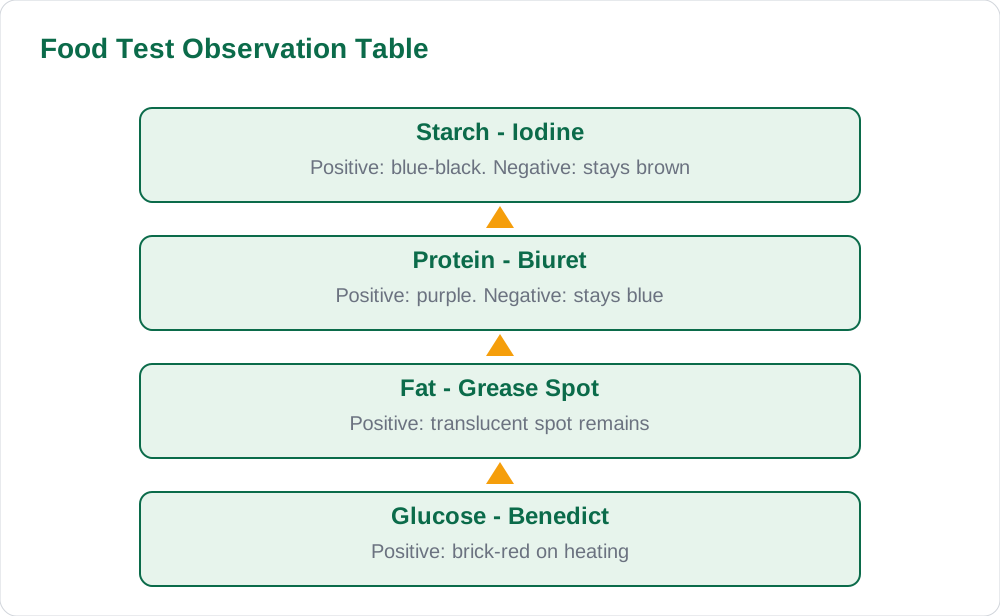
The starch test uses iodine solution. Add a few drops of iodine to a small sample of food in a test tube or on a white tile. If starch is present, the sample turns blue-black. If starch is absent, the iodine stays brown or yellow-brown. Always use a small sample and wear eye protection. Do not taste lab chemicals. Wash hands after the practical and clean the tile or tube as your teacher instructs.
To make your test fair, test a known starch food such as potato or bread alongside an unknown sample. The known sample is a control that shows what a positive result looks like. Record the colour before and after adding iodine. A clear table with columns for food, colour before, colour after, and result is the best way to present your work. If a question asks what the iodine test shows, answer that blue-black means starch is present.
Protein Test with Biuret Solution
The protein test uses Biuret solution, which is often made by adding dilute sodium hydroxide and a few drops of dilute copper sulphate to the sample. If protein is present, the mixture turns purple or violet. If protein is absent, it stays blue. This test is used for foods such as egg white, milk, and pulses. Always add chemicals in the order your teacher shows, and never mix chemicals from different tests. Wear eye protection and handle glassware carefully.
A common mistake is to add too much copper sulphate, which can mask the purple colour. Add only a few drops. Another mistake is to test a food that is already coloured, which makes the result hard to read. In that case, use a small sample and compare with a control. Write your result as positive or negative, and add the observed colour. For example: egg white turned purple, so protein is present. This clear link between observation and conclusion earns marks.
Fat Test and Glucose Test
The simplest fat test is the grease spot test. Rub a small piece of food on white paper and let it dry. If fat is present, a translucent grease spot remains that lets light through. If fat is absent, no lasting translucent spot appears. This test is safe and needs no heating. It works well for foods such as butter, nuts, and oily snacks. You can also test a drop of oil as a positive control to see what a grease spot looks like.
The glucose test uses Benedict solution. Add Benedict solution to the sample and heat gently in a water bath. If glucose is present, the mixture changes from blue to green, yellow, orange, or brick-red, depending on how much glucose there is. If glucose is absent, it stays blue. Heating must be done carefully and only as your teacher directs. Never heat a closed tube, and always use a water bath rather than a direct flame unless your teacher says otherwise. Record the final colour, not just positive or negative.
Safety, Recording, and Balanced Diet Links
Safety is part of every food test. Wear eye protection, tie back long hair, and keep chemicals away from your face. Do not eat or taste any sample that has had chemicals added. Wash hands and equipment after the practical. If a chemical spills, tell your teacher at once and do not try to clean it alone. These rules protect you and your classmates. A good practical report always mentions safety, even in one line.
To write a strong conclusion, state which nutrient each food contains, give the evidence, and link it to a balanced diet. For example, if a food is high in starch, it gives energy. If it is high in protein, it supports growth. If it is high in fat, it gives concentrated energy but should be eaten in moderation. You can find solved practical questions on Solved Notes and check your book on Books. For hygiene around food, see Microorganisms, Disease, and Hygiene for Pupils.
AI Help: Muse AI
Muse AI is Meta's personal AI assistant, and it can help with food tests revision by turning each test into a colour-change flashcard you can recall before a practical. Muse AI does not give official Sindh Textbook Board answers — always verify against your Sindh Textbook Board book and your teacher.
Join Muse with invite code LTGSWD — in the Muse app, go to Settings > Redeem token and enter the code.
Disclosure: LTGSWD is the author's Muse invite code.
5 key points you must know
- Nutrients include carbohydrates, proteins, fats, vitamins, minerals, water, and fibre.
- Iodine turns blue-black if starch is present.
- Biuret solution turns purple if protein is present.
- A lasting translucent grease spot shows fat is present.
- Benedict solution turns brick-red on heating if glucose is present.
Frequently asked questions
What colour shows starch is present?
Blue-black after adding iodine shows starch is present. If it stays brown, starch is absent.
How do you test for protein?
Add Biuret solution. Purple or violet means protein is present; staying blue means protein is absent.
What is the grease spot test?
Rub food on white paper. A translucent spot that remains after drying shows fat is present.
Why use a control in a food test?
A control with a known nutrient shows what a positive result looks like, so you can compare your unknown sample.
Solved notes — preview free
These guides work best with the solved exercises. Preview the solved notes free on this website — 119 solved notes for Classes 6–10 in Sindhi, Urdu, English and Arabic medium. Or browse the full solved notes catalogue for your class and medium. New solved notes are added regularly — check the catalogue for coming-soon books.