Biology: Food Chain and Food Web Diagrams
Every living thing needs energy, and in almost every habitat that energy starts with the sun and flows through a chain of feeding relationships. A food chain shows who eats whom in a single line, while a food web shows the many interconnected chains of a real habitat, where most animals eat more than one kind of food. Understanding these diagrams is essential biology, because they explain how energy moves, why populations depend on each other, and what happens when one species disappears. This guide explains producers, consumers, and decomposers, how to draw food chain and web diagrams correctly, and the common mistakes that cost marks.
Producers: Where Every Chain Begins
Every food chain begins with a producer, an organism that makes its own food, usually a green plant or algae carrying out photosynthesis. Producers capture light energy and store it as chemical energy in glucose and other food molecules, and this stored energy is what the rest of the chain lives on. Without producers, there would be no food for any consumer, because animals cannot make food from sunlight themselves. In a food chain diagram, the producer always comes first, on the left, and every arrow after it traces energy away from the producer towards the animals that eat, directly or indirectly, what it made.
In aquatic habitats, the main producers are microscopic algae called phytoplankton, which float near the surface where light reaches them, and which support the entire ocean food web. On land, producers range from grasses to large trees, and they support herbivores of every size, from grasshoppers to elephants. A common exam mistake is starting a food chain with a consumer, such as a rabbit, instead of the plant it eats, so always check that your chain begins with a green plant or algae. If the first organism cannot photosynthesise, the chain is incomplete and the first mark is lost.
Consumers: Herbivores, Carnivores, and Omnivores
Consumers are animals that obtain energy by eating other organisms, and they are classified by what they eat and by their position in the chain. Primary consumers are herbivores, animals that eat producers directly, such as rabbits eating grass or caterpillars eating leaves. Secondary consumers are carnivores that eat primary consumers, such as foxes eating rabbits, and tertiary consumers eat secondary consumers, such as hawks eating foxes. Omnivores, like humans and crows, eat both plants and animals, so they can appear at more than one level depending on what they are eating in a particular chain.
These levels are called trophic levels, and the word trophic simply means feeding. The producer is the first trophic level, the primary consumer the second, the secondary consumer the third, and so on. Energy decreases at each level, because every organism uses much of the energy it takes in for respiration, movement, and keeping warm, and loses some as waste, so only a small part is passed on to the next level. This is why food chains rarely have more than four or five levels: there is simply not enough energy left at the top to support another level of large predators.
Decomposers and the Recycling of Nutrients
Decomposers, mainly bacteria and fungi, break down dead organisms and waste material, returning nutrients to the soil and water where producers can use them again. Without decomposers, dead leaves, fallen trees, and animal remains would pile up forever, and the nutrients locked inside them would never return to the cycle. Decomposers are sometimes left out of simple food chain diagrams, because they feed on organisms at every level rather than fitting into one position, but a complete food web should show them, with arrows from dead material at all levels pointing towards them.
Decomposers also explain why ecosystems recycle rather than simply consume. Energy flows one way through a food chain, from sun to producer to consumers, and is eventually lost as heat through respiration, but nutrients cycle round and round, from soil to plant to animal to decomposer and back to soil. This difference between energy flow and nutrient cycling is a classic exam question, so state it clearly: energy flows and is lost, nutrients cycle and are reused. A student who can explain both in one sentence shows a mature understanding of ecology, not just memorised definitions.
Food Webs: The Real Picture
A food web is a network of interconnected food chains, and it is a much more realistic picture of a habitat than a single chain. In a real grassland, for example, grass is eaten by rabbits, grasshoppers, and mice, rabbits are eaten by foxes and hawks, and mice are eaten by owls, snakes, and foxes, so removing one species affects many others. Drawing a web means drawing several chains that share organisms, with arrows crossing between them, and it shows why a habitat is stable: if one food source disappears, many consumers can switch to another, whereas in a single chain they would starve.
Food webs also show the effect of removing or adding a species, which is a favourite exam question type. If a top predator is removed, the herbivores it ate may increase and overgraze the plants, damaging the whole habitat. If a producer disappears, every consumer above it suffers, because all energy in the web traces back to producers. When answering such questions, follow the arrows step by step and state each effect in turn, rather than jumping to a conclusion. A careful chain of effects, producer down, herbivore up, predator down, earns more marks than a vague statement that the ecosystem is harmed.
Drawing Arrow Diagrams and Avoiding Mistakes
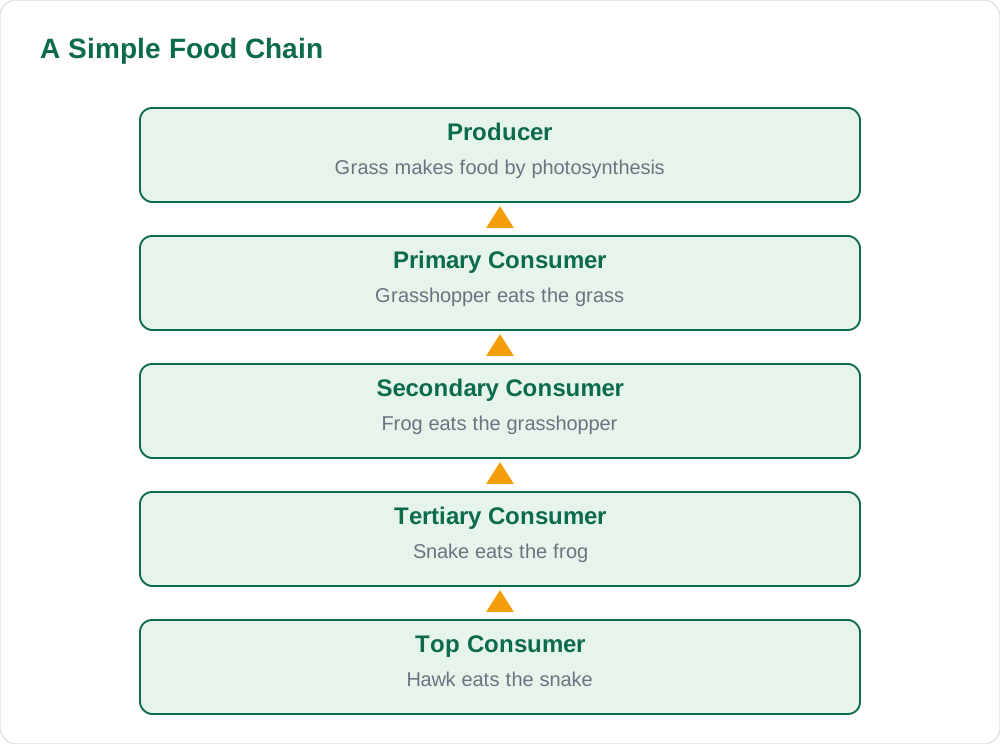
The arrow rule is the single most important rule in food chain diagrams: arrows point in the direction of energy flow, from the food to the feeder, which is the same as from prey to predator. Grass points to grasshopper, grasshopper points to frog, and so on, because energy flows from the eaten to the eater. The most common mistake is drawing arrows the wrong way, pointing from predator to prey, as if the arrow meant eats, and this error loses marks even when the organisms are in the right order. Always read your arrows back after drawing: each arrow should mean is eaten by, and the energy flows along it.
Other mistakes include starting with a consumer instead of a producer, leaving out decomposers from a web, and drawing a web with arrows that do not connect into a network. Label each organism clearly, keep the producer on the left, and arrange consumers in trophic order from left to right so the examiner can follow the chain at a glance. For more biology revision guides and solved notes, explore Solved Notes, browse the full collection on Books, and read other study articles on the Blog to complete your ecology revision.
AI Help: Muse AI
Muse AI is Meta's personal AI assistant, and it can help you learn food webs by building a chain from a habitat you name, then asking what happens if one species is removed. You can ask it to check the direction of your arrows, or to explain why energy decreases at each trophic level. Muse AI does not give official STBB answers — always verify against your STBB book and your teacher. Always verify against your Sindh Textbook Board book and your teacher before using anything in classwork.
Join Muse with invite code LTGSWD — in the Muse app, go to Settings > Redeem token and enter the code. Disclosure: LTGSWD is the author's Muse invite code.
5 key points you must know
- Every food chain starts with a producer, a green plant or algae that photosynthesises.
- Primary consumers are herbivores, secondary consumers eat herbivores, and so on up the levels.
- Arrows point in the direction of energy flow, from food to feeder, or prey to predator.
- Energy decreases at each trophic level because organisms use energy for life processes.
- Decomposers recycle nutrients from dead material back to producers, completing the cycle.
Frequently asked questions
Which way should arrows point in a food chain?
Arrows point in the direction of energy flow, from the food to the feeder, which means from prey to predator. Grass points to grasshopper because energy flows from the grass into the grasshopper when it is eaten. Drawing arrows from predator to prey is the most common food chain mistake, so always read arrows back as is eaten by.
What is the difference between a food chain and a food web?
A food chain is a single line showing one path of feeding relationships, such as grass, grasshopper, frog, snake, hawk. A food web is a network of many interconnected food chains in a habitat, showing that most organisms eat, and are eaten by, several species. Webs are more realistic and more stable, because consumers can switch food sources if one disappears.
Why are food chains usually short?
Energy decreases at each trophic level because organisms use most of the energy they take in for respiration, movement, and warmth, and lose some as waste. Only a small part of the energy is stored in the body and passed to the next level. After four or five levels, too little energy remains to support another level of predators.
What do decomposers do in a food web?
Decomposers, mainly bacteria and fungi, break down dead organisms and waste, releasing nutrients back into the soil and water for producers to reuse. They feed on material from every trophic level, so they do not fit into one position in a chain. Without them, nutrients would stay locked in dead material and ecosystems would run out of raw materials for growth.
What happens if a top predator is removed from a food web?
Removing a top predator usually lets its prey, the herbivores, increase in number, which can lead to overgrazing and damage to the producers. The effects ripple through the web, because species are connected by feeding relationships. Following the arrows step by step, rather than guessing, gives the correct chain of effects in an exam answer.
Solved notes — preview free
These guides work best with the solved exercises. Preview the solved notes free on this website — 119 solved notes for Classes 6–10 in Sindhi, Urdu, English and Arabic medium. Or browse the full solved notes catalogue for your class and medium. New solved notes are added regularly — check the catalogue for coming-soon books.