Biology: Parts of a Flower Diagram and Pollination
Flowers are the reproductive organs of flowering plants, and their beauty has a practical purpose: attracting pollinators, protecting the reproductive parts, and producing seeds that grow into new plants. Every part of a flower, from the green sepals at the base to the pollen-bearing anthers at the centre, has a specific job in this process. A flower diagram is a standard exam question because it tests structure, function, and the sequence from pollination to fertilisation in a single drawing. This guide explains each part, how pollination works, and how to draw and label a flower diagram with confidence.
The Outer Parts: Sepals and Petals
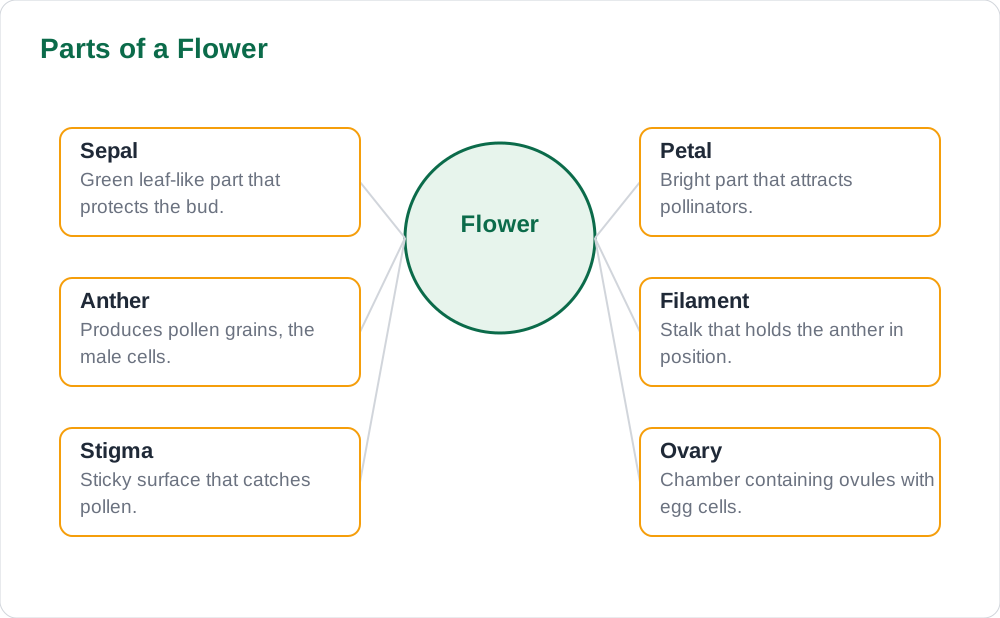
The outermost parts of a flower are the sepals, usually green and leaf-like, which together form the calyx. Sepals protect the flower bud before it opens, shielding the delicate parts inside from damage, drying, and insects, and they continue to support the open flower from below. In a diagram, sepals are drawn at the base of the flower, pointing outwards or downwards, and they are usually smaller and greener than the petals. Students sometimes forget sepals entirely, but they are an easy mark, so always include and label them, even in a simple diagram.
Inside the sepals sit the petals, which together form the corolla, and petals are usually large, brightly coloured, and often scented. Their job is to attract pollinators, especially insects, by advertising the flower with colour and scent, and in some flowers they also provide a landing platform for visiting insects. Petal colour and scent vary with the pollinator: insect-pollinated flowers are often bright and sweet-scented, while wind-pollinated flowers have small, dull petals or none at all, because they do not need to attract anyone. Noting this link between petal appearance and pollination method shows real understanding in an exam answer.
The Male Parts: Stamen, Anther, and Filament
The male reproductive parts of a flower are the stamens, and each stamen has two parts: the anther and the filament. The filament is a thin stalk that holds the anther up in a position where pollinators brush against it, and the anther is a sac-like structure that produces pollen grains, the male sex cells. When a flower is mature, the anthers split open and release pollen, which is often yellow and powdery, and which sticks easily to insects or blows away on the wind. In a diagram, draw several stamens around the centre, each with a clear filament and a two-lobed anther at the top, and label both parts separately.
Pollen grains are tough little packages designed to survive the journey to another flower, with a hard outer wall that protects the male cell inside. A single anther produces huge numbers of pollen grains, because most of them never reach a stigma, and the plant compensates for this waste by sheer quantity. This is a useful exam point: plants produce far more pollen than needed because pollination is a hit-or-miss process. Insect-pollinated flowers produce sticky pollen that clings to bodies, while wind-pollinated flowers produce light, smooth pollen in enormous amounts that drifts on the air.
The Female Parts: Carpel, Stigma, Style, and Ovary
The female reproductive part is the carpel, which sits at the centre of the flower and has three parts of its own. At the top is the stigma, a sticky surface that catches pollen grains, and below it is the style, a tube down which the pollen tube grows. At the base is the ovary, a swollen chamber containing one or more ovules, each holding a female egg cell. A flower may have one carpel or several fused together, but the pattern is always the same: stigma to catch, style to guide, and ovary to protect the ovules until fertilisation happens.
The stickiness of the stigma is important, because it holds pollen grains in place long enough for them to germinate and grow a pollen tube down the style towards an ovule. In insect-pollinated flowers, the stigma is often feathery or sticky and positioned where a visiting insect brushes against it, while in wind-pollinated flowers it is large and feathery to catch drifting pollen from the air. When labelling a flower diagram, make sure the carpel is central and clearly separate from the stamens around it, and label stigma, style, ovary, and ovule as four distinct parts, since each earns its own mark.
Pollination: Self, Cross, Wind, and Insects
Pollination is the transfer of pollen from an anther to a stigma, and it comes in two types. Self-pollination happens when pollen moves within the same flower or to another flower on the same plant, and it is reliable but produces offspring that are genetically identical to the parent. Cross-pollination happens when pollen moves to a flower on a different plant of the same species, and it produces variation, which helps the species adapt to changing conditions. Most flowering plants have features that encourage cross-pollination, such as ripening anthers and stigmas at different times, because variation is valuable for survival.
The agents of pollination are mainly insects and wind, and flowers are adapted to their agent. Insect-pollinated flowers have bright petals, scent, nectar to reward visitors, and sticky pollen, while wind-pollinated flowers have small dull petals, no nectar, large feathery stigmas, and anthers hanging outside the flower to release pollen into the air. Comparing these two sets of features is a classic exam question, so learn them as a pair: bright, scented, nectar, and sticky for insects, versus dull, no scent, feathery stigma, and light pollen for wind. Water and animals also pollinate some flowers, but insects and wind cover most school questions.
From Fertilisation to Seeds and Fruit
After pollination, fertilisation follows: a pollen grain germinates on the stigma and grows a pollen tube down the style, carrying the male nucleus to an ovule, where it fuses with the egg cell to form a zygote. The zygote divides and grows into an embryo inside the seed, while the ovule wall becomes the seed coat and the ovary wall develops into a fruit. The seed stores food for the young plant, and the fruit helps dispersal, whether by animals eating it, by wind carrying it, or by bursting open. This sequence, pollination, fertilisation, seed, fruit, is the complete story that exam questions often ask students to write in order.
Drawing a flower diagram well means showing the reproductive parts clearly, not just the pretty petals. Draw the sepals and petals around the outside, the stamens in a ring, and the carpel in the centre with its stigma, style, and ovary visible. Label every part with a straight leader line, and avoid drawing the ovary so small that the ovules cannot be seen. For more biology revision guides and solved notes, explore Solved Notes, browse the full collection on Books, and read other study articles on the Blog to finish your revision of plant reproduction.
AI Help: Muse AI
Muse AI is Meta's personal AI assistant, and it can help you learn flower parts by quizzing you on which part makes pollen and which part catches it. You can ask it to compare insect-pollinated and wind-pollinated flowers, or to walk you through the steps from pollination to seed formation. Muse AI does not give official STBB answers — always verify against your STBB book and your teacher. Always verify against your Sindh Textbook Board book and your teacher before using anything in classwork.
Join Muse with invite code LTGSWD — in the Muse app, go to Settings > Redeem token and enter the code. Disclosure: LTGSWD is the author's Muse invite code.
5 key points you must know
- Sepals protect the bud; petals attract pollinators with colour and scent.
- Each stamen has a filament stalk and an anther that produces pollen grains.
- The carpel has a stigma to catch pollen, a style, and an ovary holding ovules.
- Cross-pollination creates variation; self-pollination is reliable but produces identical offspring.
- After fertilisation, the ovule becomes a seed and the ovary becomes a fruit.
Frequently asked questions
What is the difference between pollination and fertilisation?
Pollination is the transfer of pollen from an anther to a stigma, and it is a physical movement that can happen by wind, insects, or other agents. Fertilisation is the fusion of the male nucleus from a pollen grain with the egg cell inside an ovule, forming a zygote. Pollination must happen first, but fertilisation is the actual joining of male and female cells.
How are insect-pollinated and wind-pollinated flowers different?
Insect-pollinated flowers have bright petals, scent, nectar, sticky pollen, and stigmas positioned to brush visiting insects. Wind-pollinated flowers have small dull petals, no nectar or scent, light smooth pollen produced in huge amounts, and large feathery stigmas that catch drifting pollen. These differences match the agent: one must attract, the other must cast pollen widely.
What happens to the ovary after fertilisation?
After fertilisation, the ovary wall develops into a fruit, which protects the seeds and helps disperse them. At the same time, each fertilised ovule becomes a seed, with the zygote growing into an embryo and the ovule wall becoming the seed coat. The rest of the flower, such as petals and stamens, usually withers and falls away.
Why do plants produce so much pollen?
Pollination is a hit-or-miss process, because most pollen grains never land on a stigma of the same species. Wind blows most of it away, and insects visit many flowers without depositing pollen correctly. Plants compensate by producing enormous numbers of grains, so that even a tiny success rate still delivers enough pollen for fertilisation.
What is the advantage of cross-pollination over self-pollination?
Cross-pollination mixes genetic material from two different parent plants, producing offspring with variation. Variation helps a species adapt to diseases, pests, and changing environments, because some offspring may carry useful new combinations. Self-pollination is more reliable, but it produces offspring identical to the parent, with no new variation to draw on.
Solved notes — preview free
These guides work best with the solved exercises. Preview the solved notes free on this website — 119 solved notes for Classes 6–10 in Sindhi, Urdu, English and Arabic medium. Or browse the full solved notes catalogue for your class and medium. New solved notes are added regularly — check the catalogue for coming-soon books.