Cell Structure and Functions Explained Simply
This guide covers cell structure functions explained simply, beginning with one idea: a cell is the smallest living unit that can carry out the jobs of life. Just as a factory has different rooms and machines for different tasks, a cell has small parts called organelles that each do a special job. When you understand what each part does, the whole cell starts to make sense. This guide compares the cell to a small factory so you can remember each organelle without cramming. It is written for Sindh Textbook Board pupils in Classes 6 to 10 and follows the way your STBB biology book introduces cells, microscopes, and living things. Read slowly, picture the factory in your mind, and use the solved exercises on this site to check your answers.
The Cell as a Small Factory
Imagine a small factory that makes food, packs it, cleans up waste, and protects itself from outside damage. A cell works in a very similar way. The outer wall and gate decide what comes in and what goes out. Inside, machines make energy, build new parts, and store materials until they are needed. The manager gives instructions so every part knows what to do. When all parts work together, the factory stays alive and productive. A cell is the same: no single part can do everything alone, but together the parts keep the cell alive.
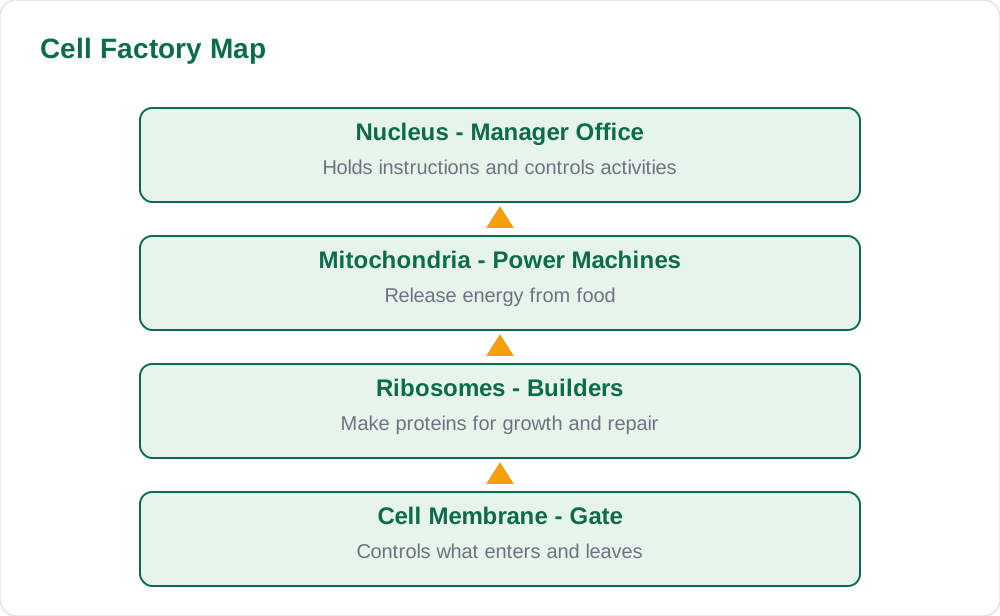
This comparison helps because biology has many new words. Instead of memorising a list, link each word to a factory job. The cell membrane is the gate. The cytoplasm is the factory floor where work happens. The nucleus is the manager office that holds instructions. Mitochondria are the power machines. Ribosomes are small builders that make proteins. When you revise, ask yourself: what is the factory job of this part? If you can answer that, you have understood the function. You can also find worked examples in the solved notes on Solved Notes and check which book your class uses on Books.
The Nucleus and Cytoplasm
The nucleus is the control centre of the cell. It holds the genetic material that carries instructions for growth, repair, and reproduction. In most animal and plant cells you can see the nucleus as a large round structure. Inside it, a smaller part called the nucleolus helps make ribosomes. The nucleus does not do all the work itself, but it tells other parts what to do by sending messages. Without clear instructions, the cell would not know when to grow, when to divide, or what proteins to make.
Around the nucleus lies the cytoplasm, a jelly-like material where most cell work takes place. Organelles float in the cytoplasm, and many chemical reactions happen there. Think of it as the factory floor: workers, machines, and materials all meet in this space. The cytoplasm also helps the cell keep its shape and allows materials to move from one organelle to another. When you draw a cell, show the nucleus in the centre and the cytoplasm filling the space around it. Label both clearly so your diagram earns full marks.
Cell Membrane, Cell Wall, and Vacuole
The cell membrane is a thin layer around the cell that controls movement. It lets useful materials such as water, oxygen, and nutrients enter, and it helps waste leave. It is selective, which means it does not allow everything to pass. In a factory, this is like a gate with a guard who checks what comes in and out. In plant cells there is also a cell wall outside the membrane. The cell wall is strong and stiff, and it gives the plant cell its shape and extra protection. Animal cells do not have a cell wall.
The vacuole is a storage space inside the cell. In plant cells it is usually large and filled with cell sap, and it helps keep the plant firm by storing water. In animal cells vacuoles are smaller and more temporary. The vacuole can store water, salts, sugars, and sometimes waste until the cell is ready to remove it. When you compare plant and animal cells, the large vacuole and the cell wall are two of the clearest differences. Your Sindh Textbook Board book often asks you to draw both cells side by side, so practise that comparison. For more biology topics, see Photosynthesis: Process and Steps for Pupils.
Mitochondria, Ribosomes, and Chloroplasts
Mitochondria are known as the powerhouse of the cell because they release energy from food. The cell uses this energy for movement, growth, repair, and all other life processes. A cell that needs a lot of energy, such as a muscle cell, has many mitochondria. If the factory had no power, its machines would stop. In the same way, a cell without mitochondria would not have enough energy to work. When you answer an exam question about mitochondria, always link the structure to energy release.
Ribosomes are tiny structures that build proteins. Proteins are needed for growth, repair, and making enzymes. Some ribosomes float freely in the cytoplasm, and others sit on the endoplasmic reticulum. Chloroplasts are found only in plant cells and some algae. They contain chlorophyll, the green pigment that traps sunlight for photosynthesis. This is why leaves look green. If you are studying plant cells, remember that chloroplasts are the reason plants can make their own food, a topic explained in Photosynthesis: Process and Steps for Pupils.
Plant Cell versus Animal Cell and Revision Tips
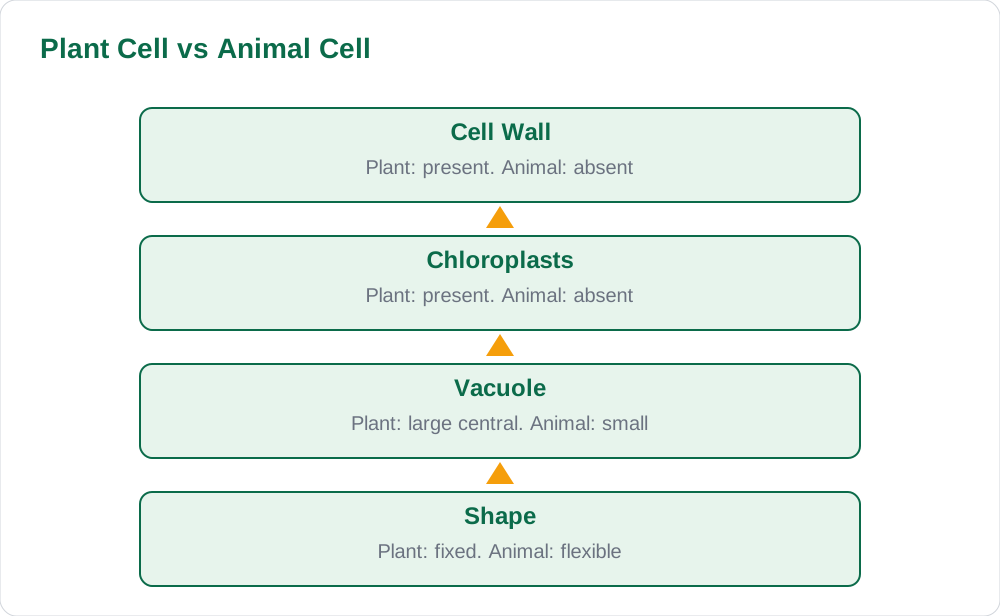
Plant and animal cells share many parts, including the nucleus, cytoplasm, cell membrane, mitochondria, and ribosomes. They differ in a few important ways. Plant cells have a cell wall, chloroplasts, and a large central vacuole. Animal cells have no cell wall or chloroplasts, and their vacuoles are small. Animal cells are often round or irregular in shape, while plant cells often look more fixed and rectangular under the microscope. Learning this table of differences is one of the most common exam tasks, so make it a habit to write it from memory.
To revise well, draw a labelled diagram of each cell at least twice without looking at the book. Then compare your drawing with the book and fix any missing labels. Write one sentence for each organelle in your own words. Teach the factory comparison to a friend or family member: if you can explain it simply, you have learned it. Finally, practise short questions such as naming the powerhouse of the cell or the function of the nucleus. Small daily revision is more effective than one long session before the exam. You can also explore related life-science guides such as The Respiratory System and How Breathing Works.
AI Help: Muse AI
Muse AI is Meta's personal AI assistant, and it can help with biology revision by turning each organelle into a one-line factory-job flashcard you can test yourself on. Muse AI does not give official Sindh Textbook Board answers — always verify against your Sindh Textbook Board book and your teacher.
Join Muse with invite code LTGSWD — in the Muse app, go to Settings > Redeem token and enter the code.
Disclosure: LTGSWD is the author's Muse invite code.
5 key points you must know
- A cell is the smallest living unit that carries out the jobs of life.
- The nucleus controls the cell and holds instructions for growth and repair.
- Mitochondria release energy from food for all cell activities.
- Plant cells have a cell wall, chloroplasts, and a large vacuole; animal cells do not.
- Comparing the cell to a factory makes each organelle function easier to remember.
Frequently asked questions
What is the function of the nucleus?
The nucleus controls cell activities and holds genetic instructions for growth, repair, and reproduction.
Why are mitochondria called the powerhouse of the cell?
Because they release energy from food, which the cell uses for movement, growth, repair, and other life processes.
What is the difference between a plant cell and an animal cell?
Plant cells have a cell wall, chloroplasts, and a large central vacuole. Animal cells do not have a cell wall or chloroplasts and have small vacuoles.
What does the cell membrane do?
The cell membrane is a selective layer that controls what enters and leaves the cell, allowing useful materials in and waste out.
Solved notes — preview free
These guides work best with the solved exercises. Preview the solved notes free on this website — 119 solved notes for Classes 6–10 in Sindhi, Urdu, English and Arabic medium. Or browse the full solved notes catalogue for your class and medium. New solved notes are added regularly — check the catalogue for coming-soon books.