Biology: Cell Diagram With Labels Students Remember

A labelled cell diagram is one of the most common diagram questions in school biology, and it is also one of the easiest places to earn full marks, if you know what to draw and how to label it. Examiners do not expect artistic perfection, but they do expect the right parts, drawn in the right places, with clear labels that are easy to read. Many students lose marks not because they do not know the cell, but because their labels cross each other, point to the wrong part, or are written in a messy hand. This guide teaches you the parts of animal and plant cells, the rules of neat labelling, and memory tricks that help you recall every label under exam pressure.
Why a Labelled Cell Diagram Earns Easy Marks
Diagram questions are popular with examiners because a single drawing can test many facts at once: the shape of the cell, the position of each organelle, and whether the student knows the function of each part. A well-labelled diagram therefore works like a short answer written in pictures, and it often earns marks faster than a long paragraph. Students who practise drawing the cell a few times before the exam usually find this question relaxing, because once the outline is on the page, the labels follow in a fixed order. The secret is practice, not talent, and even a simple, tidy drawing can score full marks.
A labelled diagram also helps you revise the whole topic in one glance. When you draw the nucleus in the centre, the mitochondria scattered in the cytoplasm, and the cell membrane as the boundary, you are revising structure and function at the same time. Teachers often say that a student who can draw and label a cell truly understands it, because the drawing forces you to decide where each part belongs and what it does. That is why this guide treats drawing as a study method, not just an exam trick, and why you should redraw the diagram from memory several times before test day.
The Animal Cell Parts You Must Label
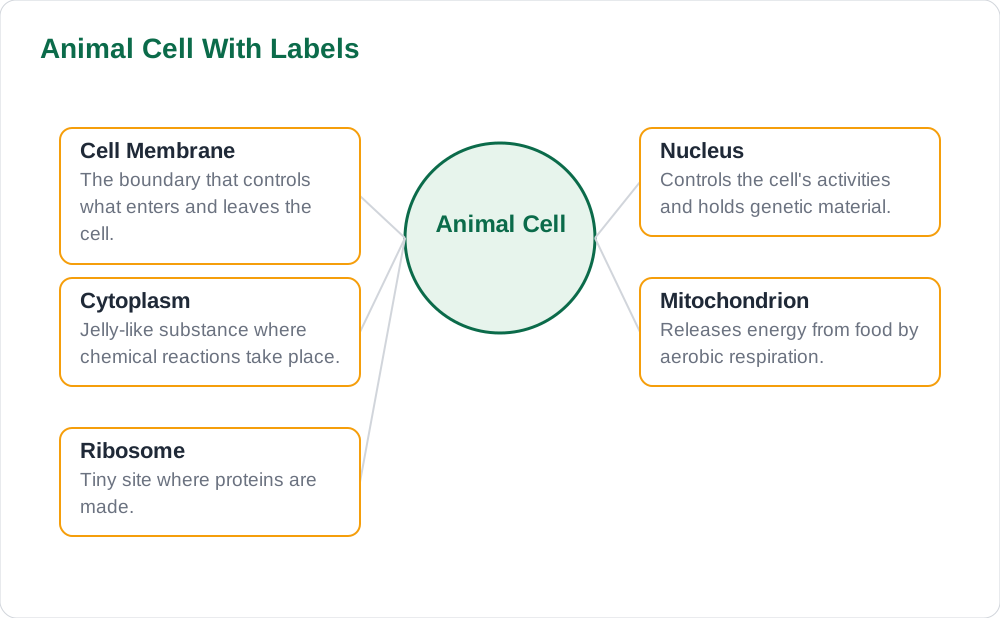
An animal cell has no fixed shape, so draw it as a rounded, slightly irregular outline, which is the cell membrane. The cell membrane is a thin boundary that controls what enters and leaves the cell, and it is drawn as a single line around the edge. Inside it lies the cytoplasm, a jelly-like substance where most chemical reactions happen and where the organelles float. The largest and most obvious organelle is the nucleus, a round body that controls the cell's activities and contains the genetic material. Drawing the nucleus clearly in the middle of the cell is the first step to a diagram that looks right.
The other labels every animal cell diagram needs are the mitochondria and the ribosomes. Mitochondria are small, bean-shaped structures where aerobic respiration releases energy from food, and they are often called the powerhouse of the cell. Ribosomes are tiny dots, often shown on the cytoplasm or on folded membranes, and they are the sites where proteins are made. In a simple school diagram, you do not need to draw every fold and detail; a few mitochondria and a scattering of ribosomes, each labelled with a straight leader line, show the examiner that you know both the structure and the function of each part.
Plant Cell Extras: Wall, Chloroplast and Big Vacuole
A plant cell shares most parts with an animal cell, but it has three extra features that examiners always look for, so never draw a plant cell that looks exactly like an animal cell. First, the plant cell has a cell wall outside the cell membrane, drawn as a firm, regular outline, often rectangular, which gives the cell its fixed shape and strength. Second, it contains chloroplasts, small green disc-shaped organelles where photosynthesis takes place, and these should be drawn scattered in the cytoplasm. Third, it has one large, permanent vacuole filled with cell sap, which pushes the cytoplasm to the edges and keeps the cell firm.
The large vacuole is the easiest way to tell a plant cell diagram from an animal cell diagram at a glance, because animal cells have only small, temporary vacuoles, if any are shown at all. When you label a plant cell, make sure the vacuole is drawn large and central, with the nucleus pushed to one side, which is how a real plant cell looks. The cell wall should be labelled as a separate line from the cell membrane, and the chloroplasts should be labelled clearly, since students often confuse them with mitochondria. Remembering these three extras, wall, chloroplast, and large vacuole, is the key to a correct plant cell diagram.
How to Draw and Label Neatly, Step by Step
Neat labelling follows a few simple rules that examiners reward. First, draw the outline in pencil, fairly large, taking up about half the answer space, because a tiny diagram leaves no room for labels. Second, write each label on the outside of the diagram, never inside it, and connect it to the part with a straight, horizontal leader line that touches the part exactly. Leader lines must never cross each other, and labels should be arranged on both sides of the diagram so they do not crowd together. Finally, write labels in clear print, not joined-up handwriting, and check each line by tracing it back from the label to the part it names.
A good drawing order saves time and prevents mistakes. Start with the outer boundary, then add the nucleus, then the large vacuole if it is a plant cell, and then the smaller organelles. Only when the drawing is complete should you add the labels, working from top to bottom on each side so you do not miss a part. Do not shade the diagram heavily or use colours unless the question asks for them, because shading can hide the outlines. A clean pencil drawing with straight label lines and correct spellings looks professional and makes the examiner's job easy, which is exactly what earns marks.
Memory Tricks and Mistakes to Avoid
Memory tricks make labels stick. Think of the nucleus as the brain or control room of the cell, the mitochondria as the power station, the ribosomes as tiny factories making proteins, and the cell membrane as the security gate. For plant cells, remember the three extras with the phrase wall, green, and big sap: wall for the cell wall, green for the chloroplasts, and big sap for the large vacuole full of cell sap. Saying the labels aloud while you draw, in the same order every time, builds a habit that survives exam stress, because your hand remembers the sequence even when your mind feels blank.
The most common mistakes are easy to avoid once you know them. Never label the cell wall on an animal cell, never draw a plant cell without its large vacuole, and never let a leader line point to empty cytoplasm when it should touch an organelle. Spelling matters too, so practise words like mitochondria, cytoplasm, and chloroplast until they feel automatic. For more solved notes and revision guides, explore the collection on Solved Notes, browse the full book list on Books, and read other study guides on the Blog to keep your biology revision organised and complete.
AI Help: Muse AI
Muse AI is Meta's personal AI assistant, and it can help you master cell diagrams by quizzing you on labels, for example by naming a part and asking you to recall its function. You can ask it to describe an animal cell part by part so you can draw along, or to test you on the differences between plant and animal cells. Muse AI does not give official STBB answers — always verify against your STBB book and your teacher. Always verify against your Sindh Textbook Board book and your teacher before using anything in classwork.
Join Muse with invite code LTGSWD — in the Muse app, go to Settings > Redeem token and enter the code. Disclosure: LTGSWD is the author's Muse invite code.
5 key points you must know
- Draw the diagram large, in pencil, with labels outside and straight leader lines that never cross.
- An animal cell needs membrane, cytoplasm, nucleus, mitochondria, and ribosomes labelled.
- A plant cell adds three extras: cell wall, chloroplasts, and one large permanent vacuole.
- Label in a fixed order every time so your hand remembers the sequence under exam pressure.
- Check each leader line by tracing it back from the label to the exact part it names.
Frequently asked questions
What is the correct order to draw a cell diagram?
Start with the outer boundary, then add the nucleus, then the large vacuole for a plant cell, and finally the smaller organelles like mitochondria and ribosomes. Add the labels only after the drawing is complete, working from top to bottom on each side. This order prevents crowding and makes sure no part is forgotten.
How are plant and animal cell diagrams different?
A plant cell has a regular shape with a cell wall, chloroplasts, and one large permanent vacuole, while an animal cell has an irregular shape with no cell wall, no chloroplasts, and only small temporary vacuoles. Both have a cell membrane, cytoplasm, nucleus, mitochondria, and ribosomes. Drawing these three plant extras correctly is the main difference examiners check.
Why do leader lines matter in a labelled diagram?
Leader lines connect each label to the exact part it names, so the examiner can see what you mean without guessing. They must be straight, horizontal where possible, and must never cross each other, because crossed lines make labels confusing. A leader line that points to empty cytoplasm instead of an organelle can lose the mark for that label.
What does each main cell part do?
The nucleus controls the cell and holds genetic material, the cell membrane controls entry and exit, and the cytoplasm is where chemical reactions happen. Mitochondria release energy from food, ribosomes make proteins, and in plant cells chloroplasts carry out photosynthesis while the large vacuole stores cell sap and keeps the cell firm.
Should I shade or colour my cell diagram?
No, a clean pencil drawing is best unless the question specifically asks for colour. Heavy shading can hide outlines and make labels hard to read, and colouring wastes time in an exam. Focus instead on correct shapes, correct positions, straight label lines, and correct spellings, which are what actually earn marks.
Solved notes — preview free
These guides work best with the solved exercises. Preview the solved notes free on this website — 119 solved notes for Classes 6–10 in Sindhi, Urdu, English and Arabic medium. Or browse the full solved notes catalogue for your class and medium. New solved notes are added regularly — check the catalogue for coming-soon books.