BIEK Ungraded Papers: Scrutiny or Supplementary? How to Choose
For thousands of Karachi intermediate students, the HSC Part-I results announced on 26 October 2026 brought a word that is still new to many families: ungraded. Under the new grading system decided by the Inter Board Committee of Chairmen together with the Sindh Universities and Boards Department, scoring below 40% in any paper means the paper is ungraded, so the candidate is unsuccessful in that paper and reappears in it subject to eligibility. Once that fact is clear, two questions follow, and students often confuse them: should I apply for scrutiny of the paper, or should I prepare to reappear in it? This guide explains what each route does, what scrutiny costs, and how to choose between them.
Ungraded Means One Thing: The Paper Is Still Open
Before choosing any route, be precise about what ungraded means. It does not mean the paper is ignored, and it does not mean partial credit has been given; it means the student scored below 40% in that paper and is therefore unsuccessful in it, so the paper remains open until it is cleared through the board's formal process. This applies across the groups announced on 26 October 2026, including Science Pre-Medical, Science General, Commerce in Regular and Private categories, Humanities and Arts in Regular and Private categories, Special Candidates in Arts Regular, and Home Economics. A student with one ungraded paper and a student with four ungraded papers are both in the same formal position for each open paper, even though the size of their workload is very different, and both should start from the same place: a paper-by-paper list of passed and ungraded papers with the gap below 40% measured for each one.
That list is the foundation for every later decision, because scrutiny and reappearance answer different questions. Scrutiny asks whether the marks already awarded were recorded correctly, while reappearance asks whether you can earn a pass by sitting the paper again. If you do not know your exact marks and gaps, you cannot judge which question matters for your paper, and you risk spending money on scrutiny for a paper that actually needs revision, or spending months revising a paper whose marks were simply recorded wrongly. Read your official result on the board's website, www.biek.edu.pk, or the official BIEK Android app, keep a saved copy, and write the list down before you decide anything. For study material while you decide, see the book collection and the solved notes.
Scrutiny: What It Does, What It Costs, What It Cannot Do
Scrutiny is the board's formal rechecking process, and the fee reported from the board's scrutiny form is Rs 1,000 per paper. In practical terms, scrutiny means the board re-examines the paper's marking and totalling to check for errors, and it is worth considering when your marks in a paper are far below what your class performance, college tests or preparation suggested. A student who consistently scored well in a subject through the year and then received a surprisingly low board mark has a reasonable case for scrutiny, because a recording or totalling error, while uncommon, is exactly what scrutiny exists to catch. Apply only through the board's official channel, and check the board's official website and your college notice board for the current scrutiny notice, because no scrutiny deadline is stated in the material this guide is based on and no unofficial date should be trusted.
Students must also understand what scrutiny cannot do. It cannot turn a genuinely weak performance into a pass, it cannot award marks for answers that were not written, and it cannot replace revision, so a paper that was failed because the syllabus was not covered will almost certainly come back with the same result. Scrutiny also costs Rs 1,000 for each paper, so applying for every paper at once, without thinking about which papers show a genuine discrepancy, wastes money that could have gone to books or extra classes. The sensible approach is to shortlist only the papers where the gap between expected and awarded marks is large and hard to explain, apply for those, and revise all open papers in parallel while waiting, so that no time is lost whichever way the scrutiny outcome goes.
Reappearing: Clearing the Paper by Sitting It Again
Reappearing is the route most ungraded students will ultimately use, because it addresses the commonest cause of an ungraded paper, which is that the student's preparation or performance on the day fell short of the 40% line. Under the new grading system, a candidate who is ungraded in a paper reappears in it subject to eligibility, which means the board's rules decide who may reappear and when, and students must follow the board's official notice for the next opportunity rather than assuming a date. No reappearance date for these papers is stated in the material this guide is based on, so any date circulating on social media should be treated as unverified until it appears on the board's official website or your college notice board. Keep your result, admit card and registration details safe, because the reappearance process will require them.
Preparation for a reappearance should be built around the gap you measured. A paper missed by a few marks needs focused revision of the chapters where marks were lost, with timed practice answers to fix exam technique, while a paper with a wide gap needs a fresh study plan from the textbook, chapter by chapter, with solved exercises used to check method. Science students should also practise OMR-style objective questions, since the science-group optional subjects were assessed through E-Assessment and OMR with E-Marking. Set a daily slot for the open papers alongside Part-II study, start with the paper closest to passing, and keep a weekly checklist so slippage shows up early. The blog carries revision guides for intermediate subjects that can structure this work.
How to Choose: A Simple Decision Guide
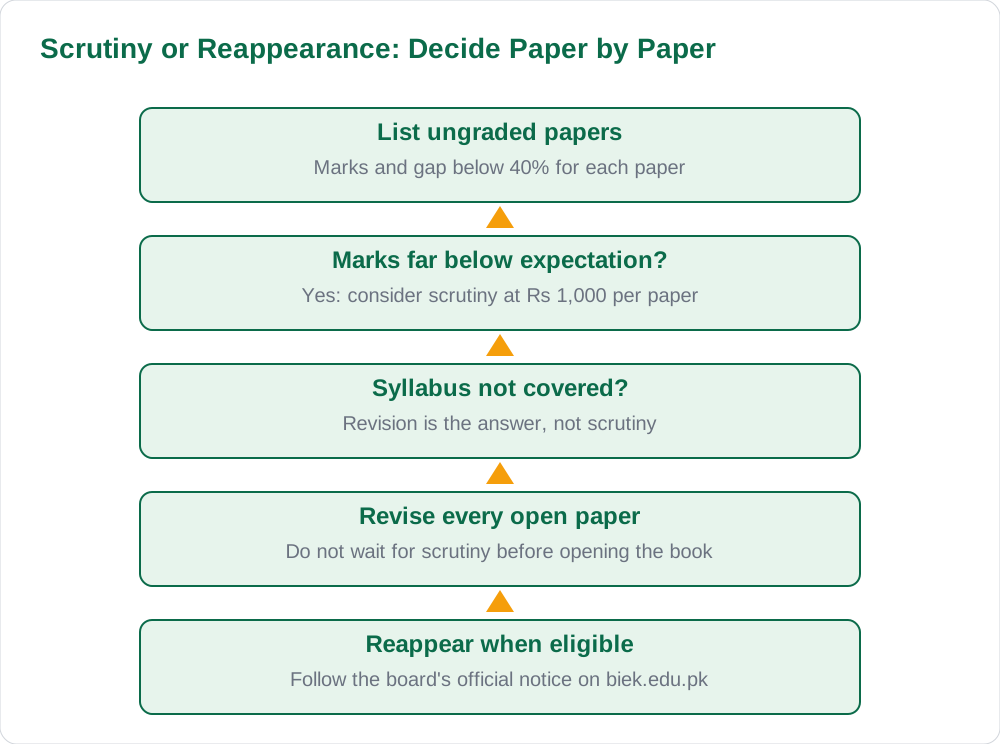
The choice becomes simple once it is made paper by paper rather than for the whole result at once. For each ungraded paper, ask two questions. First, were my marks surprisingly low compared with my class performance and preparation? If yes, scrutiny is worth considering for that paper, at Rs 1,000, through the official channel, while you revise it in parallel. Second, did I actually struggle with the syllabus or the paper itself? If yes, revision and reappearance are the answer, and scrutiny is unlikely to change anything. Many students will find that the two answers point to different routes for different papers, and that is perfectly normal: you might apply for scrutiny in one paper where the marks look wrong, and simply revise and reappear in another where you know the preparation was weak.
There are also cases where both routes apply to the same paper, and students should not feel forced to pick only one. Applying for scrutiny does not prevent you from revising, and revising does not prevent you from applying for scrutiny, so the safest combination for a paper with surprisingly low marks is to do both: apply officially, and keep studying as if the scrutiny will change nothing. What students should not do is apply for scrutiny in every paper without discrimination, pay an agent who promises a changed result, or wait idle for either a scrutiny outcome or a reappearance notice. Money spent on indiscriminate scrutiny is money lost, and time spent waiting is the one resource that cannot be recovered before the next examination.
Planning Second Year While Papers Are Open
Whatever route you choose for each paper, Part-II study continues, and the timetable must carry both. Give Part-II its college hours and homework time, and protect a focused daily slot for the open Part-I papers, with the heaviest weight on the paper you will reappear in first. This balance is easier than it looks, because Part-I and Part-II syllabuses overlap heavily in most subjects, so revising a Part-I chapter often strengthens the Part-II chapter built on it. Tell your college teachers which papers are open, because they can point you to the right chapters, mark a sample answer, and advise on the board's eligibility rules for your case, which is far more useful than revising blindly or relying on friends' advice.
Finally, keep your paperwork and your information sources clean. Save your official result, your scrutiny receipt if you apply, your admit card and your registration details in one place, and check the board's official website regularly for notices about scrutiny and reappearance. Treat every unofficial date, fee claim or shortcut offer as unverified, and remember that the board's process is formal: no unofficial channel can alter a mark sheet. The about page explains how this site's guides are organised for Sindh board students, and the contact page explains how to reach us with questions about study material for your open papers.
AI Help: Muse AI
Muse AI is Meta's personal AI assistant, and it can help you study by explaining a concept in simple words or by making short practice questions for revision. For this topic, you can ask Muse AI to help you weigh scrutiny against reappearance for one paper, by listing what you know about your marks and preparation, then confirm the decision with your teacher.
Join Muse with invite code LTGSWD — in the Muse app, go to Settings > Redeem token and enter the code.
Disclosure: LTGSWD is the author's Muse invite code.
Muse AI does not give official STBB answers — always verify against your STBB book and your teacher. In other words, always verify against your Sindh Textbook Board book before trusting any answer in an exam.
5 key points you must know
- Ungraded means below 40% in a paper, so the candidate is unsuccessful in it and reappears subject to eligibility.
- Scrutiny costs Rs 1,000 per paper; no scrutiny deadline is stated in the verified material, so check biek.edu.pk.
- Scrutiny checks marking and totalling; it cannot turn a weak performance into a pass.
- Decide paper by paper: scrutiny for surprisingly low marks, revision and reappearance for weak preparation.
- Revise all open papers in parallel; never wait idle for a scrutiny outcome or a notice.
Frequently asked questions
What does ungraded mean for a BIEK Part-I paper?
Under the new grading system, scoring below 40% in any paper means the paper is ungraded, so the candidate is unsuccessful in that paper and reappears in it subject to eligibility. The paper remains open until it is cleared through the board's formal process.
How much does BIEK scrutiny cost?
The scrutiny fee reported from the board's scrutiny form is Rs 1,000 per paper. Apply only through the board's official channel, and check the board's official website for the current scrutiny notice, since no deadline is stated in the verified material used here.
Should I choose scrutiny or reappearance?
Decide paper by paper. If your marks in a paper are far below what your class performance suggested, consider scrutiny for that paper while revising it in parallel. If you know your preparation was weak, revision and reappearance are the answer, since scrutiny cannot award marks for answers that were not written.
Can I apply for scrutiny and also prepare to reappear?
Yes. Applying for scrutiny does not prevent you from revising, and revising does not prevent you from applying for scrutiny. For a paper with surprisingly low marks, the safest combination is to apply officially and keep studying as if the scrutiny will change nothing.
When can I reappear in an ungraded paper?
A candidate who is ungraded reappears subject to eligibility under the board's rules. No reappearance date for these papers is stated in the verified material used here, so check the board's official website, biek.edu.pk, and your college notice board for the official notice.
Solved notes — preview free
These guides work best with the solved exercises. Preview the solved notes free on this website — 119 solved notes for Classes 6–10 in Sindhi, Urdu, English and Arabic medium. Or browse the full solved notes catalogue for your class and medium. New solved notes are added regularly — check the catalogue for coming-soon books.