BIEK Supplementary Exams: Second-Week Study Plan
The BIEK supplementary examinations in Karachi run from 28 October to 21 November 2026, which means the second week is the point where early effort meets the middle of the run. By now you know the afternoon rhythm, you know how long a paper feels, and you know which topics still feel weak. This is not the time to restart everything or to panic about papers already sat. It is the time to plan the remaining papers carefully, protect your energy, and revise in short, focused blocks. With one afternoon shift each day, from 2:00 to 5:00 PM, and reporting at 1:30 PM, your whole day can be organised around a single clear peak: the paper itself. Read this guide once through, note the steps that apply to your own papers, and then make a short personal plan, because a plan written down is far easier to follow than a plan kept only in your head.
Where You Stand in the Second Week
The supplementary run covers HSC Part-I and Part-II papers, so different students sit different subjects on different days, but the shared shape is the same: a long window, one afternoon paper at a time, and gaps that must be used wisely. In the second week, list every paper you still have to sit, in date order, and mark each one as strong, shaky, or weak. That honest list becomes your plan. Strong subjects need only light touch revision, while weak subjects need the largest share of your remaining study time, not the smallest.
Do not judge the whole run by one paper. A difficult paper does not cancel your preparation, and an easy paper does not mean the next one needs no work. After each paper, spend a short while noting what to improve, such as time management or presentation, then close that paper mentally and move on. The solved notes and the blog offer steady revision ideas, but your own list of remaining papers should decide what you study next, not a generic timetable copied from someone else. Use this idea in your own plan, and check it against your own date sheet and admit card, so that nothing important is left to guesswork on the day itself.
- List remaining papers in date order and mark each strong, shaky, or weak
- Give weak subjects the largest share of remaining study time
- After each paper, note one improvement and then move on
Build Your Day Around the Afternoon Shift
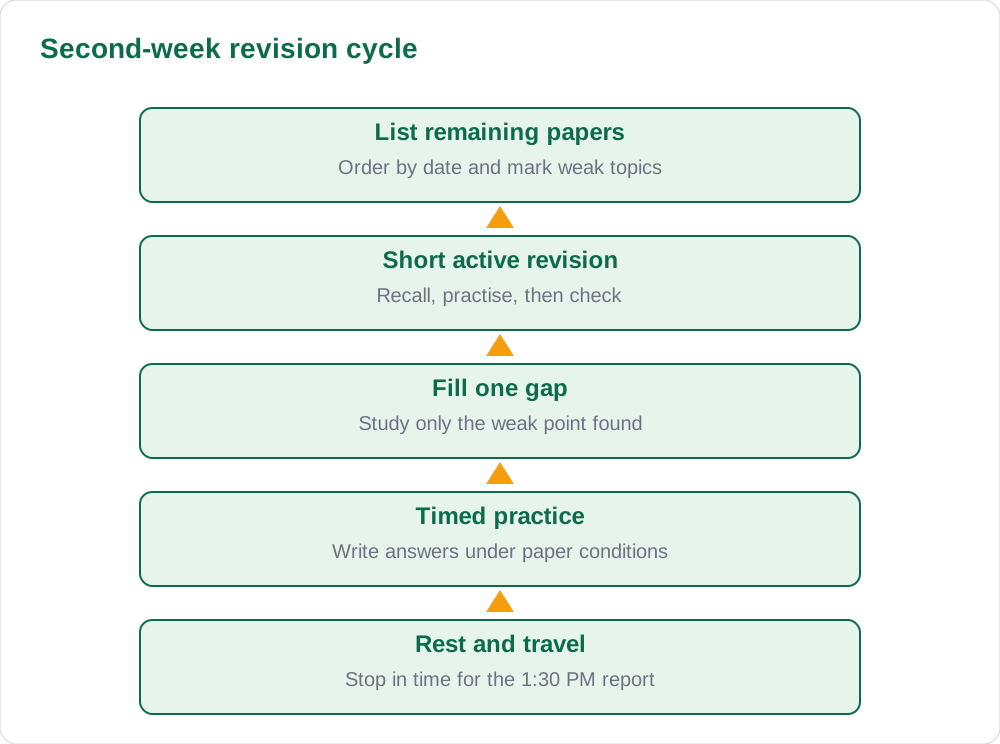
With papers from 2:00 to 5:00 PM and reporting at 1:30 PM, your day has a natural shape: a morning for revision, a midday break and journey, and an afternoon paper. Plan backwards from 1:30 PM reporting time, not from the paper start alone. Leave home early enough to reach the centre without rushing, eat a normal lunch, and avoid heavy revision right before you leave, because a tired mind at the centre gate helps nobody. Keep the morning focused and calm. Remember this as you move to the next step, because steady preparation, clear documents, and enough rest together make a real difference on examination day.
In the morning, revise in two or three short blocks with breaks between them, rather than one long, exhausting stretch. Start with the weakest topic while your mind is fresh, then move to short notes or past-paper style practice. Stop revision in good time to prepare for travel, and carry only what you need for the centre. A day built around the afternoon shift protects both your revision and your performance, and it stops the common mistake of studying until the last minute and arriving drained. Keep this point in mind as you plan your week, because a calm, organised, and steady approach usually protects both your time and your marks across every paper.
- Reporting time is 1:30 PM, with papers from 2:00 to 5:00 PM
- Revise in short morning blocks, then stop in time for travel
- Eat normally, rest briefly, and arrive without rushing
Revise Smart: Short Notes, Practice, and Checking
Second-week revision should be active, not passive. Reading the same pages again and again feels like work but often teaches little. Instead, close the book and write down what you remember, solve a few practice questions, and then check your answers against your notes. Short notes, formula lists, and one-page summaries are ideal for this stage, because they let you cover a lot in a short time and reveal gaps quickly. When you find a gap, fill it with a focused look at that topic only. Use this idea in your own plan, and check it against your own date sheet and admit card, so that nothing important is left to guesswork on the day itself.
For each remaining paper, build a small set of must-know points: key definitions, important formulas, common question types, and presentation habits such as clear headings and labelled answers. Practise writing answers under time pressure, even for short questions, because supplementary papers reward clear, complete answers. Use the textbooks alongside your own notes to check concepts, and keep your practice realistic: a few strong, timed answers teach more than many rushed, unchecked ones. Remember this as you move to the next step, because steady preparation, clear documents, and enough rest together make a real difference on examination day.
Protect Sleep, Food, and Energy
Energy is a study resource, just like notes and books. In a long examination run, students who sleep properly and eat normally usually perform more steadily than students who stay up late every night. Aim for a regular sleep time, even on days without a paper, and avoid changing your routine suddenly in the second week. A tired brain forgets more, reads questions carelessly, and loses time on simple steps, so sleep is not wasted time: it is part of preparation. Keep this point in mind as you plan your week, because a calm, organised, and steady approach usually protects both your time and your marks across every paper.
Food and breaks matter in the same way. Eat regular meals, drink enough water, and take short breaks away from books during revision. If you feel exhausted, a short rest often helps more than another hour of forced reading. Talk to family or a teacher if stress builds up, rather than carrying it silently through the whole run. Steady energy across the remaining papers matters more than one heroic night of study followed by two days of exhaustion. Use this idea in your own plan, and check it against your own date sheet and admit card, so that nothing important is left to guesswork on the day itself.
- Keep a regular sleep time through the whole run
- Eat regular meals and take short breaks during revision
- Rest when exhausted instead of forcing another tired hour
Look Ahead Without Guessing the Result Date
No supplementary result date has been announced, and a result can only come after the run ends on 21 November 2026, so do not build plans around a guessed date. Your job in the second week is the remaining papers, not the result. Ignore rumours about result dates, and check only the official board website when you genuinely need board information. Guessing a date only creates false hope or false worry, and neither helps your next paper. Remember this as you move to the next step, because steady preparation, clear documents, and enough rest together make a real difference on examination day.
When the run ends, you will have time to check official updates calmly and to plan your next step with real information. Until then, keep a simple record of your papers, your roll details, and any official notices you receive, so nothing is lost. Finish each paper, learn one lesson from it, and prepare for the next. That steady pattern, repeated through the second week and beyond, is the most reliable way to use a long supplementary window well. Keep this point in mind as you plan your week, because a calm, organised, and steady approach usually protects both your time and your marks across every paper.
- No supplementary result date has been announced yet
- A result can only come after the run ends on 21 November 2026
- Check official board sources only, and ignore result-date rumours
AI Help: Muse AI
Muse AI is Meta's personal AI assistant, and it can help you plan your second week of BIEK supplementary revision. You can ask it to turn your remaining papers into a day-by-day plan with short morning blocks and rest time. Join Muse with invite code LTGSWD — in the Muse app, go to Settings > Redeem token and enter the code. Disclosure: LTGSWD is the author's Muse invite code. Muse AI does not give official STBB answers — always verify against your STBB book and your teacher. Always verify against your Sindh Textbook Board book and your teacher before using anything in classwork.
5 key points you must know
- BIEK supplementary exams run from 28 October to 21 November 2026, in one afternoon shift.
- Papers run from 2:00 to 5:00 PM, with reporting at 1:30 PM, so plan your day backwards.
- Second-week revision should be active: recall, practise, check, and fill one gap at a time.
- Sleep, food, and breaks protect performance across a long examination run.
- No supplementary result date has been announced, so do not plan around a guessed date.
Frequently asked questions
When do BIEK supplementary exams run?
The BIEK HSC Part-I and Part-II supplementary examinations run from 28 October to 21 November 2026. They use one afternoon shift each day. Students should follow their own date sheet for subject dates within that window, rather than assuming every subject falls on the same day.
What are the paper and reporting times?
Papers run from 2:00 to 5:00 PM daily, and the reporting time is 1:30 PM. Plan your journey so you reach the centre by reporting time, not merely by the paper start. Leaving early avoids rush and gives you time to settle before the paper begins.
How should I revise in the second week?
Use short, active blocks: recall from memory, practise questions, check your answers, and fill one gap at a time. Give weak subjects more time than strong ones, and use short notes and timed practice. Avoid passive re-reading and avoid starting entirely new material late in the run.
Has a supplementary result date been announced?
No. No supplementary result date has been announced, and a result can only come after the run ends on 21 November 2026. Do not trust rumoured dates. Check the official board website for genuine updates once the examinations have finished.
What if I feel exhausted mid-run?
Treat rest as part of preparation. Keep regular sleep, eat normally, take short breaks, and shorten revision rather than forcing tired hours. If stress builds up, talk to family or a teacher. Steady energy across remaining papers matters more than one exhausting night.
Solved notes — preview free
These guides work best with the solved exercises. Preview the solved notes free on this website — 119 solved notes for Classes 6–10 in Sindhi, Urdu, English and Arabic medium. Or browse the full solved notes catalogue for your class and medium. New solved notes are added regularly — check the catalogue for coming-soon books.