BIEK Supplementary Exams 2026: The Running-Exams Guide (28 Oct – 21 Nov)
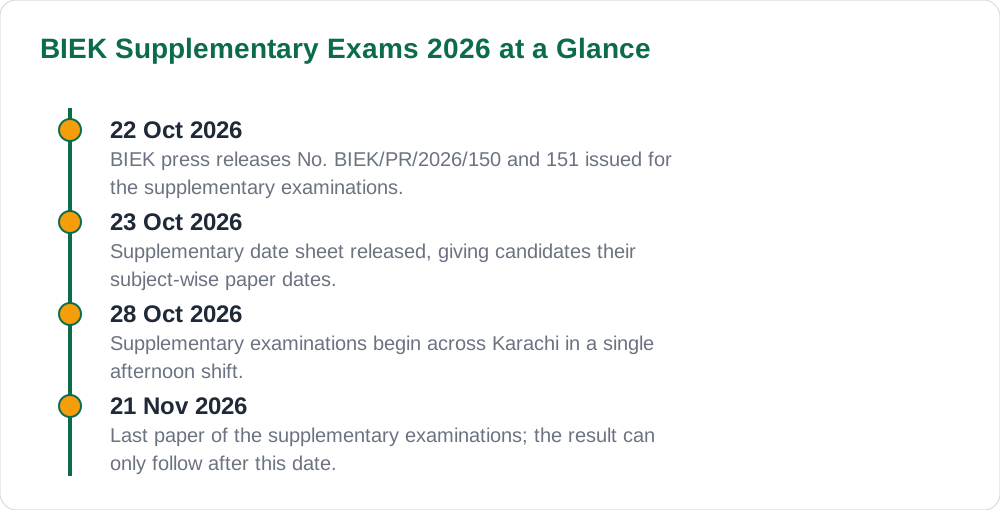
The Board of Intermediate Education Karachi (BIEK) supplementary examinations 2026 are running right now. They began on Wednesday 28 October 2026 and will continue until Saturday 21 November 2026, giving thousands of Karachi intermediate students a second chance to clear the papers they could not pass in the annual examinations. The examinations are being held under press releases No. BIEK/PR/2026/150 and 151, dated 22 October 2026, with the date sheet released on 23 October 2026. This guide brings together everything a supplementary candidate needs to know while the examinations are in progress: the shift timing, the groups covered, how to stay organised across a long examination window, and what happens after the last paper. It is written for students who are already appearing, and for families supporting them through the remaining papers.
The Examination Window: 28 October to 21 November 2026
The supplementary examinations cover a long window of just over three weeks, from 28 October to 21 November 2026, and that length is itself something candidates must plan around. Unlike a short annual schedule packed into a few days, a supplementary schedule can leave gaps of several days between a student's own papers, which means revision must be paced rather than crammed. The smart approach is to treat the whole window as a timetable: mark each of your own papers on a calendar, work backwards from each paper date, and keep the subjects you are not currently revising warm with short daily review. Students who only revise the next paper and forget the later ones often find themselves relearning a subject from scratch in the final days before its paper.
The window also matters because the result can only come after the last paper on 21 November 2026, and no supplementary result date has been announced by BIEK. Students should therefore not believe rumours about a result date circulating on social media or in coaching circles. The board announces its results on its Recent Result Declaration page at biek.edu.pk, and any genuine date will appear there first. Until then, the job is simple: sit every paper well, keep your admit card and roll number safe, and avoid spending the waiting period chasing unverified claims. For solved notes and revision material that can support preparation between papers, students can visit Solved Notes and browse the book collection on Books.
One Afternoon Shift: 2:00 PM to 5:00 PM, Reporting at 1:30 PM
All supplementary papers are held in one afternoon shift, from 2:00 PM to 5:00 PM, with a reporting time of 1:30 PM. That single-shift arrangement makes the day predictable, but it also means there is no morning alternative if a student arrives late, so reaching the centre by 1:30 PM is not a suggestion but a requirement to plan around. Karachi traffic in the early afternoon can be slow, especially on routes that pass through commercial areas, so candidates should aim to leave home with enough margin to arrive before the reporting time rather than at it. Reaching early also gives time to find the room, settle in, and read the question paper calmly instead of starting in a rush.
The afternoon timing also shapes how students should prepare on the day of a paper. A light, early lunch, a short rest, and a final glance at key formulas or definitions in the late morning work better than a heavy meal followed by last-minute cramming. Students should also prepare their stationery, admit card, and any permitted items the night before, because an afternoon paper leaves the morning free and that free time can easily turn into anxiety if it is not structured. A simple plan for paper day, wake, revise briefly, rest, travel early, and sit the paper, keeps the mind steady. Parents can help by keeping the house calm in the hours before departure and by confirming the centre location in advance.
Which Groups Are Covered
The supplementary examinations cover six groups: Pre-Medical, Pre-Engineering, Science General, Commerce, Arts and Humanities, and Home Economics. That breadth means the same afternoon shift serves students from very different streams, each with different subjects and different stakes. A Pre-Medical student clearing a biology or chemistry paper, a Commerce student clearing accounting, and an Arts student clearing an elective all face the same discipline of showing up on time and writing a complete paper. The shared schedule should not confuse anyone: your own date sheet, not another group's, decides which days you must attend.
Students should also remember that supplementary examinations are a second chance, not a lesser examination. The papers carry the same weight for clearing the subject, and a pass here removes the same obstacle that held up the student's result. That is why preparation should be taken as seriously as for the annual papers, even though the number of papers a supplementary candidate sits is usually smaller. Focusing on the failed subject alone, with targeted practice of past papers and weak chapters, is more productive than re-reading the whole syllabus at equal depth. Solved notes can help with that targeted revision, and the full collection is available on Books for students who want subject-wise support.
Staying Organised Across a Three-Week Window
A long examination window rewards students who keep a simple written plan and punishes those who rely on memory. The plan needs only three things: the date and subject of each of your papers, the chapters you are weakest in for each subject, and a daily revision slot that survives even on non-paper days. Many supplementary candidates make the mistake of treating gap days as holidays, then discovering that the next paper is only a day away and the material has gone cold. A short daily habit, even one focused hour on the next subject, keeps the material alive and reduces the panic that builds before a paper after a long gap.
Equally important is protecting sleep and health during the window. Supplementary candidates often study late into the night before a paper and arrive exhausted, which hurts performance more than a missed chapter would. Regular sleep, proper meals, and short breaks between study sessions keep the mind sharper across three weeks than any single all-night session. If a paper goes badly, the right response is to note what went wrong briefly, then move on to the next paper's preparation rather than dwelling on it for days. One weak paper does not decide the whole supplementary attempt, and every remaining paper is still a full opportunity to improve the result.
After the Last Paper: What Is Known and What Is Not
Once the last paper is over on 21 November 2026, the honest position is this: no supplementary result date has been announced by BIEK, and students should not act on any date that is not published by the board itself. Annual results appear on the board's Recent Result Declaration page at biek.edu.pk, and that is where a genuine supplementary result announcement will be published when it is ready. Until that happens, the sensible steps are to keep the admit card and roll number safe, keep an eye on the board's website rather than on rumour pages, and use the waiting time productively, whether that means preparing for the next class, revising weak areas, or resting after a demanding examination period.
Students should also keep perspective about what the supplementary result will and will not do. It will settle the papers they sat in this window, and it will let them move forward with a cleared record in those subjects. It will not, by itself, answer questions about admissions or next steps that depend on other institutions' schedules, and those questions should be handled when the relevant announcements actually appear. For now, the focus belongs on the remaining papers. Every paper still to be sat is a chance to finish the job properly, and the best preparation for result day is a set of papers written with full effort. More study support is available through the blog listing on Blog for guides on revision and examination preparation.
AI Help: Muse AI
Muse AI is Meta's personal AI assistant, and it can help you plan a supplementary examination window by turning your paper dates into a day-by-day revision plan. You can ask it to spread your weak chapters across the gap days, to make short self-test questions for one subject at a time, or to summarise a difficult topic in simple words before a paper. Muse AI does not give official STBB answers — always verify against your STBB book and your teacher. Always verify against your Sindh Textbook Board book and your teacher before using anything in classwork.
Join Muse with invite code LTGSWD — in the Muse app, go to Settings > Redeem token and enter the code. Disclosure: LTGSWD is the author's Muse invite code.
5 key points you must know
- BIEK supplementary examinations 2026 run from 28 October to 21 November 2026.
- All papers are in one afternoon shift, 2:00 PM to 5:00 PM, with reporting at 1:30 PM.
- Groups covered are Pre-Medical, Pre-Engineering, Science General, Commerce, Arts/Humanities, and Home Economics.
- No supplementary result date has been announced by BIEK — do not trust rumoured dates.
- A written plan for gap days and steady sleep matter as much as revision itself.
Frequently asked questions
When do the BIEK supplementary examinations 2026 end?
They run until Saturday 21 November 2026, having begun on Wednesday 28 October 2026. The examinations were announced through BIEK press releases No. BIEK/PR/2026/150 and 151, dated 22 October 2026, with the date sheet released on 23 October 2026. The result can only come after the last paper, and no result date has been announced yet.
What time are the supplementary papers held?
All papers are held in a single afternoon shift from 2:00 PM to 5:00 PM, and candidates must report by 1:30 PM. There is no morning shift for these examinations, so arriving late carries real risk. Students should plan travel to reach the centre before the 1:30 PM reporting time.
Which groups are included in the supplementary examinations?
The groups are Pre-Medical, Pre-Engineering, Science General, Commerce, Arts and Humanities, and Home Economics. Each student's own date sheet decides which days they must attend, so candidates should follow their own subject-wise schedule rather than another group's dates. Preparation should focus on the specific failed subjects.
Has BIEK announced the supplementary result date?
No, BIEK has not announced any supplementary result date. Students should check the board's Recent Result Declaration page at biek.edu.pk for genuine announcements and ignore dates shared on social media or by unofficial pages. Any date that is not published by the board itself should be treated as a rumour.
How should students use gap days between papers?
Gap days should be used for short, focused revision of the next subject, not treated as holidays. A daily habit of even one focused hour keeps earlier material warm and prevents the panic of relearning a subject the night before its paper. Regular sleep and proper meals during the window also protect performance across three weeks.
Solved notes — preview free
These guides work best with the solved exercises. Preview the solved notes free on this website — 119 solved notes for Classes 6–10 in Sindhi, Urdu, English and Arabic medium. Or browse the full solved notes catalogue for your class and medium. New solved notes are added regularly — check the catalogue for coming-soon books.