After the Last BIEK Supplementary Paper: What Happens Next (and What Is Not Announced Yet)
The last BIEK supplementary paper falls on Saturday 21 November 2026, and for thousands of Karachi intermediate students that day will bring a mixture of relief and a new question: what happens next? This guide gives the honest answer, separating what is known from what is not yet announced. What is known is the examination window, the shift timing, and where genuine announcements appear. What is not known, and must not be guessed, is the supplementary result date, because BIEK has not announced one. Students who understand that distinction will spend the waiting period well, while those who chase rumours will waste it. Here is how to handle the weeks after the last paper, step by step.
The Last Paper Ends the Window, Not the Process
The supplementary examinations began on 28 October 2026 and end on 21 November 2026, and the last paper closes the examination window, but it does not close the process. After the papers, answer scripts must be collected, checked, and marked, and results must be compiled before anything can be announced. That is normal board work, and it takes time, which is exactly why no result date can be responsibly promised before the marking is done. Students who finished their papers early in the window have already been waiting, and students finishing on 21 November will join them, so the waiting period is a shared experience, not a personal delay.
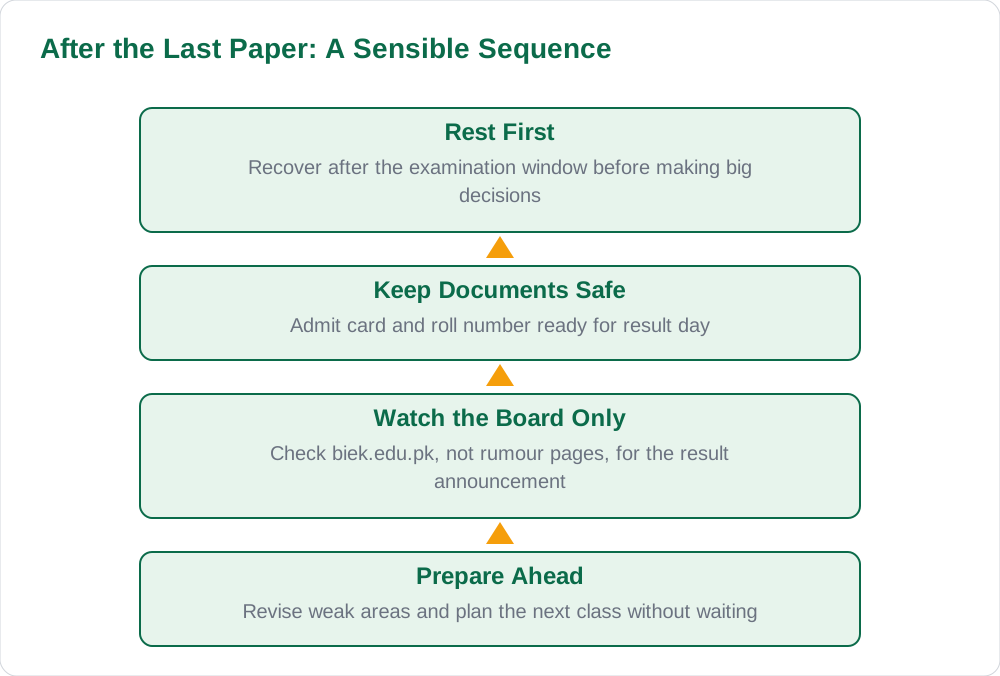
The practical consequence is that the days immediately after the last paper should be treated as a transition, not as a countdown to a date nobody has given. Rest comes first, because three weeks of afternoon papers are tiring, and a few days of proper rest will do more for a student's next step than anxious refreshing of unofficial pages. After that, the waiting period can be used for the next stage of study, whether that is the next class, a weak subject that still needs work, or preparation for whatever admission or academic step follows. The key is to act on plans that do not depend on the result date, and to leave result-dependent decisions until the result genuinely exists.
What Is Not Announced Yet: The Result Date
To be completely clear: no supplementary result date has been announced by BIEK. Any date circulating on social media, in WhatsApp groups, or from coaching centres before the board publishes it should be treated as a rumour, not as information. Rumoured dates cause real harm: students plan travel or admissions around them, families worry when they pass without a result, and the disappointment is then blamed on the board for a date the board never gave. The only reliable source is the board itself, and annual results appear on the board's Recent Result Declaration page at biek.edu.pk, which is where a genuine supplementary announcement will be published when it is ready.
Students should also be careful about pages that dress up a guess as news by adding urgency, such as claiming a result is coming tonight or tomorrow. A genuine board announcement gives the date and the method of checking, usually the board website and, for annual results, the official BIEK Android app. If a claim does not come from the board, it has no standing, however confidently it is written. The discipline of waiting for the official source is itself a useful skill, because the same rumour problem surrounds almost every board result, and students who learn to check the source now will be protected in every future examination cycle.
Keeping Your Record Safe for Result Day
Result day will require the roll number, and possibly the admit card, so both should be kept safe from the last paper onwards. The admit card is easy to lose in the relief that follows the final paper, especially when students clear out bags and study material, so putting it in a fixed place at home, and keeping a photograph of it as a backup, is a small step that prevents a real problem later. The roll number is also worth writing down somewhere separate, such as a notebook or a note on a parent's phone, so that it survives even if the card itself is misplaced.
Students should also keep their own honest record of which papers they sat and how each one went, because that record helps them interpret the result when it arrives. If a paper felt weak, the student can already think about what the next step would be if that paper does not clear, without waiting for the result to start thinking. That is not pessimism; it is preparation. It also helps families have calm, practical conversations about next steps, instead of discovering the options for the first time on a stressful result day. Solved notes for the next stage of study are available on Solved Notes for students who want to keep moving.
Using the Waiting Time Productively
The waiting period is genuinely useful time if it is used deliberately. The most valuable use is strengthening weak areas, because the subjects that needed a supplementary attempt are, by definition, subjects where the student had a gap, and that gap will matter again in the next class whether or not the supplementary paper is cleared. Revisiting those chapters now, while the examination experience is fresh, is more efficient than returning to them months later. Short daily study, rather than heavy cramming, keeps the habit alive without turning the waiting period into a second examination season.
The waiting period is also a good time to organise the next stage: gathering books and notes for the next class, setting up a study routine, and reading ahead in subjects that will be new. Students who do this arrive at their next step already moving, while students who spend the whole wait refreshing unofficial pages arrive at result day with nothing else prepared. Both groups get the same result on the same day, but only one group has used the weeks well. The blog listing at Blog carries further guides on revision and study planning for students who want structured ideas for this period.
What to Do on Result Day, Whenever It Comes
When the board does announce the supplementary result, the first step is to check it calmly through the official channel, and to confirm the result before sharing it widely. Results websites and apps can be slow in the first hours because many students check at once, so patience is better than panic if a page loads slowly. Once the result is confirmed, the student should note exactly which papers are cleared and whether anything remains outstanding, because that precise picture, not a general feeling of pass or fail, is what decides the next step. A screenshot or written note of the result is worth keeping alongside the admit card.
Whatever the result shows, the next step should be taken deliberately rather than emotionally. A cleared result means moving forward with the next class or admission step as planned, and a result with a paper still outstanding means asking the school, college, or board office what the next available route is, rather than assuming the worst. Either way, the supplementary attempt itself was a constructive step: the student chose to face the paper again instead of giving up on the subject. That attitude, applied to the next stage, is what will carry the student further than any single result. The full book collection for continued study is on Books.
AI Help: Muse AI
Muse AI is Meta's personal AI assistant, and it can help you use the waiting time after your last supplementary paper by building a short daily revision plan for your weak chapters. You can ask it to explain a topic you found difficult in the paper, to make practice questions for the next class, or to help you organise your notes for the next stage of study. Muse AI does not give official STBB answers — always verify against your STBB book and your teacher. Always verify against your Sindh Textbook Board book and your teacher before using anything in classwork.
Join Muse with invite code LTGSWD — in the Muse app, go to Settings > Redeem token and enter the code. Disclosure: LTGSWD is the author's Muse invite code.
5 key points you must know
- The last BIEK supplementary paper is on Saturday 21 November 2026.
- No supplementary result date has been announced by BIEK — rumoured dates are not information.
- Genuine announcements appear on the board's Recent Result Declaration page at biek.edu.pk.
- Keep the admit card and roll number safe throughout the waiting period.
- Use the wait to strengthen weak subjects and prepare for the next class.
Frequently asked questions
When will the BIEK supplementary result 2026 be announced?
No date has been announced by BIEK, so there is no honest answer beyond that. The result can only come after the last paper on 21 November 2026, and the board will publish the genuine announcement on its website. Students should ignore dates shared by unofficial pages and check biek.edu.pk for the real announcement.
Where will the genuine result announcement appear?
Annual results appear on the board's Recent Result Declaration page at biek.edu.pk, and that is where a supplementary announcement should be expected. For annual results, the official BIEK Android app is also a channel. Any claim that does not come from the board itself should be treated as a rumour, however confidently it is written.
What should I keep safe after my last paper?
Keep your admit card and roll number safe, because the roll number will be needed to check the result. Store the card in a fixed place at home and keep a photograph of it as a backup, and write the roll number down separately as well. These small steps prevent a stressful search on result day.
How should I spend the waiting period?
Rest first, then use short daily study to strengthen the subjects that needed a supplementary attempt, since those gaps will matter again in the next class. Organising books and notes for the next stage is also valuable. Avoid spending the whole period refreshing unofficial pages, which produces anxiety without information.
What should I do if a paper is still not cleared in the supplementary result?
Note exactly which papers remain outstanding, then ask your school, college, or the board office what the next available route is, rather than assuming the worst. The supplementary attempt itself was a constructive step, and the right response to a remaining paper is a calm, practical plan for the next opportunity, not panic.
Solved notes — preview free
These guides work best with the solved exercises. Preview the solved notes free on this website — 119 solved notes for Classes 6–10 in Sindhi, Urdu, English and Arabic medium. Or browse the full solved notes catalogue for your class and medium. New solved notes are added regularly — check the catalogue for coming-soon books.