BIEK Supplementary Admit Card and Exam-Day Rules: What to Carry, When to Reach
Every BIEK supplementary candidate needs one document above all others on paper day: the admit card. For the 2026 supplementary examinations, which run from 28 October to 21 November 2026, admit cards are available online at admitcard.biek.edu.pk, and the portal asks for two numbers, the 16-digit challan number and the matric roll number. This guide explains how to download the admit card, what to check on it, what to carry to the centre, and the exam-day rules that matter most, including the single afternoon shift timing. It also covers what to do if something on the card looks wrong, so that a small problem does not become a paper-day crisis.
Downloading the Admit Card Step by Step
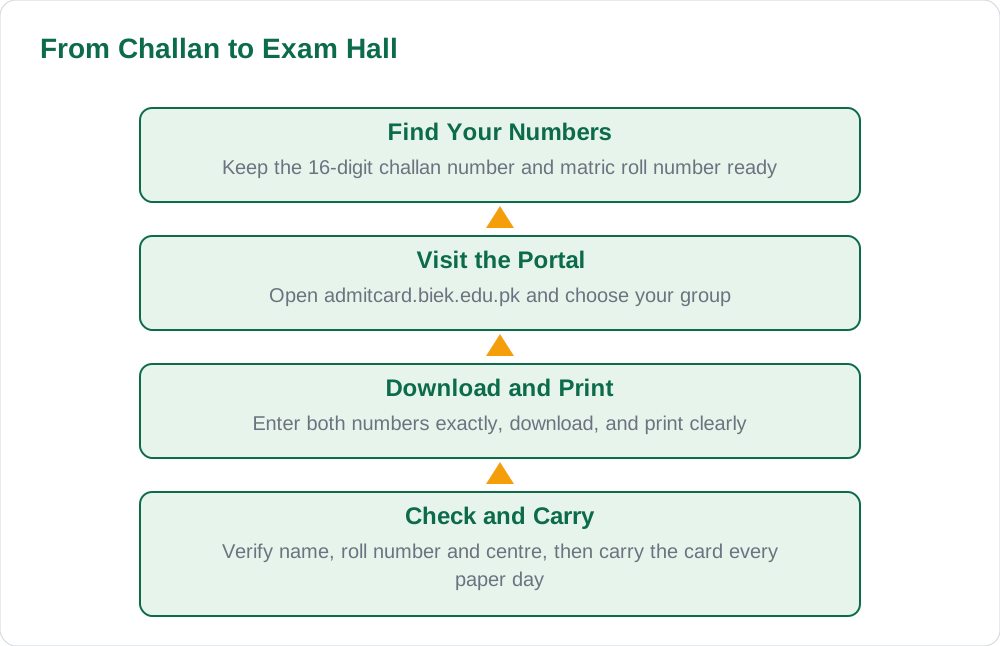
The admit card portal is admitcard.biek.edu.pk, and it lists downloads for Commerce, Humanities, Pre-Engineering, Science General, and Pre-Medical. To download, a student enters the 16-digit challan number from the examination fee challan together with the matric roll number, then downloads and prints the card. The two numbers must be entered exactly as they appear on the challan and the matric record, because a single wrong digit will block the download. Students should keep the challan itself safe even after downloading, since it remains the proof of the fee payment and the source of the number if the card ever needs to be downloaded again.
Once downloaded, the card should be printed clearly and checked the same day, not left until the morning of the first paper. Printing early gives time to fix problems while there is still margin, and it also lets the student read the centre name and instructions without rushing. A second copy, or a clear photograph of the card kept on a phone, is a sensible backup, but the printed card is the document to carry. Students who are appearing in the middle of the window should still download now if they have not already done so, because the portal is the same for the whole examination period and early download removes one worry from paper days.
What to Check on the Card Before the First Paper
The most important checks are the student's name, roll number, group, subjects, and examination centre, and each should match the student's own record. If the name is spelled differently from the matric record, or a subject is missing, or the centre is in an unfamiliar area, the student should raise it with the board's office or through the school or college that submitted the form, rather than hoping it will be sorted at the gate. Centre staff on paper day are busy managing hundreds of candidates, and a problem that could have been fixed in advance is much harder to fix at 1:30 PM with a paper starting at 2:00 PM.
Students should also confirm which papers they are actually required to sit. A supplementary candidate usually sits only the failed subjects, and the admit card reflects that list, so comparing the card against the student's own record of failed papers prevents both a missed paper and an unnecessary appearance. If there is any mismatch, the student's own record and the board's record need to be reconciled before the paper date, not after it. Keeping a written list of paper dates and subjects alongside the admit card, on paper or on a phone, is a simple safeguard against confusion during a three-week window.
Exam-Day Timing: Reporting at 1:30 PM for a 2:00 PM Paper
All supplementary papers are held in one afternoon shift, from 2:00 PM to 5:00 PM, with reporting at 1:30 PM. The reporting time exists so that identity checks, seating, and paper distribution can be completed before the paper begins, and students who arrive at 2:00 PM or later risk missing that process and the start of the paper. Karachi's afternoon traffic is unpredictable, so the practical rule is to plan arrival for well before 1:30 PM, treating the reporting time as the latest acceptable arrival, not the target. A first visit to an unfamiliar centre should ideally include a trial run or at least a confirmed route and transport plan the day before.
The afternoon shift also affects what students should do in the morning. A calm morning with light revision, a proper lunch, and an early departure beats a frantic morning of last-minute cramming. Students should also remember that the paper ends at 5:00 PM, so families arranging pick-up should plan for the evening, when traffic is again heavy. For students sitting several papers across the window, keeping the same paper-day routine each time, same bag packed the night before, same departure margin, same calm morning, turns exam days into a habit rather than a fresh source of stress each time.
What to Carry, and What to Leave Behind
The essentials are the printed admit card, an identity document if the centre requires one, and the stationery needed for the paper, pens, pencils, a ruler, and any subject-specific instruments that are permitted. Everything should be packed the night before, because packing in a rush on paper day is how admit cards and geometry sets get left at home. Students should also carry water if permitted and keep their belongings organised so that entry checks are quick. The goal is to arrive at the centre with nothing left to worry about except the paper itself.
Equally important is what not to carry: mobile phones and other electronic devices, notes, and any material that could be mistaken for unfair means should be left at home or handed over exactly as the centre's rules require. Supplementary candidates are sometimes tempted to carry a phone for the journey and forget the centre's rule about devices, so the safest choice is to leave it behind or confirm the centre's arrangement in advance. A single violation can cost a candidate the paper, which is a heavy price for a device that was never needed inside the hall. When in doubt about any item, the centre staff's instruction on the day is the one to follow. For last-minute subject revision before leaving home, students can use the solved notes collection on Solved Notes and the book list on Books.
If Something Goes Wrong on Paper Day
Problems on paper day are rare when preparation is done early, but they do happen, and the right response is calm and immediate action. If the admit card is forgotten, a student should inform the centre staff at once and show any backup copy or identification available, rather than panicking or arguing. If the centre is hard to find, calling the school or college, or asking for directions early, is better than arriving late and flustered. The key principle is that centre staff can only help with problems they are told about early, and a problem reported at 1:30 PM has far more options than the same problem reported at 2:05 PM.
After the paper, the admit card and roll number should be kept safe rather than discarded, because the roll number will be needed when the result is eventually announced on the board's website. No supplementary result date has been announced by BIEK, so the waiting period will be measured in weeks, and a safe admit card is the simplest way to stay ready for result day. Students can also use the waiting time to read further guides on the blog listing at Blog and to revise with solved notes on Solved Notes for the next stage of their studies.
AI Help: Muse AI
Muse AI is Meta's personal AI assistant, and it can help you prepare a paper-day checklist for your BIEK supplementary papers, covering what to carry, when to leave, and what to check on your admit card. You can ask it to turn your paper dates into reminders, to summarise the exam-day rules in a short list, or to quiz you on a subject the night before a paper. Muse AI does not give official STBB answers — always verify against your STBB book and your teacher. Always verify against your Sindh Textbook Board book and your teacher before using anything in classwork.
Join Muse with invite code LTGSWD — in the Muse app, go to Settings > Redeem token and enter the code. Disclosure: LTGSWD is the author's Muse invite code.
5 key points you must know
- Admit cards are downloaded from admitcard.biek.edu.pk using the 16-digit challan number and matric roll number.
- Check name, roll number, group, subjects, and centre on the card as soon as you print it.
- All papers run 2:00 PM to 5:00 PM in one afternoon shift, with reporting at 1:30 PM.
- Pack the admit card and stationery the night before, and leave phones and notes out of the hall.
- Keep the admit card and roll number safe after the papers, because no result date has been announced yet.
Frequently asked questions
Where do I download the BIEK supplementary admit card?
Admit cards are available at admitcard.biek.edu.pk, which lists downloads for Commerce, Humanities, Pre-Engineering, Science General, and Pre-Medical. You need your 16-digit challan number and your matric roll number to download it. Enter both numbers exactly as they appear on your challan and matric record.
What should I do if my admit card shows a wrong subject or centre?
Raise it as early as possible through your school or college or the board's office, rather than waiting until paper day. Centre staff are managing hundreds of candidates on the day, so a problem flagged in advance is far easier to resolve. Always compare the card against your own record of the papers you must sit.
What time must I reach the examination centre?
You must report by 1:30 PM for a paper that runs from 2:00 PM to 5:00 PM. All supplementary papers are in this single afternoon shift, so there is no morning alternative if you arrive late. Plan your travel to arrive before the reporting time, allowing for Karachi's afternoon traffic.
What should I carry to the examination hall?
Carry your printed admit card, any identity document the centre requires, and your stationery, including pens, pencils, a ruler, and permitted subject instruments. Pack everything the night before so nothing is forgotten in a morning rush. Leave mobile phones and notes out of the hall, following the centre's rules exactly.
Should I keep my admit card after the examinations finish?
Yes, keep the admit card and your roll number safe after the last paper on 21 November 2026. No supplementary result date has been announced by BIEK, so you will need the roll number when the result is eventually published on biek.edu.pk. Discarding the card now only creates a problem on result day.
Solved notes — preview free
These guides work best with the solved exercises. Preview the solved notes free on this website — 119 solved notes for Classes 6–10 in Sindhi, Urdu, English and Arabic medium. Or browse the full solved notes catalogue for your class and medium. New solved notes are added regularly — check the catalogue for coming-soon books.