BIEK Pre-Medical Part-I Result 2026: 11,966 Passed All Six — Reading the Numbers
Pre-Medical is the largest and most watched group in the BIEK HSC Part-I examination, and its 2026 result, announced on 26 October 2026, gives students a useful case study in how to read board figures honestly. Of 25,157 registered students, 24,544 appeared, and 11,966 passed all six papers — 48.75% of those who appeared. That single percentage has already been quoted as proof of many things, from the difficulty of the papers to the quality of teaching, but a careful reading shows both less and more than the headlines suggest. This article works through the Pre-Medical numbers step by step, explains how the science papers were marked, compares the group with its neighbours, and separates what the figures genuinely show from what they cannot show at all.
The Pre-Medical Numbers, Step by Step
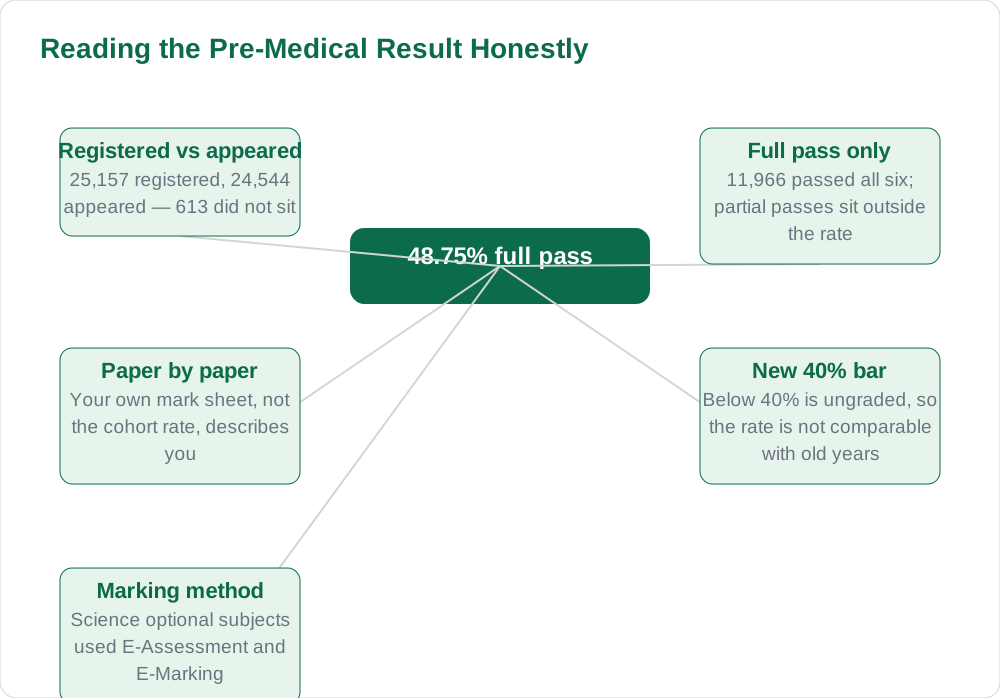
Start with the three counts, because each one answers a different question. Registered students numbered 25,157, which is the size of the cohort that entered for the examination. Appeared students numbered 24,544, which means 613 registered students did not sit the examination, a gap that usually reflects illness, changed plans, or registration problems rather than academic failure. Passed-all-six students numbered 11,966, and the headline rate of 48.75% is simply 11,966 divided by 24,544, the appeared total. Students who passed some papers but not all sit outside that headline figure, just as they do in the BSEK result, so the 48.75% describes full passes only, not the share of students who passed most of their papers.
The complement of the headline figure is equally important: 12,578 appeared students did not pass all six papers, a group that includes both partial passes and students who passed none. That large remainder is the reason this result matters so much for guidance work, because more than half the cohort now needs a plan for open papers. It is also the reason the percentage should not be read as a verdict on individual students. A cohort rate describes a whole group of nearly 25,000 young people across hundreds of colleges; it cannot tell you whether your own 42% in chemistry was good, bad, or typical, and it certainly cannot tell you whether you are suited to a medical career. Your own mark sheet, paper by paper, is the only result that describes you. For textbooks behind these subjects, see the book collection.
How the Science Papers Were Marked
One verified feature of this year's marking deserves attention: science-group optional subjects were assessed through E-Assessment using OMR sheets, together with E-Marking. In practical terms, this means objective portions of the science papers were captured and marked electronically rather than by hand, which the boards present as a step towards faster and more consistent marking. For students, the main implication is about how to answer: objective sections reward careful, complete filling of the answer sheet and penalise careless slips, such as marking two options or leaving a question blank by accident, in ways that a human marker might have forgiven.
Electronic marking also changes what scrutiny can and cannot do. If you believe an objective answer was misread, the formal scrutiny route exists — the fee is Rs 1,000 per paper — but students should understand that electronic capture leaves less room for the kinds of addition errors that scrutiny used to catch in hand-marked papers. That does not make scrutiny useless, but it does mean the strongest response to a disappointing science result is usually better preparation for reappearance rather than a dispute about marking. Practise objective questions under timed conditions, learn to manage the answer sheet calmly, and treat every multiple-choice question as a mark that is fully within your control. The solved notes include practice material for science subjects.
Pre-Medical Beside the Other Groups
Pre-Medical's 48.75% sits close to Science General's 49.48%, the highest full-pass rate among the groups announced on 26 October, and clearly above Commerce Regular at 41.12%, Commerce Private at 44.44%, Arts Regular at 35.10%, Arts Private at 42.63%, and Home Economics at 29.07%. It also sits above the Pre-Engineering full-pass figure from 2 October, where 6,310 of 14,683 appeared students passed all six papers, about 43%. The honest summary is therefore that Pre-Medical performed near the top of this year's groups, roughly level with Science General and ahead of the commerce, arts, and home economics groups.
These comparisons have limits that students should respect. Different groups take different subjects, so a higher rate in one group does not mean its students worked harder or its papers were easier in any simple sense. Pre-Medical students take biology, chemistry, and physics alongside compulsory subjects, while Commerce students take a different seven-paper combination, and the difficulty of each combination cannot be reduced to a single percentage. The comparison is useful for one purpose only: it shows that a full-pass rate below half was normal across the whole Part-I examination this year, not a peculiar failure of Pre-Medical students. That context should reassure students with open papers without excusing the need to clear them. More result analysis is on the blog.
What the Figures Do Not Say
The published figures do not include a subject-wise breakdown for Pre-Medical, so nobody can say from them whether biology, chemistry, or physics pulled the rate down, or whether the pattern was even. Claims online that name a single difficult subject as the cause of the result are therefore unverified, however widely they are shared. The figures also do not show how many students passed five papers, four papers, or fewer, so the size of each partial-pass band within Pre-Medical is unknown from the release reporting. Without that breakdown, advice must stay at the level of the individual mark sheet: your open papers are known to you, even if the group's bands are not published.
The figures also say nothing about why any individual student scored as they did. A cohort rate cannot distinguish between a student who missed the threshold in one paper by two marks and a student who struggled across all six, and it cannot measure teaching quality, paper difficulty, or preparation in any direct way. Students who treat 48.75% as a judgement on their own ability are making a statistical error, and parents who do the same risk pressuring a child for a result that mostly reflects a new threshold applied to a very large cohort. The right response to the number is practical: check your own papers against the 40% line, clear what is open, and start Part-II with a study method that leaves a margin above the threshold.
What Pre-Medical Students Should Do Now
If you passed all six papers, your task is simple: begin Part-II with the same seriousness, knowing that the 40% standard applies there too, and that Part-II biology, chemistry, and physics build directly on Part-I foundations. Do not let a comfortable Part-I result breed complacency, because Part-II papers are longer and the competition for professional-college entry only sharpens. Revise Part-I chapters that Part-II assumes, keep a steady weekly test routine, and use the months before Part-II examinations for depth rather than last-minute cramming.
If you have open papers, treat them as a defined project with a deadline set by the board's next notice. List each open paper, note the gap to 40%, and revise from the textbook with timed practice, asking teachers to mark sample answers. Check biek.edu.pk for the official reappearance procedure and confirm any scrutiny decision — Rs 1,000 per paper — from the board's own notice, since no scrutiny deadline is stated in the release reporting used here. And whatever your result, remember that Part-I is one stage of a longer path: students who clear open papers promptly and study Part-II steadily are in a far stronger position than students who spend the year worrying about a percentage that described a cohort, not a person. The [home page](/) links to further guides for intermediate students.
AI Help: Muse AI
Muse AI is Meta's personal AI assistant. You can ask it to explain a concept in simple words, summarise a lesson, or make practice questions for revision.
For Pre-Medical revision, you can ask Muse AI to explain a biology or chemistry concept in simple words or to make short practice questions on a chapter, then verify every answer against your textbook.
Join Muse with invite code LTGSWD — in the Muse app, go to Settings > Redeem token and enter the code.
Disclosure: LTGSWD is the author's Muse invite code.
Muse AI does not give official STBB answers — always verify against your Sindh Textbook Board book and your teacher.
5 key points you must know
- Pre-Medical: 25,157 registered, 24,544 appeared, 11,966 passed all six (48.75%).
- The 48.75% counts full passes only; partial passes sit outside it.
- Science optional subjects used E-Assessment (OMR) and E-Marking.
- Pre-Medical sits near the top of the 2026 groups, roughly level with Science General.
- No subject-wise breakdown is published, so single-subject causes are unverified.
Frequently asked questions
What was the BIEK Pre-Medical Part-I 2026 pass rate?
11,966 of the 24,544 students who appeared passed all six papers, which is 48.75%. The rate counts full passes only; students who passed some papers are not included in it.
How many Pre-Medical students registered and appeared?
25,157 students registered and 24,544 appeared, so 613 registered students did not sit the examination.
How were the science papers marked in 2026?
Science-group optional subjects were assessed through E-Assessment using OMR sheets, together with E-Marking, which means objective portions were captured and marked electronically.
Is Pre-Medical's rate higher than other groups?
It is close to Science General's 49.48% and above Commerce, Arts and Home Economics, but different groups take different subjects, so the rates are not a direct measure of difficulty or effort.
I passed five Pre-Medical papers. What should I do?
Identify your one open paper, check its gap to the 40% threshold, and prepare to reappear in it when the board announces the procedure on biek.edu.pk, while starting Part-II work in parallel.
Solved notes — preview free
These guides work best with the solved exercises. Preview the solved notes free on this website — 119 solved notes for Classes 6–10 in Sindhi, Urdu, English and Arabic medium. Or browse the full solved notes catalogue for your class and medium. New solved notes are added regularly — check the catalogue for coming-soon books.