BIEK Pre-Medical Gazette 2026: How to Read the 178-Page Result Gazette

A result gazette can look intimidating, especially when it runs to 178 pages, but it is really just a long, organised list, and learning to read it is a useful skill for any BIEK student. The Pre-Medical gazette for HSC Part-I Annual Examination 2026, announced on 26 October 2026, contains the results of thousands of students, arranged so that a roll number can be found if you know how to search rather than flipping page by page. This guide explains how to approach the gazette on biek.edu.pk, what the entries mean in general terms, and what to do if a paper shows Ungraded, without inventing gazette details that are not in the verified snapshot. The verified figures behind the gazette are 25,157 registered, 24,544 appeared, and 11,966 students who passed all six papers, so most readers will be looking for one line among many thousands. Students can also find study support through [solved notes](/solved.html) once they know which papers need work. A gazette rewards patience and method, not speed, and this guide gives you that method.
What a Gazette Is and Where to Find It
A gazette is the board's published result document, listing results in a structured order so that colleges, students, and the public can verify outcomes. Unlike a personal result slip, which shows only your result, a gazette shows many students together, which is why it is long and why it needs a search strategy. For BIEK, results are available on the official website, biek.edu.pk, and through the official BIEK Android app, and the Pre-Medical gazette is reported to run to 178 pages. That length reflects the size of the cohort: with 24,544 students appearing, even a compact listing needs many pages. Do not be put off by the page count; you are not expected to read the gazette from beginning to end, only to locate your own entry accurately.
Start by using the official source only. Unofficial copies of gazettes circulate in chat groups and on file-sharing links, and they may be incomplete, outdated, or altered, even when they look convincing. Download or open the gazette from biek.edu.pk, or use the official app's result view, and keep the official version as your reference. If your college provides a gazette copy, check that it matches the official version before relying on it. A few minutes spent confirming the source can save hours of confusion later, especially if an unofficial copy contains a typographical error in a roll number or a grade. The books page is a separate study resource and should not be confused with the board's official result documents.
Finding Your Roll Number Without Flipping 178 Pages
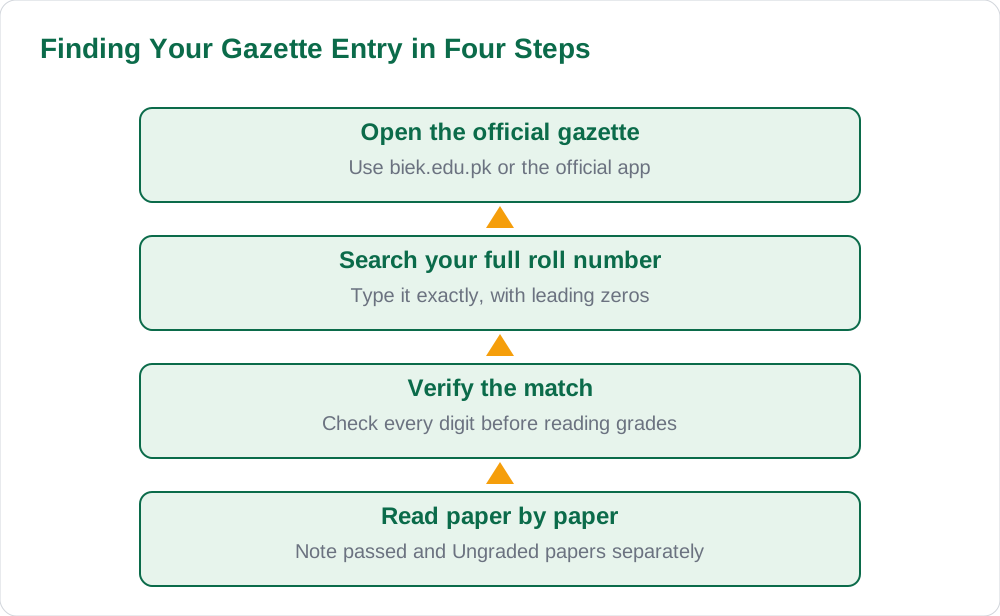
The efficient way to find a roll number in a digital gazette is to search, not to browse. If you open the gazette as a document on a computer or phone, use the document's find function and type your full roll number exactly as it appears on your admit card, including any leading zeros or prefixes. Search for the full number rather than part of it, because a partial number can match many other students' numbers and lead you to the wrong line. Once the search lands on a match, check the surrounding entries carefully: confirm that the roll number matches yours digit for digit, and that the name or college details alongside it, if shown, are consistent with your own. If you are using a printed gazette, use the roll-number ordering to narrow the range first, then scan within that range, rather than starting at page one.
Take your time with this step, because a single-digit error can produce a completely different student's result. If the search finds no match, do not immediately assume failure; check for typing errors, check whether you are searching the correct group's gazette, and confirm that your roll number belongs to the Pre-Medical Part-I 2026 gazette announced on 26 October 2026 rather than to another group or year. If the problem persists, ask your college office to help you locate the entry, because colleges work with gazettes regularly and can spot ordering or formatting issues quickly. Never share your roll number in a public group to ask strangers to find your result, because your roll number is personal information and unofficial helpers may return the wrong line.
Reading the Columns in General Terms
Gazette entries are laid out in columns or fields so that many results fit on each page, and the exact column headings can vary between boards and years. This guide therefore explains gazette reading in general terms rather than inventing specific Pre-Medical column headings that are not in the verified snapshot. In general, an entry will identify the student by roll number, and will then show an outcome for each paper in the group, followed by an overall outcome. For Pre-Medical Part-I, that means six papers, matching the six-paper structure behind the passed-all-six figure. Read across the entry slowly, paper by paper, and write down each paper's outcome separately, because the overall outcome alone does not tell you which subject needs work if you did not pass all papers.
Pay particular attention to any entry that shows Ungraded, because under the new grading decision, a score under 40 percent in a paper is recorded as Ungraded, meaning not passed in that paper. An Ungraded entry in one paper does not erase passed entries in other papers, and it should be treated as a focused task, not as a whole-result failure. If an entry shows a code, abbreviation, or symbol you do not recognise, do not guess its meaning; ask your teacher or college office to explain it with the gazette in hand. Gazette abbreviations are compact by design, and a wrong guess can lead to a wrong study plan. Keep a written copy of your entry, with the gazette page noted, so that you can refer to it when asking for help.
What to Do If a Paper Shows Ungraded
If your gazette entry shows Ungraded in one or more papers, follow the same calm sequence as for any board result: confirm the entry, tell your parents and teacher, and identify the topics behind the weak paper. A gazette entry is a summary, not a diagnosis, so the next step is to work with your teacher to understand whether the difficulty was conceptual, practised, or related to exam technique in that subject. Pre-Medical subjects build heavily on each other, so a weak paper in Part-I deserves prompt attention before Part-II, even if the overall result feels disappointing. Start re-studying that subject in small daily sessions, using your textbook and class notes, and ask for practice questions in the areas where you lost marks, if your teacher can identify them from your preparation.
On procedures, this guide stays general, because the verified snapshot does not give a general supplementary or rechecking procedure for the 26 October Pre-Medical group, and inventing one would mislead students. Follow the board's own notice on biek.edu.pk for whatever procedure applies to your case, and ask your college which notice is current for Pre-Medical Part-I 2026. Do not follow forwarded messages that claim dates or fees for this group, and do not pay anyone who offers to change a gazette entry, because gazette entries are board records and cannot be changed through unofficial channels. While you wait for any official procedure, your re-study is the part you control, and it is the part that will matter most when the next step opens.
- Confirm the gazette entry digit by digit before acting.
- Treat each Ungraded paper as a separate, focused revision task.
- Follow only the board's own notice for official procedures.
Using the Gazette Wisely and Safely
A gazette is a public document, but your entry in it should still be handled with care. Do not post your full entry, roll number, or result screenshot in public groups, and do not use another student's entry to compare or to comment on their performance. Colleges and students use gazettes to verify results, not to rank classmates, and the Pre-Medical cohort is large enough that individual comparisons are rarely informative. If you need to prove your result to a college or institution, use the official result or gazette copy through proper channels, and keep your own copy safe for future forms. A gazette entry, once understood, is a tool for planning, not a label to carry in public.
Finally, remember what the gazette does not show. It does not show how hard you worked, which topics you understood deeply, or how much you improved during the year; it shows paper outcomes on one examination occasion. A student who passed all six papers still has weak topics to strengthen for Part-II, and a student with an Ungraded paper still has passed papers and real knowledge to build on. Use the gazette to make a precise study list, then put the gazette aside and return to the textbooks themselves, because that is where improvement actually happens. Students looking for general study methods can explore study guides alongside their subject revision.
AI Help: Muse AI
Muse AI is Meta's personal AI assistant, and it can help you work with a long result document. For example, you can ask it to help you turn your gazette entry into a short revision list, with one section for each paper that needs work. Join Muse with invite code LTGSWD — in the Muse app, go to Settings > Redeem token and enter the code. Disclosure: LTGSWD is the author's Muse invite code. Muse AI does not give official STBB answers — always verify against your STBB book and your teacher. Always verify against your Sindh Textbook Board book and your teacher before using anything in classwork.
5 key points you must know
- The BIEK Pre-Medical Part-I gazette for 2026 runs to 178 pages.
- Pre-Medical figures: 25,157 registered, 24,544 appeared, 11,966 passed all six papers.
- Search for your full roll number exactly, rather than flipping through the gazette page by page.
- Read each of the six papers separately, because Ungraded applies paper by paper.
- Follow only the board's own notice on biek.edu.pk for official procedures after an Ungraded paper.
Frequently asked questions
How long is the BIEK Pre-Medical gazette for 2026?
The Pre-Medical gazette is reported to run to 178 pages, reflecting the large cohort of 24,544 appeared students.
Where can I find the official Pre-Medical gazette?
Results are available on the board's official website, biek.edu.pk, and the official BIEK Android app. Use the official source rather than unofficial copies in chat groups.
How do I find my roll number quickly?
Use the document's find function and type your full roll number exactly as on your admit card, including leading zeros. Verify every digit of the match before reading the grades.
What does Ungraded mean in the gazette?
Under the new grading decision, a score under 40 percent in a paper is recorded as Ungraded, meaning not passed in that paper. It does not cancel your passed papers.
What should I do if I cannot find my roll number?
Check for typing errors, confirm you are in the correct Pre-Medical Part-I 2026 gazette, and ask your college office for help. Do not share your roll number in public groups.
Solved notes — preview free
These guides work best with the solved exercises. Preview the solved notes free on this website — 119 solved notes for Classes 6–10 in Sindhi, Urdu, English and Arabic medium. Or browse the full solved notes catalogue for your class and medium. New solved notes are added regularly — check the catalogue for coming-soon books.