BIEK Pre-Engineering Scrutiny 2026: The 19 Oct – 18 Nov Window Explained
If you are a BIEK Pre-Engineering student who feels your HSC Part-I marks do not reflect what you wrote, there is a formal route open right now: scrutiny. The submission window for HSC Part-I Pre-Engineering scrutiny runs from 19 October to 18 November 2026, with a fee of Rs 1,000 per paper, according to the BIEK scrutiny notification 2026. This guide explains what scrutiny actually means, who should consider it, how to decide which papers to put in, and why the 18 November deadline must be treated as fixed. It covers the Pre-Engineering window only, because that is the window the notification covers, and students of other groups should not assume the same dates apply to them without a board notice of their own.
What Scrutiny Means, and What It Does Not Mean
Scrutiny is a re-checking of the marks already awarded: the board verifies that every answer was marked, that the marks were totalled correctly, and that the total was transferred correctly to the result. It is not a re-marking by a new examiner, and it is not a chance to have answers judged more generously. That distinction matters, because students who apply expecting a fresh evaluation will be disappointed, while students who apply because they suspect a totalling or transfer error are using the route for its real purpose. Understanding scrutiny correctly is the first step to using it well.
Because scrutiny checks the process rather than re-judging the answers, the outcome is usually confirmation of the original marks, with changes only where a genuine error is found. That is not a reason to avoid it when a real doubt exists, but it is a reason to apply with realistic expectations. A student who is confident about a paper and simply unhappy with the grade is unlikely to gain from scrutiny, while a student whose total looks inconsistent with their own careful estimate of the paper may have a genuine case. The fee of Rs 1,000 per paper also means the decision should be made paper by paper, not as a blanket application for everything.
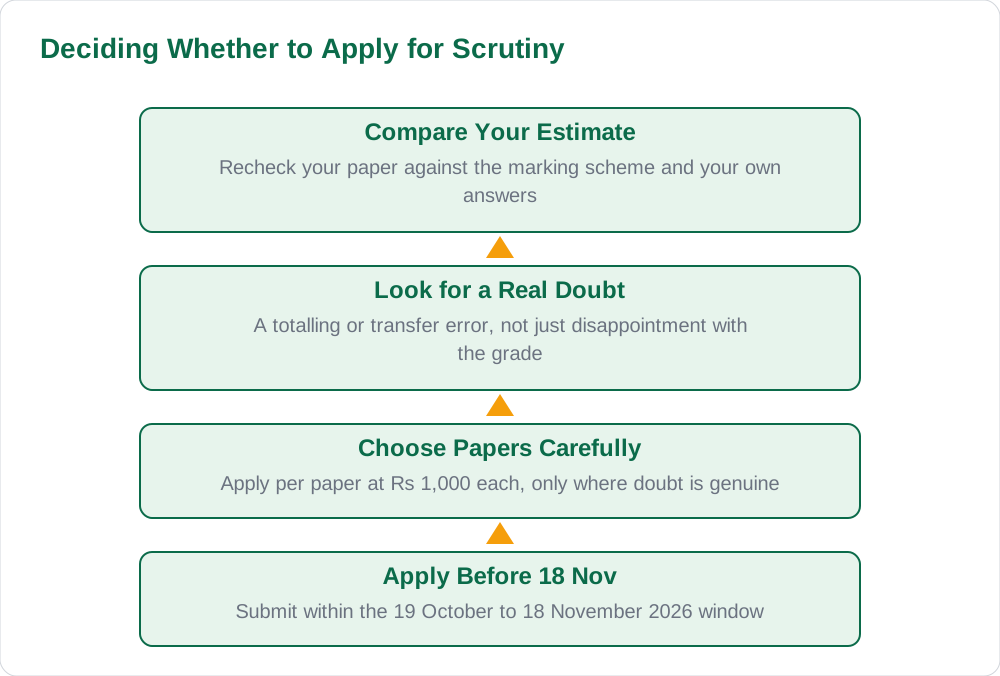
The Window and the Fee: 19 October to 18 November, Rs 1,000 Per Paper
The scrutiny submission window opened on 19 October 2026 and closes on 18 November 2026, and the fee is Rs 1,000 per paper. Both facts should shape the decision: the window is generous but not open-ended, and the per-paper fee makes careful selection important. A student applying for three papers pays three times the single-paper fee, so applying for every paper on the off chance is an expensive way to express general disappointment. The sensible approach is to list the papers, rank them by strength of doubt, and apply for those where the doubt is specific, such as a total that does not match the student's own addition of the awarded marks.
The deadline deserves particular respect because it falls inside the supplementary examination window, when many students are focused on papers rather than paperwork. A Pre-Engineering student who is also sitting supplementary papers could easily let 18 November pass while preparing for the next paper, so the scrutiny application, if it is to be made at all, should be submitted early in the window rather than left to the final days. Marking the deadline on a calendar, and treating it as fixed, is the simplest protection against losing the opportunity through distraction.
Why Pre-Engineering Students Have This Window Now
Pre-Engineering results were announced earlier than the remaining groups: BIEK announced the HSC Part-I Pre-Engineering result on 2 October 2026, while the remaining groups, including Science Pre-Medical, Science General, Commerce, Arts, Special Candidates, and Home Economics, followed on 26 October 2026. The scrutiny window follows the Pre-Engineering announcement, which is why it opened on 19 October, before the other groups' results were even declared. Students of other groups should therefore not read this window as applying to them; their own scrutiny arrangements, if any, would come through their own board notices, and assuming otherwise could lead to missed deadlines or wrong applications.
The timing also means Pre-Engineering students have had several weeks since 2 October to consider their results and decide. That is an advantage if it is used well: the decision can be made calmly, with time to recheck estimates and discuss with teachers, rather than in the rush of result week. Students who are still undecided should use the remaining days before 18 November to talk to a subject teacher, who can give an honest view of whether a paper's marks look out of line. A teacher who marked similar papers or who knows the student's work can often tell quickly whether a doubt is worth pursuing.
How to Choose Which Papers to Put In
The best method is a paper-by-paper review. For each paper, the student should recall the answers written, estimate the marks each answer deserved under the marking scheme, and compare that estimate with the awarded marks. A large gap on its own is not proof of an error, because self-estimates are often generous, but a gap combined with a specific suspicion, such as a question the student is sure was answered well receiving no credit, or a total that does not add up, is a genuine reason to apply. Papers where the student knows the answers were weak should not be put in, because scrutiny will not turn weak answers into strong marks.
Students should also weigh the fee against the value of the outcome. If a paper's marks affect an important threshold, such as passing the paper or reaching a grade that matters for the next stage, then Rs 1,000 for a genuine check is a reasonable step. If the paper is already passed and the only question is a few marks either way, the student should think harder about whether the check is worth it. Discussing the choice with parents is wise, since they are usually paying the fee, and a joint decision made on specific reasons is better than a hurried application made alone. Further study support for Pre-Engineering subjects is available on Solved Notes and Books.
After You Apply: What to Expect
After applying within the window and paying the fee per paper, the student should keep the application receipt safe and wait for the board's scrutiny outcome, which will either confirm the original marks or correct them where an error is found. There is no shortcut to the outcome, and students should not expect daily updates; the board processes scrutiny applications in its own order. While waiting, the best use of time is to continue with current studies, including any supplementary papers still to be sat, rather than pausing everything for the scrutiny result. The scrutiny outcome, when it comes, will be a correction or a confirmation, and either way the student's studies should have kept moving.
It is also worth remembering that scrutiny is one route among several, and it does not replace other options where they exist. A student with a failed paper may also be sitting the supplementary examinations, which run until 21 November 2026, and the two routes serve different purposes: supplementary examinations give a fresh chance to pass, while scrutiny checks whether the original marks were recorded correctly. Students should not confuse the two or assume that applying for one removes the need for the other. If in doubt, a teacher or the college office can explain which route fits the student's situation. More board guides are listed on Blog.
AI Help: Muse AI
Muse AI is Meta's personal AI assistant, and it can help you decide about scrutiny by walking you through a paper-by-paper comparison of your estimated marks against your awarded marks. You can ask it to help you list your reasons for each paper, to draft a clear checklist of what to submit, or to explain the difference between scrutiny and re-marking in simple words. Muse AI does not give official STBB answers — always verify against your STBB book and your teacher. Always verify against your Sindh Textbook Board book and your teacher before using anything in classwork.
Join Muse with invite code LTGSWD — in the Muse app, go to Settings > Redeem token and enter the code. Disclosure: LTGSWD is the author's Muse invite code.
5 key points you must know
- BIEK HSC Part-I Pre-Engineering scrutiny window: 19 October to 18 November 2026.
- Fee is Rs 1,000 per paper, so choose papers with a genuine, specific doubt.
- Scrutiny re-checks marking, totalling, and transfer — it is not a fresh re-marking.
- This window covers Pre-Engineering only; other groups need their own board notice.
- Apply early in the window, before the 18 November deadline passes during supplementary papers.
Frequently asked questions
What are the dates and fee for BIEK Pre-Engineering scrutiny 2026?
The submission window runs from 19 October to 18 November 2026, and the fee is Rs 1,000 per paper, according to the BIEK scrutiny notification 2026. Students should apply early rather than leaving it to the final days, since the deadline falls inside the supplementary examination window when attention is elsewhere.
Does scrutiny mean my paper will be marked again by a new examiner?
No, scrutiny is a re-checking of the process: that every answer was marked, that marks were totalled correctly, and that the total was transferred correctly to the result. It is not a fresh evaluation of the answers, so it will not turn weak answers into strong marks. It corrects genuine errors where they exist.
Which groups does this scrutiny window cover?
This window covers HSC Part-I Pre-Engineering only, because Pre-Engineering results were announced on 2 October 2026, ahead of the remaining groups on 26 October 2026. Students of other groups should not assume these dates apply to them and should wait for their own board notice before acting.
How do I decide which papers to apply for?
Review each paper against your own estimate of the marks, and apply only where there is a specific doubt, such as a total that does not add up or a well-answered question receiving no credit. General disappointment with a grade is not a strong reason, and the per-paper fee makes blanket applications expensive. Discussing the choice with a subject teacher helps.
Can I apply for scrutiny and also sit supplementary papers?
Yes, the two routes serve different purposes and do not replace each other. Supplementary examinations, running until 21 November 2026, give a fresh chance to pass a failed paper, while scrutiny checks whether the original marks were recorded correctly. If you are unsure which route fits your situation, ask a teacher or your college office.
Solved notes — preview free
These guides work best with the solved exercises. Preview the solved notes free on this website — 119 solved notes for Classes 6–10 in Sindhi, Urdu, English and Arabic medium. Or browse the full solved notes catalogue for your class and medium. New solved notes are added regularly — check the catalogue for coming-soon books.