BIEK Part-I Small Groups: Special Candidates and Home Economics Guide
Large result announcements often hide small groups behind big headlines, yet for the students in those groups, the result matters just as much. BIEK announced HSC Part-I Annual Examination 2026 results on 26 October 2026 for several groups, including Special Candidates in Arts Regular and Home Economics, alongside the larger Pre-Medical, Science General, Commerce, and Arts groups. This guide explains those smaller cohorts clearly: what is verified for Special Candidates, why Home Economics guidance must stay general where figures were not published, and what students in small groups should do next after checking their own results. This guide keeps every fact to what the board has actually announced, and it explains each step in plain language, so you can plan with confidence, avoid common mistakes, and focus on the work that actually matters this week.
Why Small Groups Deserve Their Own Guide
Small groups are easy to overlook in a busy result season, because news reports naturally focus on the largest cohorts and the highest totals. Yet a small cohort often means closer teaching, clearer subject identity, and a stronger need for accurate, group-specific advice. A Special Candidate or a Home Economics student who reads only large-group guidance may miss the details that apply to their own subjects, and may wrongly assume that large-group figures describe their own cohort. A dedicated guide corrects that by naming each group separately and by being honest about what is verified and what is not.
Small groups also face a practical problem: fewer classmates to compare notes with, and fewer online guides written for their subjects. That makes official sources even more important. Check your result at biek.edu.pk or through the official BIEK Android application, read your own subjects carefully, and ask a teacher who knows your group for next-step advice. The solved notes and the blog can support general study, but group-specific steps should come from your teacher and the board record. Keep this point in mind as you plan your week, because a calm, organised, and steady approach usually protects both your time and your marks across every paper.
- Small cohorts need group-specific guidance, not large-group averages
- Fewer classmates means official sources and teachers matter more
- Check your own result officially, subject by subject
Special Candidates: Verified Figures Explained
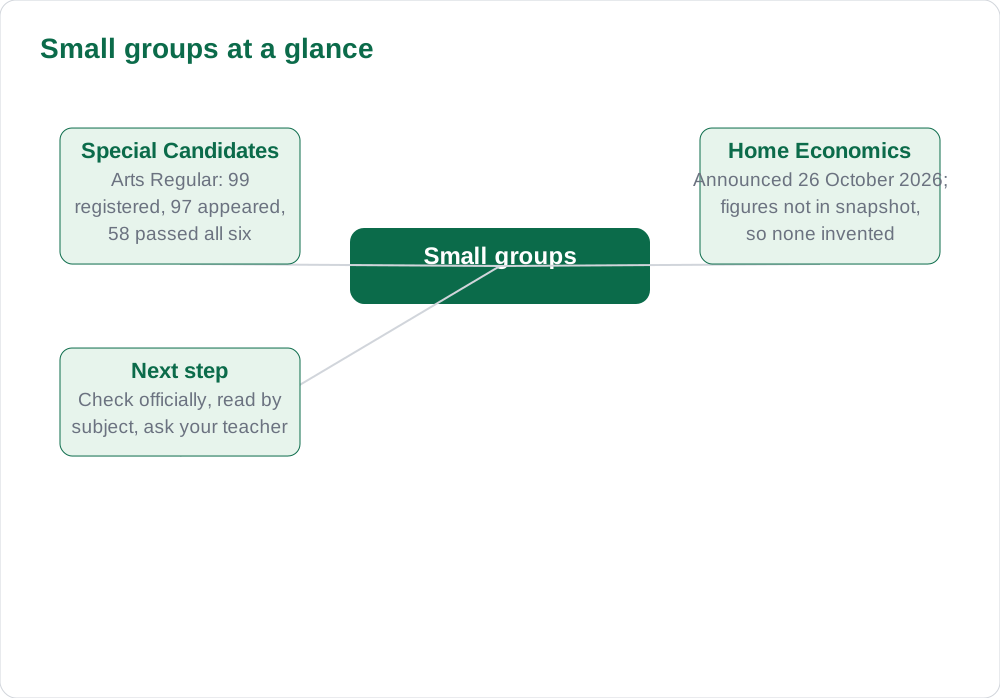
For Special Candidates in Arts Regular, the verified figures are clear and small enough to understand fully: 99 students registered, 97 appeared, and 58 passed all six papers. Those numbers tell a simple story. Almost every registered student appeared, which shows strong commitment, and 58 students passed all six papers, which shows that the full pass is achievable but demanding. The remaining students may have passed some papers while missing others, so individual results still vary, and each student should read their own subject list rather than judging themselves by the group total alone.
The small size of this cohort is itself useful information. It means teachers and board staff can often give more personal guidance, and it means that students should not feel invisible because their group rarely makes headlines. If you are a Special Candidate, note your passed and remaining papers, keep your official result record safe, and discuss your next step with a teacher who understands your category. A clear, personal plan matters more than any comparison with a large group. Use this idea in your own plan, and check it against your own date sheet and admit card, so that nothing important is left to guesswork on the day itself.
- Special Candidates (Arts Regular): 99 registered, 97 appeared, 58 passed all six
- Almost every registered student appeared, showing strong commitment
- Read your own subjects, not just the group total, to plan next
Home Economics: General Guidance Without Invented Figures
Home Economics was among the groups announced on 26 October 2026, but its detailed figures were not included in the snapshot used for this guide, so this guide does not invent them. That honesty matters: quoting a Home Economics total without a board source would mislead students, parents, and teachers who need reliable numbers for planning. Instead, this guide gives Home Economics students the same practical framework as every other group: check officially, read subject by subject, note any Ungraded paper, and ask a teacher about the proper next step for your own subjects.
Home Economics students should also value their subject identity. The subject combines practical knowledge, household and family understanding, and academic study, and its papers deserve the same steady preparation as any other stream. If you passed all papers, plan Part-II with teacher guidance and keep your practical skills sharp. If you have a paper to clear, give it regular, focused time in your weekly plan, and use your textbooks and class notes together to rebuild weak topics step by step. Remember this as you move to the next step, because steady preparation, clear documents, and enough rest together make a real difference on examination day.
The Ungraded Rule in Small Groups
Under the new grading decision, scoring under 40 percent in a paper means that paper is marked Ungraded, which means not passed in that paper. The rule applies paper by paper, in small groups just as in large ones, so a student can pass most papers and still need to address one Ungraded paper. Do not let the small size of your cohort make you feel that an Ungraded paper is unusual or shameful: it is a normal part of result season, and teachers handle such cases regularly across every group.
If you have an Ungraded paper, write down the subject, keep your result record, and ask your teacher about the proper route for that paper. Do not wait silently until the next examination cycle, and do not accept unofficial promises about changing the result. A timely question, asked with your record in hand, usually produces a clear answer and a workable study plan. In a small group, that personal conversation with a teacher is often easier to arrange, so use that advantage. Keep this point in mind as you plan your week, because a calm, organised, and steady approach usually protects both your time and your marks across every paper.
- Under 40 percent in a paper means Ungraded, not passed in that paper
- The rule applies paper by paper in every group
- Ask your teacher promptly about the proper route for that paper
Next Steps for Small-Group Students
Whether you passed all papers or still have papers to clear, your next step should be written down, not just thought about. List your subjects, mark each one as passed or to be addressed, and agree a simple weekly plan with your teacher or mentor. For Part-II planning, choose subjects that follow naturally from your Part-I stream, and discuss any subject change carefully rather than copying a classmate's choice. A small group rewards careful, personal decisions more than hurried ones. Use this idea in your own plan, and check it against your own date sheet and admit card, so that nothing important is left to guesswork on the day itself.
Also keep your documents organised. Save your official result record, note your roll details safely, and keep any board notices you receive. When you later need a mark sheet, a Part-II admission step, or a teacher's advice, a complete record saves time and avoids confusion. Small-group students who check officially, plan in writing, and study steadily are in a strong position, and their quiet, focused progress deserves the same respect as any large-group headline. Remember this as you move to the next step, because steady preparation, clear documents, and enough rest together make a real difference on examination day.
- Write down passed and remaining subjects and agree a weekly plan
- Choose Part-II subjects from your own stream with teacher guidance
- Keep your official result record and board notices organised
AI Help: Muse AI
Muse AI is Meta's personal AI assistant, and it can help you understand your small-group BIEK Part-I result and plan next. You can ask it to explain the Special Candidates figures simply and to help you list your passed and remaining subjects. Join Muse with invite code LTGSWD — in the Muse app, go to Settings > Redeem token and enter the code. Disclosure: LTGSWD is the author's Muse invite code. Muse AI does not give official STBB answers — always verify against your STBB book and your teacher. Always verify against your Sindh Textbook Board book and your teacher before using anything in classwork.
5 key points you must know
- Special Candidates (Arts Regular): 99 registered, 97 appeared, 58 passed all six papers.
- Home Economics was announced on 26 October 2026, but its figures were not in the snapshot.
- Under 40 percent in a paper means Ungraded, which is not passed in that paper.
- Check results only at biek.edu.pk or through the official BIEK Android application.
- Small-group students should plan subject by subject with teacher guidance.
Frequently asked questions
What are the Special Candidates figures?
Special Candidates in Arts Regular reported 99 students registered, 97 appeared, and 58 who passed all six papers. These verified figures show strong appearance and a demanding full pass. Individual students should still read their own subject results to plan their next step.
Why are no Home Economics figures given here?
Home Economics was announced on 26 October 2026, but its detailed figures were not included in the snapshot used for this guide. Inventing totals would mislead readers, so this guide keeps Home Economics guidance general and advises checking the official result and asking a teacher.
When were these Part-I results announced?
BIEK announced the HSC Part-I Annual Examination 2026 results on 26 October 2026 for the listed groups, including Special Candidates and Home Economics. Pre-Engineering had been announced earlier, on 2 October 2026, and sits outside this announcement. Ask your teacher or school office if anything still looks unclear after checking the official source.
What does Ungraded mean?
Under the new grading rule, scoring under 40 percent in a paper means that paper is marked Ungraded, which means not passed in that paper. The rule applies paper by paper, so note any Ungraded subject and ask your teacher about the proper route for it.
What should small-group students do next?
Check officially, list passed and remaining subjects in writing, and agree a weekly plan with a teacher. Choose Part-II subjects from your own stream, keep your result record organised, and give any remaining paper regular, focused study time. Ask your teacher or school office if anything still looks unclear after checking the official source.
Solved notes — preview free
These guides work best with the solved exercises. Preview the solved notes free on this website — 119 solved notes for Classes 6–10 in Sindhi, Urdu, English and Arabic medium. Or browse the full solved notes catalogue for your class and medium. New solved notes are added regularly — check the catalogue for coming-soon books.