BIEK Part-I Private Candidates: What to Do After the Result
BIEK announced the HSC Part-I Annual Examination 2026 results on 26 October 2026 for several groups, including Commerce in both Regular and Private categories and Arts in both Regular and Private categories, alongside Pre-Medical, Science General, Special Candidates, and Home Economics. Private candidates often feel less guided than regular students, because they do not sit in a daily classroom where teachers explain every next step. This guide is written for them: it explains what the announcement covers, how to read Regular figures without mistaking them for private figures, and what practical, general steps to take next, without inventing private-candidate numbers that were not published. Read this guide once through, note the steps that apply to your own papers, and then make a short personal plan, because a plan written down is far easier to follow than a plan kept only in your head.
What Was Announced on 26 October 2026
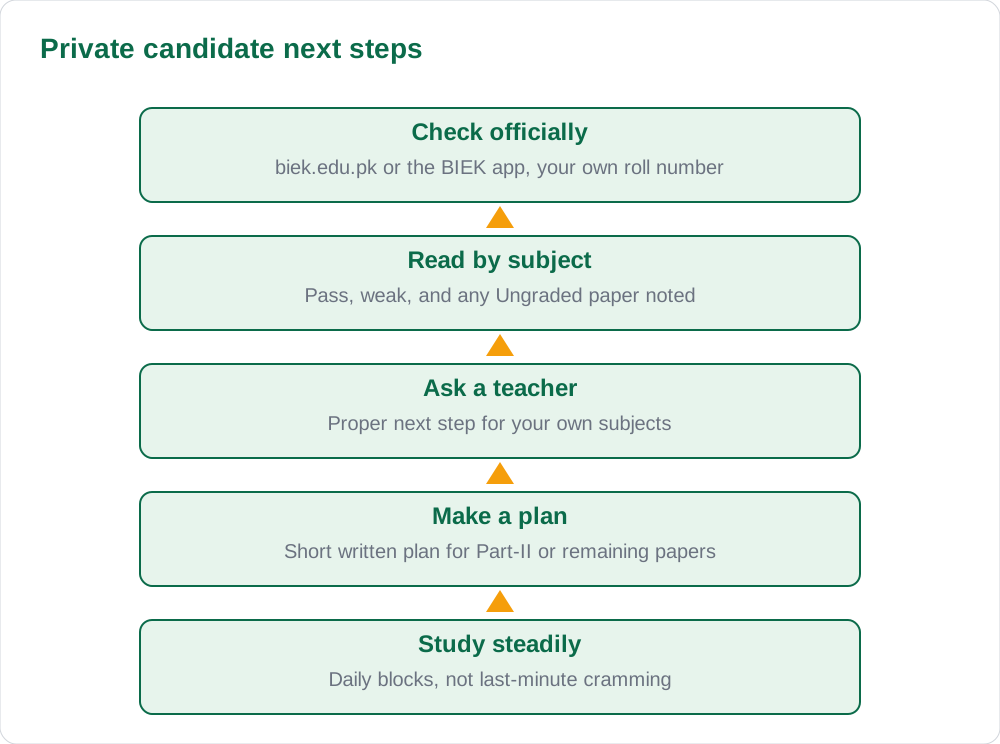
The 26 October 2026 announcement covered HSC Part-I results for Pre-Medical, Science General, Commerce Regular and Private, Arts Regular and Private, Special Candidates in Arts Regular, and Home Economics. Pre-Engineering had been announced earlier, on 2 October 2026, so it sits outside this particular announcement. For a private candidate, the key point is simple: your category was included, and your individual result should be checked through the official board website at biek.edu.pk or the official BIEK Android application, just as regular students check theirs. Use this idea in your own plan, and check it against your own date sheet and admit card, so that nothing important is left to guesswork on the day itself.
Do not rely on forwarded lists, screenshots, or unofficial pages for your result. Those sources can mix categories, copy old results, or show another student's record by mistake. Check your own roll number on an official route, read each subject separately, and save your result record. If you studied through a private arrangement or a coaching setup, share your official result with your teacher or mentor so they can advise you on the next step for your own subjects. Remember this as you move to the next step, because steady preparation, clear documents, and enough rest together make a real difference on examination day.
- Announcement date: 26 October 2026 for the groups listed above
- Commerce and Arts were announced in both Regular and Private categories
- Check only at biek.edu.pk or the official BIEK Android application
Regular Figures as Context Only, Not Private Figures
Verified Regular figures give useful context about overall standards, but they are not private-candidate figures and must not be quoted as such. For example, Commerce Regular reported 23,549 registered, 22,693 appeared, and 9,332 students who passed all seven papers, while Arts Regular reported 11,171 registered, 10,678 appeared, and 3,748 who passed all six papers. Those numbers describe Regular students only. Private-candidate figures were not included in the snapshot for this guide, so this guide does not invent them, and any site quoting private totals without a board source should be treated with caution.
Why does the distinction matter? Because a private cohort can differ in size, subjects, and preparation, and applying Regular averages to private students can mislead both individuals and families. Use Regular figures only to understand that Part-I is demanding and that passing all papers is a real achievement. Then set them aside and focus on your own result, subject by subject, which is the only record that decides your next step. The solved notes and the blog offer general study help for the subjects you need to strengthen. Keep this point in mind as you plan your week, because a calm, organised, and steady approach usually protects both your time and your marks across every paper.
- Commerce Regular: 23,549 registered, 22,693 appeared, 9,332 passed all seven
- Arts Regular: 11,171 registered, 10,678 appeared, 3,748 passed all six
- These are Regular figures only; private figures were not published in the snapshot
Read Your Own Result Subject by Subject
Start by confirming your name and roll number, then read every subject on its own. Note which papers you passed, which papers need more work, and whether any paper is marked Ungraded under the new rule, where under 40 percent in a paper means not passed in that paper. A single weak paper does not erase strong papers, and a strong overall feeling does not remove a weak paper that needs attention. A written subject list, with a tick or a note beside each paper, turns a confusing result page into a clear personal plan.
If anything looks wrong, such as a missing subject or a name mismatch, save your official record and raise it through your school, coaching teacher, or the board's proper channel, with your documents ready. Do not share your roll details publicly while seeking help, and do not accept unofficial corrections. A calm, documented approach protects you and usually resolves simple errors faster than angry posts or rumours. Keep your result record in one safe place for every future step. Use this idea in your own plan, and check it against your own date sheet and admit card, so that nothing important is left to guesswork on the day itself.
Planning Part-II and Remaining Papers
For private candidates who passed Part-I, the natural next focus is Part-II preparation, built on the subjects you actually studied and the gaps your Part-I result revealed. Do not choose Part-II subjects by copying a friend: choose them from your own Part-I stream, your interests, and guidance from a teacher who knows your record. Build a simple weekly routine with daily study blocks, regular revision, and practice questions, and keep it realistic enough to follow for months, not just for one enthusiastic week. Remember this as you move to the next step, because steady preparation, clear documents, and enough rest together make a real difference on examination day.
If you still have papers to clear, give those papers a clear place in your plan rather than hiding them behind new subjects. A focused hour on a weak paper, repeated regularly, usually helps more than occasional long sessions. Use the textbooks to revisit concepts, practise writing full answers, and check your work against your notes. Private study demands self-discipline, so a written timetable, a fixed study place, and a weekly review of what you actually completed will help more than vague intentions. Keep this point in mind as you plan your week, because a calm, organised, and steady approach usually protects both your time and your marks across every paper.
- Choose Part-II subjects from your own stream and teacher guidance
- Give remaining papers a regular place in your weekly plan
- Use a written timetable and a weekly review of completed work
Getting Help Without a Daily Classroom
Private candidates can still get strong guidance, but they must seek it actively. A subject teacher, a coaching teacher, a senior student, or a school office can often explain board procedures, subject choices, and study methods, even if you do not attend that school daily. Prepare your questions before you ask: bring your result record, your subject list, and one clear question at a time. Clear questions receive clear answers, while vague worries often receive vague reassurance that does not help you plan. Use this idea in your own plan, and check it against your own date sheet and admit card, so that nothing important is left to guesswork on the day itself.
Also protect yourself from misinformation. Board procedures, dates, and rules should come from biek.edu.pk or a teacher who can show you the official source. Ignore forwarded messages that promise shortcuts, changed results, or guaranteed passes, because they waste money and time and can harm your record. A private candidate who checks officially, plans in writing, and studies steadily is in a strong position, even without a daily classroom routine. Remember this as you move to the next step, because steady preparation, clear documents, and enough rest together make a real difference on examination day.
- Ask teachers with your result record and one clear question at a time
- Trust board procedures only from official sources or a teacher showing them
- Ignore forwarded promises of shortcuts or guaranteed passes
AI Help: Muse AI
Muse AI is Meta's personal AI assistant, and it can help you plan your next steps as a BIEK Part-I private candidate. You can ask it to turn your subject results into a simple weekly study timetable for Part-II or remaining papers. Join Muse with invite code LTGSWD — in the Muse app, go to Settings > Redeem token and enter the code. Disclosure: LTGSWD is the author's Muse invite code. Muse AI does not give official STBB answers — always verify against your STBB book and your teacher. Always verify against your Sindh Textbook Board book and your teacher before using anything in classwork.
5 key points you must know
- BIEK announced HSC Part-I results on 26 October 2026, including Commerce and Arts private categories.
- Commerce Regular: 23,549 registered, 22,693 appeared, 9,332 passed all seven papers.
- Arts Regular: 11,171 registered, 10,678 appeared, 3,748 passed all six papers.
- Private-candidate figures were not in the snapshot, so this guide invents none.
- Under 40 percent in a paper means Ungraded, which is not passed in that paper.
Frequently asked questions
Were private candidates included in the 26 October announcement?
Yes. BIEK announced HSC Part-I results on 26 October 2026 for Commerce Regular and Private, Arts Regular and Private, and other listed groups. Private candidates should check their own result at biek.edu.pk or through the official BIEK Android application, using their own roll number.
What are the Commerce and Arts Regular figures?
Commerce Regular reported 23,549 registered, 22,693 appeared, and 9,332 students who passed all seven papers. Arts Regular reported 11,171 registered, 10,678 appeared, and 3,748 who passed all six papers. These are Regular figures only, not private figures. Ask your teacher or school office if anything still looks unclear after checking the official source.
Why does this guide not give private-candidate totals?
Private-candidate figures were not included in the snapshot used for this guide, so quoting totals would mean inventing them. This guide keeps private guidance general and labels Regular figures clearly as Regular, so readers do not mistake one category for another.
What does Ungraded mean?
Under the new grading rule, scoring under 40 percent in a paper means that paper is marked Ungraded, which means not passed in that paper. Read your result subject by subject, note any Ungraded paper, and ask a teacher about the proper next step for that subject.
How should a private candidate plan Part-II?
Choose subjects from your own Part-I stream with teacher guidance, build a realistic weekly timetable, and give remaining papers regular study time. Use daily blocks, practice questions, and a weekly review. Seek help actively from a teacher, and trust only official board sources for procedures.
Solved notes — preview free
These guides work best with the solved exercises. Preview the solved notes free on this website — 119 solved notes for Classes 6–10 in Sindhi, Urdu, English and Arabic medium. Or browse the full solved notes catalogue for your class and medium. New solved notes are added regularly — check the catalogue for coming-soon books.