BIEK 11th Class Result 2026: Group-by-Group Statistics Explained
On Monday 26 October 2026, the Board of Intermediate Education Karachi announced HSC Part-I Annual Examination 2026 results for Pre-Medical, Science General, Commerce, Arts, Special Candidates, and Home Economics, while Pre-Engineering had already been announced earlier on 2 October 2026. The announcement, under Controller Zarina Rashid and Chairman Faqir Muhammad Lakho, came with a set of group figures that look simple at first glance but are easy to misread. Each group reports students who passed all papers, and each group is a different size, with a different number of papers, so comparing raw passed counts across groups tells you almost nothing useful. This guide lays out the verified figures group by group, explains what passed all papers means, and shows how to compare groups fairly. Students looking for study help can start with [solved notes](/solved.html) for their own subjects, while keeping the board's official result as the authority for their personal outcome. The goal here is not to rank groups, but to help students understand where they stand inside their own group.
The Rule Behind the Numbers: Passed All Papers
Every figure in this guide counts students who passed all papers in their group, not students who passed most papers or who passed a single paper. That distinction matters enormously, because a student who passed five of six papers is not counted in the passed-all-papers figure, even though that student has clearly achieved a great deal. The board's group figures therefore describe complete passes, and the students who are not in that count include a mix of students who missed one paper, several papers, or did not appear for some papers. When you read that Pre-Medical had 11,966 students who passed all six papers, you are reading a strict standard, not a total of everyone who passed anything. The same strict reading applies to every other group in the announcement.
This strictness also explains why the passed-all-papers counts look lower than a casual reader might expect. A group with six or seven papers gives students six or seven chances to fall below the threshold in a single paper, and under the new grading decision, a score under 40 percent in a paper is Ungraded, meaning not passed in that paper. A student can therefore be strong overall and still fall outside the passed-all-papers count because of one difficult paper. That is not a reason to dismiss the figures, but it is a reason to read them as complete-pass counts rather than as a measure of how many students learned anything. Your own result, paper by paper, is always more informative than your group's total.
- Passed all papers means every paper in the group cleared, not most papers.
- A single Ungraded paper keeps a student out of the passed-all-papers count.
- Read group figures as complete-pass totals, not as total learning.
Pre-Medical and Science General: The Large Science Groups
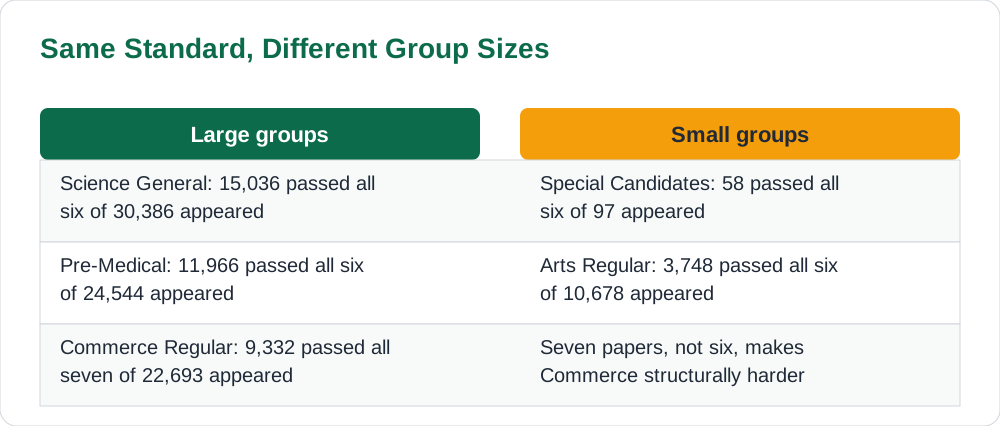
Pre-Medical reported 25,157 registered, 24,544 appeared, and 11,966 who passed all six papers. Science General reported 30,991 registered, 30,386 appeared, and 15,036 who passed all six papers. In absolute terms, Science General has the larger passed count, but that is largely because it started with a larger appeared cohort, not because its students necessarily performed better in percentage terms. A rough reading puts both groups at just under half of appeared students passing all six papers, which shows how demanding a complete pass across six papers can be. The similarity in proportion is more informative than the difference in raw counts, because it suggests that the challenge of clearing every paper, rather than the size of the group, is the main story for both science groups.
For students in these groups, the practical lesson is to look at your own paper profile before drawing conclusions from the group total. If you passed five papers and missed one, your next step is focused revision in that one subject, not a complete restart. If you passed all six, your next step is to strengthen the weakest of those six before Part-II, because Part-II will build on the same foundations. Science-group optional subjects were assessed through E-Assessment with OMR and E-Marking, according to the verified snapshot, which is a reminder that marking method can also shape how results feel to students. Results are available on biek.edu.pk and the official BIEK Android app, and the books page can help you find material for the subjects you need to revisit.
Commerce, Arts, and Special Candidates
Commerce Regular reported 23,549 registered, 22,693 appeared, and 9,332 who passed all seven papers. Commerce is the only group in this set with seven papers rather than six, which makes a complete pass structurally harder: there is one more paper in which a student could fall below the threshold. Arts Regular reported 11,171 registered, 10,678 appeared, and 3,748 who passed all six papers, a smaller cohort with a lower complete-pass proportion than the science groups. Special Candidates in Arts Regular reported 99 registered, 97 appeared, and 58 who passed all six papers, a very small cohort where each student changes the percentage by roughly a full point, so its proportion should never be compared naively with large groups. The announcement also covered Commerce Private, Arts Private, and Home Economics, but the verified snapshot gives detailed passed-all-papers figures only for the groups listed here, so this guide does not invent figures for the others.
The lesson across these groups is the same: size and paper count change what a raw number means. Commerce students should not feel that 9,332 is a poor result simply because it is smaller than the science groups' counts, because Commerce students faced seven papers and a smaller appeared cohort than Science General. Arts students should not compare 3,748 directly with a larger group's count either, because the Arts appeared cohort was only 10,678. Fair comparison, if it is needed at all, compares proportions within similar paper structures, and even then it should be used for planning, not for ranking students. What matters for each student is which papers were cleared and which were not, and that information lives in the individual result, not in the group total.
Pre-Engineering: The Earlier 2 October Result
Pre-Engineering deserves separate treatment because it was announced earlier, on 2 October 2026, not with the 26 October groups. Its verified figures were 15,044 registered, 14,683 appeared, and 6,310 who passed all six papers, which means 8,373 appeared students did not clear all six papers. That complete-pass proportion is lower than the 26 October science groups, and it is tempting to turn that into a story about one group being weaker, but such a story would ignore differences in papers, cohorts, and timing. Pre-Engineering students sat a different combination of subjects, and their result arrived weeks earlier, so their next steps, including any scrutiny or supplementary processes, have run on a different timetable. This guide therefore reports the Pre-Engineering figures for completeness, but it does not rank Pre-Engineering against Pre-Medical or Science General.
For Pre-Engineering students, the important point is that a complete-pass figure from early October is now old news in personal terms: what matters in November is your own paper profile and the board's current notices for your group. Do not reuse a 26 October procedure for a 2 October group without checking, because procedures and windows can differ by group and by announcement date. If you are unsure which notice applies to you, ask your college office and check biek.edu.pk directly. General guidance on planning the next stage is available through study guides, but official procedures must always come from the board itself.
How to Compare Groups Without Misleading Yourself
Fair comparison starts with three questions: how many students appeared, how many papers had to be cleared, and what proportion passed all of them. A group with more appeared students will usually produce a larger passed count even if its proportion is similar or lower, and a group with seven papers will usually produce a lower complete-pass proportion than a group with six papers, all else being equal. A second rule is to distrust comparisons involving very small cohorts, such as the 97 appeared Special Candidates, because a handful of students can swing the percentage dramatically. A third rule is to remember that passed-all-papers counts exclude partial passes, so they understate how much learning happened in a group. None of this makes the figures useless; it makes them useful only when read with their denominators and paper counts attached.
Students, parents, and teachers should therefore use group figures for context and planning, not for blame or boasting. A college can use them to see which subjects need extra support, a parent can use them to ask which papers caused difficulty, and a student can use them to see that partial passes are common and that focused revision is a normal next step. Avoid headlines that declare one group the best or worst based on a single raw count, because that headline has almost certainly ignored cohort size, paper count, or both. Your group figure is background; your paper results are the foreground, and your study plan should be built from the foreground.
AI Help: Muse AI
Muse AI is Meta's personal AI assistant, and it can help you read board statistics more clearly. For example, you can ask it to explain why a larger group can have a larger passed count without having a higher pass proportion, using your own group's figures as the example. Join Muse with invite code LTGSWD — in the Muse app, go to Settings > Redeem token and enter the code. Disclosure: LTGSWD is the author's Muse invite code. Muse AI does not give official STBB answers — always verify against your STBB book and your teacher. Always verify against your Sindh Textbook Board book and your teacher before using anything in classwork.
5 key points you must know
- BIEK announced most HSC Part-I groups on 26 October 2026, while Pre-Engineering was announced on 2 October 2026.
- All group figures count students who passed ALL papers, not students who passed most papers.
- Pre-Medical: 11,966 passed all six of 24,544 appeared; Science General: 15,036 passed all six of 30,386 appeared.
- Commerce Regular: 9,332 passed all seven of 22,693 appeared; Arts Regular: 3,748 passed all six of 10,678 appeared.
- Raw passed counts cannot be compared fairly without cohort size and number of papers, and small cohorts swing percentages sharply.
Frequently asked questions
When did BIEK announce the HSC Part-I 2026 results?
Most remaining groups, including Pre-Medical, Science General, Commerce, Arts, Special Candidates, and Home Economics, were announced on 26 October 2026. Pre-Engineering had been announced earlier, on 2 October 2026.
What does passed all papers mean in the BIEK figures?
It means the student cleared every paper in their group. A student who passed five of six papers is not counted in the passed-all-papers figure, even though that is a strong partial result.
Why is Commerce harder to compare with the six-paper groups?
Commerce Regular students had to pass seven papers, not six, so a complete pass required clearing one extra paper. That structural difference alone tends to lower the complete-pass proportion.
Why should Special Candidates figures be read with caution?
Only 97 Special Candidates appeared, with 58 passing all six papers. In such a small cohort, a few students change the percentage by a large amount, so it cannot be ranked fairly against groups with tens of thousands of students.
Where can I check my own BIEK Part-I result?
Results are available on the board's official website, biek.edu.pk, and the official BIEK Android app. Your individual paper profile matters more than any group total.
Solved notes — preview free
These guides work best with the solved exercises. Preview the solved notes free on this website — 119 solved notes for Classes 6–10 in Sindhi, Urdu, English and Arabic medium. Or browse the full solved notes catalogue for your class and medium. New solved notes are added regularly — check the catalogue for coming-soon books.